Threat Hunting Maturity Model Explained: Levels, Transitions, and the Data Access Problem
Mike Dupuis
Marketing, Crogl
 Threat hunting maturity model progression stalls at operational gates.
Key Takeaways
- The threat hunting maturity model is a five-level framework (HMM0 to HMM4) that assesses a team's ability to proactively find threats that automated detection misses.
- Each step up the model is gated by one operational capability, such as moving from ad hoc searches to repeatable procedures.
- Maturity often stalls between HMM1 and HMM3 because of the data access bottleneck, where analysts must query multiple security platforms in different languages to test a single hypothesis.
- A hunt that returns no results is a finding about your data coverage: it shows what the hypothesis was tested against. Documenting these null results is a key maturity signal.
- The truest measure of a mature hunting program is a closed feedback loop where hunt findings systematically become new, automated detection rules.
The threat hunting maturity model is a five-level framework for assessing an organization's ability to proactively find threats that automated detection misses. While the model has been a fixture in security operations planning for more than a decade, many teams in practice self-assess at Level 1 or 2 and remain there for years. The model describes each level well. It says little about what has to change operationally to reach the next one, and that is where programs stall.
This guide breaks down the specific operational shift required to move from one level to the next. It identifies the binding constraint that stalls most programs, which is fragmented data access. It also covers the operational realities that generic frameworks often miss, including hunting in air-gapped environments, interpreting null results, and measuring maturity through the hunt-to-detection feedback loop.
What the Hunting Maturity Model Measures
David J. Bianco developed the Hunting Maturity Model in 2015 while at Sqrrl. The framework provides a vocabulary for evaluating a security operations team's hunting capability. It maps progression across five levels, from an initial state of relying primarily on automated alerts to a leading state of continuous improvement. The model primarily evaluates three dimensions: the quality and breadth of data collection, the type of analysis the team can perform, and whether the team consumes or creates hunting procedures.
Later versions, such as the model extended by Intel 471, incorporate threat intelligence consumption and security control integration as additional measures of maturity. While the descriptions of each level are well documented, the real challenge lies in navigating the operational gates between them.
| Level | Name | Description | Gate to the next level |
|---|---|---|---|
| HMM0 | Initial | Organization relies primarily on automated alerts; no proactive hunting. | Independent query access to collected logs. |
| HMM1 | Minimal | Analysts perform ad hoc searches for indicators from external intelligence. | Documented, repeatable hunt procedures. |
| HMM2 | Procedural | The team follows documented hunt procedures created by others. | Original hypothesis generation and baseline building. |
| HMM3 | Innovative | Analysts create original hunt procedures based on their own hypotheses. | Institutionalized feedback loop to detection engineering. |
| HMM4 | Leading | The hunt program systematically improves automated detections over time. | N/A |
What Changes Between Each Level
Each level is gated by a capability the team does not yet have. Understanding these gates is the key to advancing your program.
HMM0 to HMM1: From No Hunting to Indicator Searches
The transition from HMM0 to HMM1 is gated by data access. At HMM0, the security team relies primarily on alerts from SIEM correlation rules, EDR detections, and antivirus tools. They cannot proactively search for anything. The shift to HMM1 occurs when an analyst can independently query collected logs for a specific indicator of compromise.
Consider a CISA advisory that provides a list of known adversary command-and-control IP addresses. An HMM0 team checks their firewall and IDS logs to see if an alert fired. An HMM1 analyst can run their own query against DNS, proxy, and firewall logs in the SIEM to search for any historical connection to those IPs. The capability that changes here is access: an analyst can query the data they need without filing a ticket and waiting for another team.
HMM1 to HMM2: From Ad Hoc Searches to Repeatable Procedures
The gate between HMM1 and HMM2 is documented process. At HMM1, hunting is reactive and inconsistent. An analyst searches for an IOC when an advisory arrives and stops when the search is complete. The move to HMM2 happens when the team can execute documented hunting procedures, often created by the security community. This transition is about making hunts repeatable, even if the person who ran it last time is not in the room.
For example, a team might download a community playbook for detecting living-off-the-land binary (LOLBin) activity. They convert the provided Sigma rules into queries for their SIEM backend and run them on a weekly schedule. The challenge here is often the backend conversion itself. Field names and log formats differ between Splunk, Microsoft Sentinel, and Elastic, so a rule that works in one environment may return nothing in another without any error. HMM2 teams follow these procedures, but they do not yet create them.
HMM2 to HMM3: From Following Procedures to Creating Hypotheses
The transition to HMM3 is gated by hypothesis generation. At HMM2, a team runs hunts designed by others. At HMM3, analysts create their own hypotheses based on threat intelligence, environmental knowledge, and identified gaps in detection coverage. This requires both the analytical skill to form a testable hypothesis and the environmental expertise to build a baseline of normal activity.
For instance, a hunter reviews the organization's MITRE ATT&CK coverage and sees a gap around WMI event subscription persistence (T1546.003). They form a hypothesis that an adversary might use this technique for stealthy persistence. The hunter then builds a query against Sysmon events 19, 20, and 21, which log WMI activity. To reduce noise, they establish a benign baseline by excluding known good behavior, such as subscriptions created by the built-in SCM Event Log Consumer. This is where crown jewel analysis and adversary emulation become critical inputs.
HMM3 to HMM4: From Individual Hunts to a Programmatic Feedback Loop
The gate between HMM3 and HMM4 is institutionalization. At HMM3, skilled hunters operate effectively, but their findings often remain siloed. The difference at HMM4 is that the program's outputs systematically improve the organization's automated detection coverage over time. Every completed hunt, whether successful or not, feeds a detection-as-code pipeline.
A successful hunt query becomes a candidate for a new detection rule. A null result is documented with its data scope and time window to inform future hunts. The hunt hypothesis backlog itself is managed and prioritized like a product backlog. For example, a successful hunt for anomalous PowerShell download cradles is converted into a Sigma rule and deployed to the SIEM. The program's maturity is defined by this feedback loop.
Where Maturity Stalls: The Transition That Breaks
Many organizations plateau between HMM1 and HMM3. The binding constraint is usually the operational cost of cross-source data access. Here is a typical case. A SOC team self-assesses at HMM3 because two senior analysts write original hypotheses weekly. When the team tries to validate a persistence hypothesis involving WMI event subscriptions, they discover the Sysmon events they need are collected in one SIEM but the corresponding PowerShell ScriptBlock logs (Event ID 4104) live in a separate data lake with a different query language. The hunt stalls for three days while an engineer builds a manual export.
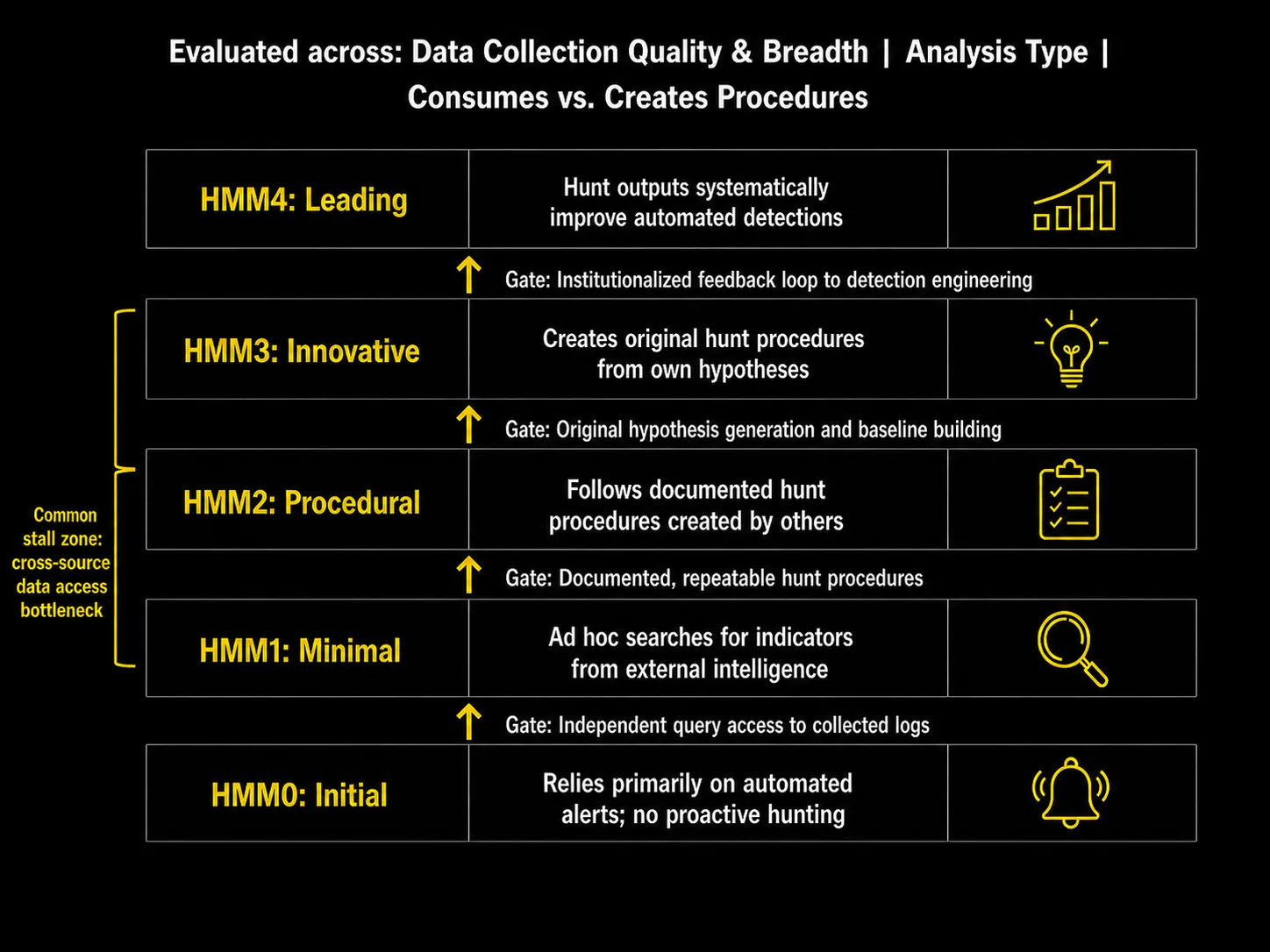
Most programs stall between HMM1 and HMM3, where testing one hypothesis means querying several sources.
The hypothesis was sound. The bottleneck was fragmented query access. This query fan-out problem, where a single hypothesis requires queries across three or four different platforms, each with its own schema and language, is what stops progression. The time spent translating queries and moving data often exceeds the time available for analysis, keeping even skilled hunters stuck performing low-level data retrieval when their time should go to proactive hunting.
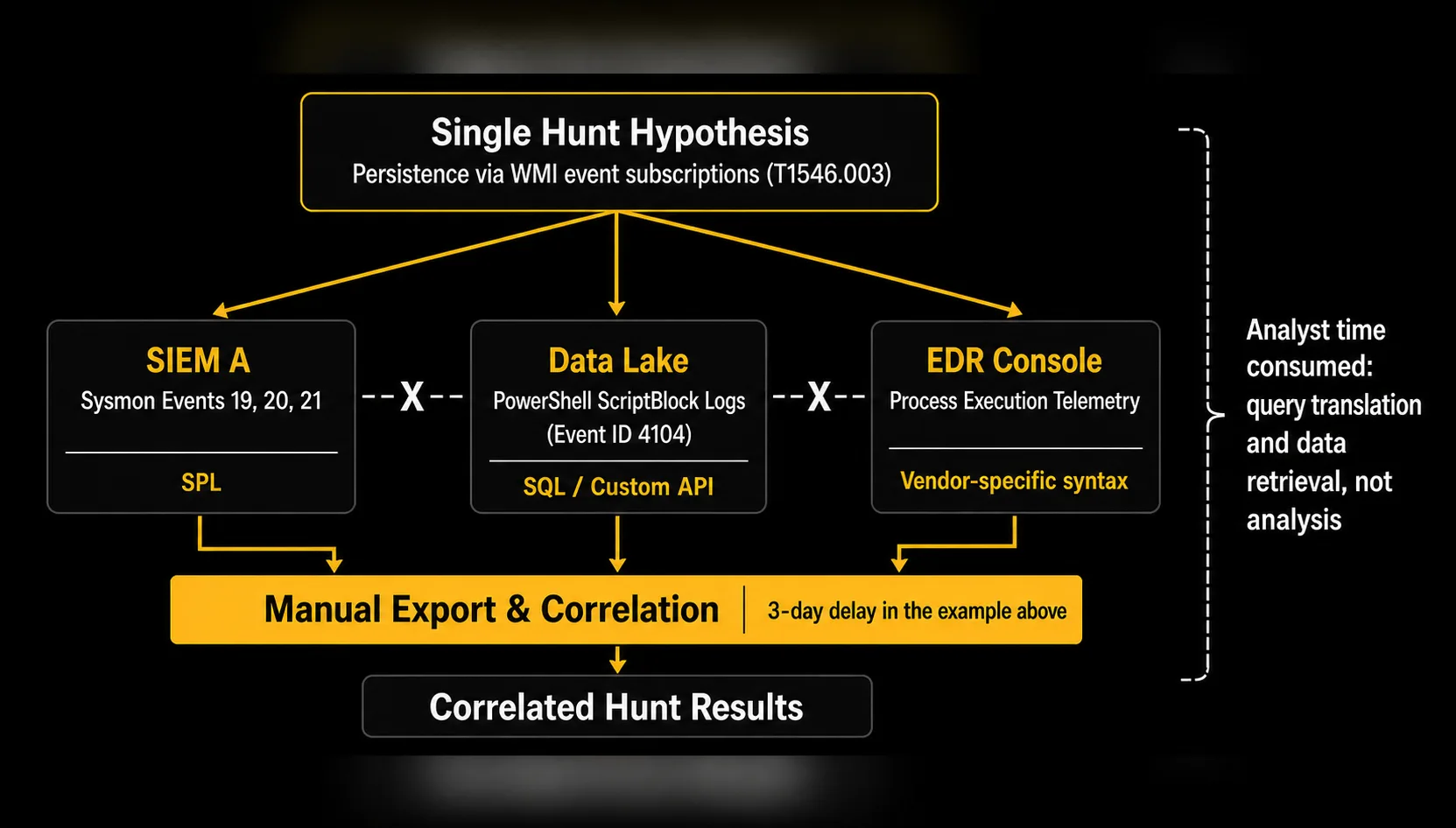
The query fan-out problem consumes analyst time on data retrieval, stalling maturity progression.
Read more: Threat Hunting Tools: A 2026 Buyer's Guide
Hunting in Air-Gapped and Classified Environments
Standard maturity models assume an internet-connected SOC. In an air-gapped or classified network, Sigma rules cannot be pulled on demand, and any hunting platform that needs cloud connectivity is disqualified. Independent research by Ponemon Institute, commissioned by Crogl, found that 45% of SOCs protect air-gapped networks, which means this is a common operational reality.
Three constraints redefine maturity in these environments:
- Delayed Intelligence: Threat intelligence must be manually transferred across security boundaries, often through a cross-domain solution. This delays indicator searches and limits the cadence of HMM1-level hunts to the transfer schedule.
- Content Portability: Model updates, rule packages, and tool patches require a formal transfer and review process. A team cannot pull the latest Sigma rules or YARA signatures from a public repository during a hunt. The bottleneck shifts from intelligence access to content portability.
- Data Sovereignty: Strict requirements may restrict which tools can be deployed and which models can process telemetry. A platform that sends data to a public cloud for analysis is a non-starter, limiting the analytics available at HMM3 and above.
When intelligence arrives on a transfer schedule, each HMM level takes on a different shape. At HMM1, hunts tend to focus on indicators from the latest transferred package, and cadence is bounded by that delivery window. At HMM2, teams can run documented procedures against each new package, but updating those procedures still depends on formal content review and transfer. At HMM3, hunters begin forming original hypotheses from local baselines and recent advisories, though every new data source, rule package, or model update still moves at enclave speed. At HMM4, the strongest programs turn completed hunts into durable detections and documented coverage gains, even when new intelligence only arrives once per shift or once per day.
Maturity in disconnected environments requires different operational assumptions and deployment models that prioritize control over data and tooling.
Read more: Autonomous SOC: 5 Requirements for On-Prem and Air-Gapped
Null Results Are Findings: Documenting Hunts That Surface Nothing
A hunt that returns zero results tells you the hypothesis did not hold in the data that was visible during the queried time window. That makes a null result a finding about coverage. Mature programs at HMM4 document null results with the same rigor as positive findings, recording the hypothesis, data sources, time window, query logic, and exclusions.
This documentation serves two critical purposes. First, it prevents the team from rerunning the same hunt without new intelligence or expanded data visibility. Second, it creates an auditable trail that demonstrates due diligence to compliance stakeholders. In regulated critical infrastructure, this record is evidence of proactive defense. For example, a hunt for WMI persistence returns no results. The hunter documents that Sysmon was not deployed on 40% of endpoints in the enclave. The null result now correctly reflects a telemetry gap. This documented context turns a seemingly empty result into a valuable data point about security posture.
The Hunt-to-Detection Feedback Loop as the Real Maturity Measure
The most reliable indicator of maturity is whether hunt outputs feed a detection-as-code pipeline. A team that hunts but never converts findings into persistent detections is running campaigns, and its coverage stays where it was. This hunt-to-detection feedback loop is the engine of a continuous hunting operation.
When a hunt identifies a new adversary pattern, the hunter writes a detection rule, often in a vendor-neutral format like Sigma. That rule enters a pipeline where it is tested, tuned against a benign baseline exclusion list, and deployed to the SIEM. The hunt hypothesis backlog is then updated to reflect the new coverage. This process distinguishes continuous hunting, which systematically expands coverage over time, from campaign-based hunting, which responds to a specific threat and then ends. Mature programs run both.
To justify the program's value, SOC leaders can report on three key metrics:
- Number of hunt hypotheses tested per quarter.
- Number of new detection rules generated from hunt findings.
- Percentage of MITRE ATT&CK techniques covered by a hunt or detection in the past year.
These three numbers show whether hunting is expanding detection coverage quarter over quarter.
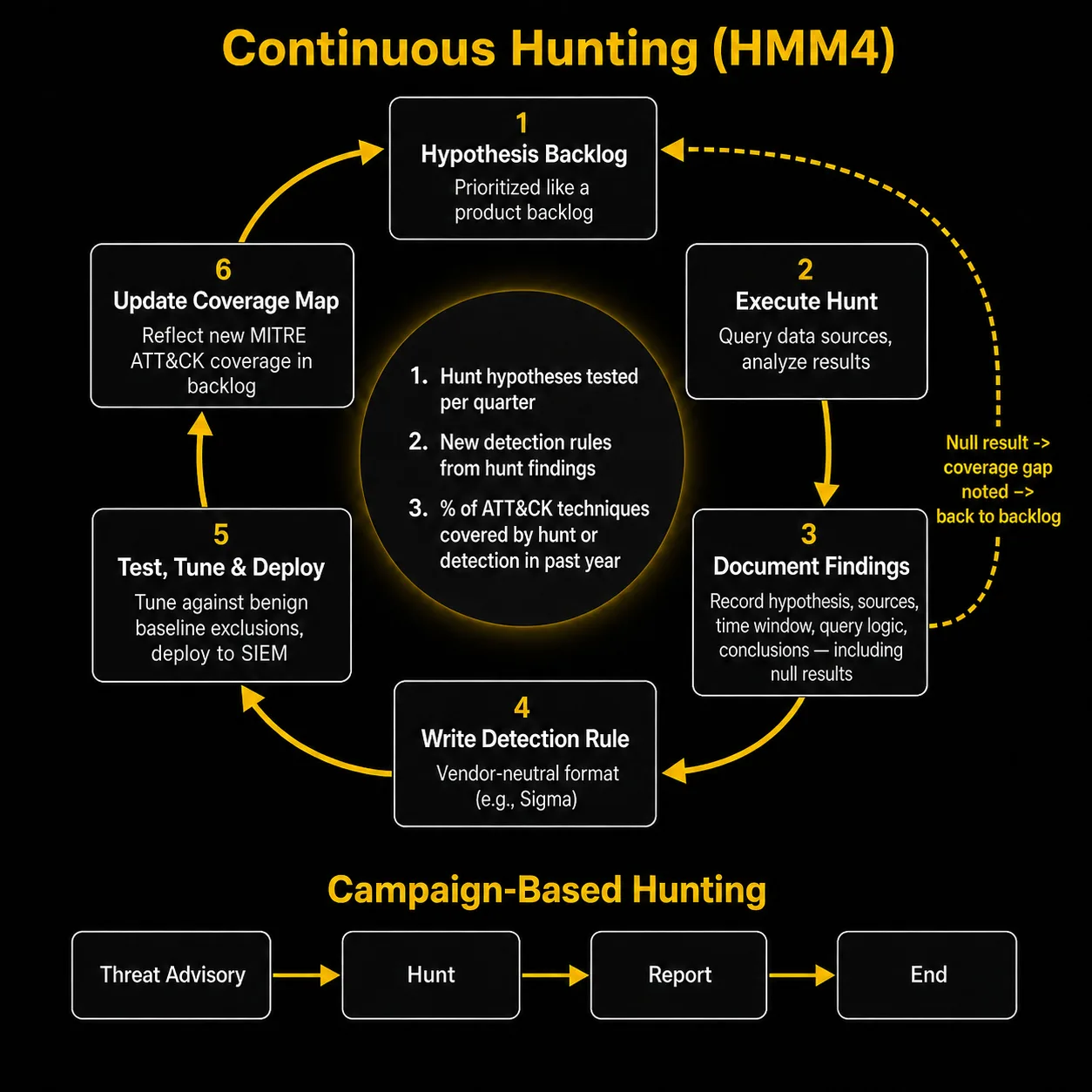
The hunt-to-detection feedback loop is the defining measure of threat hunting maturity.
Hunting Across Fragmented Sources Without a Normalization Tax
Maturity progression stalls when a single hypothesis requires evidence from a SIEM, an EDR, and a data lake. The query fan-out problem forces senior analysts to spend their time on manual data retrieval. Crogl was designed to remove that specific bottleneck. A hunter writes a hypothesis once, and Crogl generates a native query for each connected source in its own format, with no schema normalization step. The hunter can ask to see the generated queries before they run, preserving control and transparency. For teams focused on proactive threat hunting, that means more time spent testing hypotheses and less time spent translating syntax across tools.
Every query, result, and analyst decision is logged in the customer's own case system, creating the auditable hunt record needed for compliance and the feedback loop to detection engineering. For air-gapped and classified environments, Crogl runs on-prem or fully disconnected, with the customer choosing and hosting their own model. Air-gapped deployment is included in the free download. Crogl removes the data access gate without forcing the team to learn a new query language or rebuild their data architecture.
Read the proactive threat hunting guide
How to Move Up the Threat Hunting Maturity Model
A threat hunting maturity model gives your team a vocabulary for where you are, but it does not tell you how to move forward.
Advancing requires solving the query fan-out problem that consumes expert time, documenting null results with the same rigor as positive findings, and closing the loop from hunt output to detection engineering. The next time your team reviews its maturity level, ask which specific transition is currently blocked and what operational change would unblock it.
Frequently asked questions
What staffing model supports a Level 3 or Level 4 hunting program?
HMM3 requires at least one dedicated hunter who can generate hypotheses, build queries, and establish environmental baselines. HMM4 requires enough capacity for hunt outputs to feed a detection-as-code pipeline, which may mean a second analyst or a shared role with detection engineering. Organizations can extend coverage without adding headcount by reducing per-hunt query costs through federated data access.
How do Sigma rules fit into a hunting program, and what are the backend conversion challenges?
Sigma rules provide a vendor-neutral format for hunt logic. The challenge is backend conversion, as field names and log formats differ between platforms like Splunk and Microsoft Sentinel. A Sigma rule may fail silently in one backend if the field mapping is wrong. Teams with multiple SIEMs face this conversion cost on every rule, which slows both hunting and the feedback loop to detection engineering.
What is the difference between continuous hunting and campaign-based hunting?
Campaign-based hunting responds to a specific threat or advisory and ends when the objective is met. Continuous hunting maintains a rolling hypothesis backlog, a scheduled cadence, and an ongoing feedback loop to detection engineering. Mature programs run both: campaigns address urgent threats, while continuous hunting systematically expands TTP coverage over time.
How do you hunt across multiple SIEMs without normalizing data into a single schema?
The alternative to schema normalization is federated search, the approach Crogl uses. A single hypothesis generates a native query for each source in that source's own format, so the hunter does not need to learn multiple query languages. Each source returns results in its own structure. This approach preserves data fidelity and avoids the field-mapping errors common in multi-SIEM normalization projects.
How do you document and audit completed hunts for compliance?
Each hunt record should include the hypothesis, data sources queried, time window, query logic, findings, and analyst conclusion. This record should live in the organization's case management system to be available for audit. In regulated industries, this documentation demonstrates due diligence and proves the team is actively searching for threats beyond what automated detection covers.
What are the five levels of the threat hunting maturity model?
The five levels are HMM0 Initial, HMM1 Minimal, HMM2 Procedural, HMM3 Innovative, and HMM4 Leading. They describe a progression from relying primarily on automated alerts to running a hunt program that systematically improves detection coverage over time. Each step up is gated by one operational capability.
Who created the Hunting Maturity Model?
David J. Bianco created the Hunting Maturity Model in 2015 while at Sqrrl. The model became widely cited because it gave security teams a common framework for describing how threat hunting capability matures over time, across five levels from HMM0 Initial to HMM4 Leading.
How do you assess your hunting maturity level?
Assess hunting maturity by looking at what your team can do repeatedly, not what a single strong analyst can do on a good week. Check how analysts access data, whether hunts follow documented procedures, whether hunters generate original hypotheses, and whether hunt outputs become durable detections through a feedback loop.