AI for Enterprise Security
An AI SOC With Full Audit Trails. Audit-Ready by Default.
Audit season arrives and the evidence sits across six systems, with half of it in an analyst's memory. Crogl documents every investigation as it runs, so the trail is complete, the records map to SOC 2, ISO 27001, and NIST, and the gaps close before an auditor asks.
Crogl handles the investigation. The analyst makes the call.
Does an AI SOC keep a full audit trail?
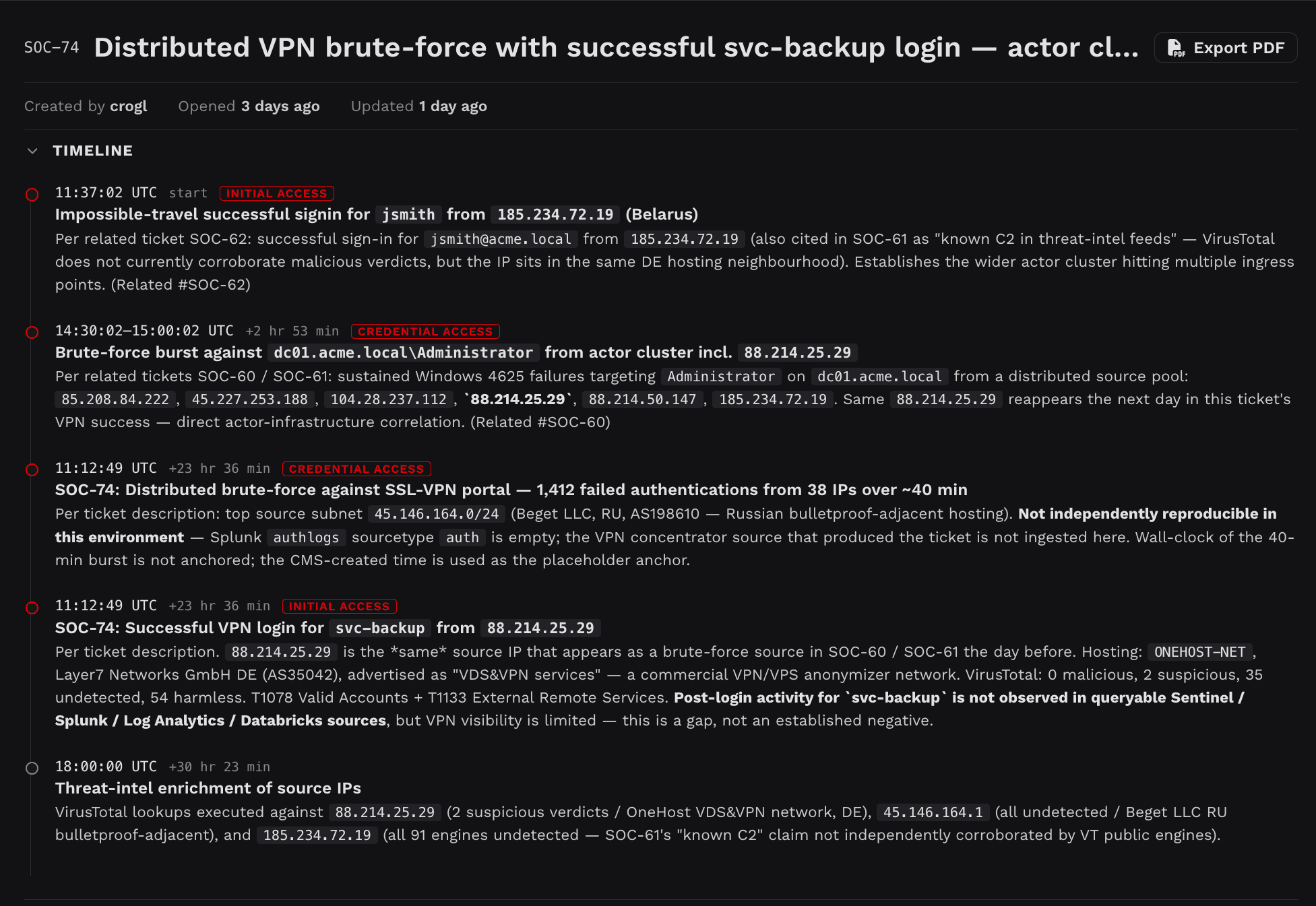
Crogl does. Every alert, benign or malicious, gets an investigation record of what was queried, what came back, and how the conclusion was reached, kept inside your environment. Those records map to SOC 2, ISO 27001, NIST CSF, NIST AI RMF, MITRE ATT&CK, and CMMC requirements, so the evidence is ready before an auditor asks.
How Crogl does it
- Records every query, the evidence it returned, and the reasoning path for every investigation, including the alerts it closes as benign.
- Maps those records to SOC 2, ISO 27001, NIST CSF, NIST AI RMF, MITRE ATT&CK, and CMMC requirements. Crogl supplies the evidence; your auditors make the assessment.
- Posts findings to Jira or ServiceNow with a link back to the full report, so the record sits where your auditors already look.
- Gates automated response on evidence through governed auto-remediation, so every automated action has a documented reason.
The Compliance Burden
Your SOC does the work. But can it prove it?
Security teams investigate threats every day. But when auditors arrive, the documentation tells a different story. Alerts closed without notes. Investigations without evidence. Decisions without rationale. The work happened, but the proof didn't follow.
The result: weeks of preparation before every audit, compliance gaps that shouldn't exist, and CISOs who can't demonstrate what their teams actually do.
68%
Of SOC teams cannot produce complete audit trails for their alert investigations
Weeks
Spent preparing documentation before each compliance audit cycle
Zero
Visibility into how alerts were closed without investigation in most organizations
The Crogl Approach
Documentation that writes itself. Compliance that never lapses.
Every Alert Investigated and Documented
Crogl investigates every alert that enters your SOC, not only the ones your analysts get to. Each investigation produces a complete, structured record: what was found, what was queried, what the determination was, and why.
Audit Trails Generated Automatically
No manual documentation. No after-the-fact report writing. Every investigation action is logged in real time with full provenance: which data sources were queried, what the results were, and how the conclusion was reached.
Compliance-Ready on Demand
When auditors arrive, the documentation is already there. SOC 2, ISO 27001, NIST CSF, NIST AI RMF, MITRE ATT&CK, CMMC. Crogl's investigation records map directly to the evidence your compliance team needs. No scramble. No gaps.
What Crogl Delivers
Complete Investigation Records
Every alert, benign or malicious, receives a full investigation record. No more "closed without investigation" entries that auditors flag and CISOs can't explain.
Real-Time Documentation
Investigation records are generated as the investigation happens, not reconstructed after the fact. Every query, every data point, every decision is captured with timestamps and provenance.
Framework-Mapped Evidence
Crogl's audit trails map directly to SOC 2, ISO 27001, NIST CSF, NIST AI RMF, MITRE ATT&CK, and CMMC requirements. Your compliance team gets the evidence in the format they need, without translation.
Continuous Compliance Posture
Audit readiness isn't a quarterly sprint. It's your default operating state. Crogl maintains documentation standards continuously, so your compliance posture never degrades between audits.
Documents Investigations Across Your Stack
“Every investigation documented. Every audit requirement met.”
Frequently asked questions
Which frameworks do Crogl's investigation records map to?
Crogl's investigation records map to SOC 2, ISO 27001, NIST CSF, NIST AI RMF, MITRE ATT&CK, and CMMC. Each record captures what was queried, what was found, and how the determination was reached, which is the evidence those frameworks ask for. Crogl maps the evidence. It does not certify your compliance, and your auditors make the determination.
Do analysts have to write up investigations for the audit trail?
No. Crogl logs every query, result, and determination in real time as the investigation runs, with timestamps and full provenance. The record is written to your ticketing system automatically, so there is no after-the-fact report writing. When auditors arrive, the documentation already exists for every alert, not only the ones an analyst had time to write up.
Are benign alerts documented too?
Yes. Every alert, benign or malicious, gets a full Crogl investigation record, so an auditor's sample doesn't turn up alerts closed without notes. Each record shows the data sources queried, the results, and the reasoning behind the close. The documentation standard holds between audits, so readiness is the default operating state rather than a quarterly sprint.
Related Reading
Ready for Your Next Audit?
Show auditors what your SOC actually does.
We'll show you exactly how Crogl documents every investigation, and how your compliance team can stop dreading audit season.
Deployed in air-gapped federal environments, critical infrastructure, and Fortune 500 financial services institutions.