AI for Enterprise Security
Every Endpoint Alert Investigated. Not Just Triaged.
Crogl investigates every EDR alert with cross-source context. Endpoint telemetry correlated with SIEM data, identity logs, and threat intelligence. Findings, not triage decisions.
Crogl handles the investigation. The analyst makes the call.
The Endpoint Investigation Gap
Your EDR detects everything. Your team can't investigate everything.
Modern EDR tools generate thousands of alerts per week. Most get a quick triage decision based solely on endpoint data. But the most dangerous threats only become visible when correlated with the rest of your environment:
- Lateral movement
- Credential theft
- Living-off-the-land attacks
Investigating every endpoint alert with full context is impossible manually. Most alerts get a surface-level triage, and the real threats hide in the uninvestigated volume.
11,000+
EDR alerts per week at a mid-size enterprise, most never investigated
45 min
Average time for an analyst to manually investigate a single endpoint alert
Zero
Context from non-EDR sources in most endpoint investigations
The Crogl Approach
Complete investigations for every endpoint alert. Automatically.
EDR Alert Triggers Full Investigation
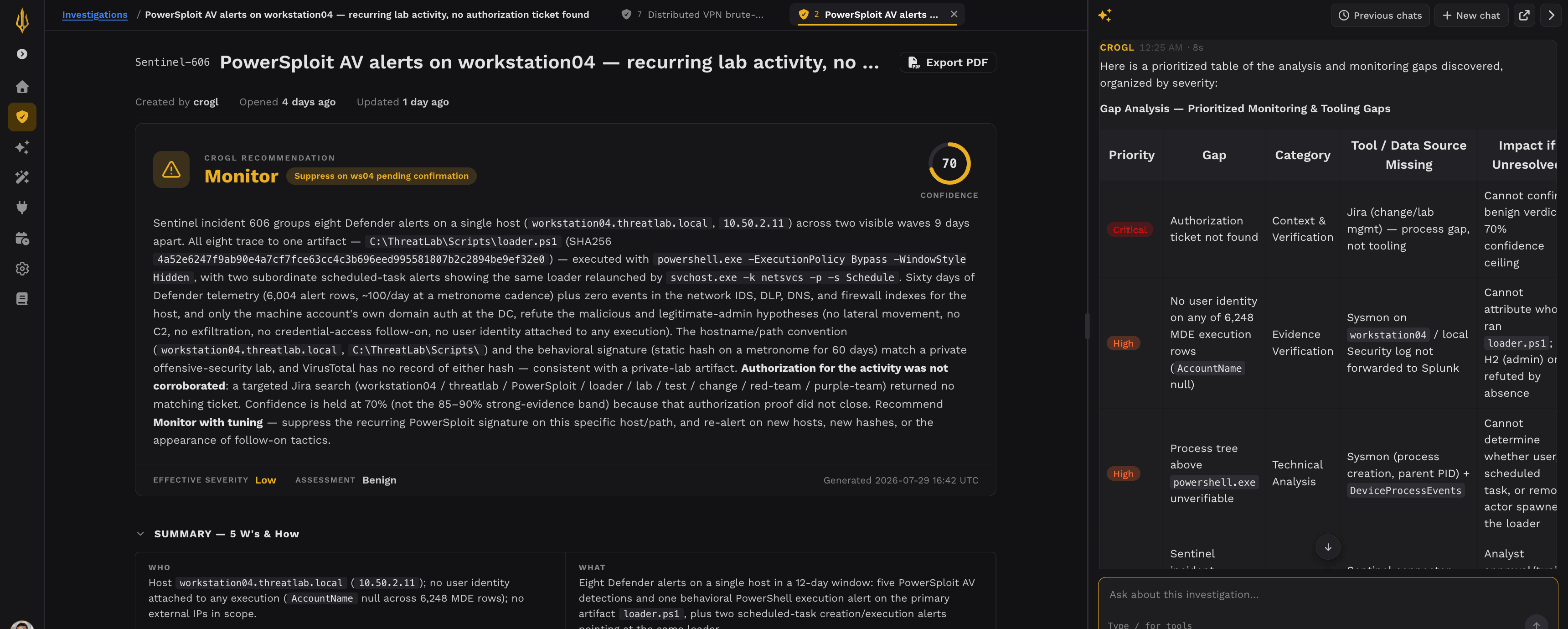
When CrowdStrike, SentinelOne, Defender, or any EDR fires an alert, Crogl does not stop at triage. It investigates. The endpoint alert is the starting point, not the entire investigation. Crogl expands the scope to include everything relevant.
Cross-Source Context Assembled Automatically
Crogl correlates the endpoint alert with SIEM logs, identity data, network telemetry, cloud audit trails, and threat intelligence. The result is a complete picture of what happened on the endpoint, and everywhere the activity touched.
Analyst Receives Complete Finding
Your analyst sees a fully contextualized finding: what happened on the endpoint, what else it connected to, whether it's part of a larger campaign, and a recommended response. The investigation work is done. The decision is theirs.
What Crogl Delivers
Full-Scope Endpoint Investigation
Every EDR alert receives a complete investigation, with correlated context from across your entire security environment rather than endpoint data alone. No alert triaged in isolation.
Cross-Source Correlation
Endpoint telemetry correlated with SIEM events, identity logs, network data, and threat intelligence automatically. The investigation includes everything relevant, not just what the EDR saw.
Automated Response Recommendations
Each investigation concludes with a recommended response based on the full context: isolate, contain, escalate, or close with documentation. Your analysts decide. Crogl assembles the evidence.
Every Investigation Documented
Complete investigation records for every endpoint alert, whether it's benign or malicious. Full audit trail, full evidence chain, ready for compliance review.
Works With Your Endpoint & Security Stack
“Every endpoint alert. Full context. Complete investigation.”
Frequently asked questions
Does Crogl replace our EDR?
No. Crogl works alongside your EDR and investigates the alerts it produces. The endpoint alert is the starting point, and Crogl correlates it with SIEM logs, identity data, network telemetry, cloud audit trails, and threat intelligence. The finding shows what happened on the endpoint, everywhere the activity touched, and whether it's part of a larger campaign.
Which EDR tools does Crogl work with?
Crogl works with the EDR you already run, including CrowdStrike, SentinelOne, and Microsoft Defender. It queries each tool in its native format, with no schema normalization, and correlates endpoint telemetry with the rest of your security stack. The custom connector builder connects tools that don't have a connector yet.
Who decides whether to isolate an endpoint?
Your analyst. Every Crogl endpoint investigation ends with a recommended response based on the full cross-source context: isolate, contain, escalate, or close with documentation. Crogl assembles the evidence behind that recommendation, and the analyst makes the call. Benign and malicious alerts both get a complete investigation record with a full audit trail.
Investigate Every Endpoint Alert
What's hiding in your uninvestigated endpoint alerts?
We'll show you how Crogl investigates endpoint alerts with full cross-source context, using your EDR, your SIEM, your environment.
Deployed in air-gapped federal environments, critical infrastructure, and Fortune 500 financial services institutions.