Autonomous SOC: Five Requirements for On-Prem and Air-Gapped Environments
Mike Dupuis
Marketing, Crogl
 When data cannot leave your environment, the investigation has to come to the data.
Key Takeaways
- An autonomous SOC investigates alerts by reasoning across fragmented tools, which is a fundamentally different capability than a SOAR playbook that only executes predefined actions.
- AI threat detection can catch what static rules miss through anomaly detection, UEBA, and cross-signal correlation, but a more sensitive detector also creates more alerts for analysts to resolve.
- SOC automation typically stalls when an investigation requires querying multiple systems in their native formats. An autonomous SOC has to carry the investigation across those systems so the analyst reviews a finding instead of running each query by hand.
- For regulated environments, sovereign deployment is non-negotiable. The platform, models, and data must operate inside the customer's controlled boundary.
- Schema normalization carries hidden costs. Federated search that queries data where it lives is more efficient and less brittle than building and maintaining a unified data model.
- An auditable investigation needs its full evidence trail. The platform must log every query, the evidence returned, and the reasoning path taken to produce a defensible record.
A Log4Shell alert fires on a host inside an air-gapped enclave. Confirming whether it matters takes four tools, four query languages, and an analyst who cannot paste a single log line into a cloud model. Independent research by Ponemon Institute, commissioned by Crogl, found that organizations average 4,330 alerts a day and investigate 37% of them . An autonomous SOC promises to close that gap without a matching increase in headcount.
The pressure on that gap is rising. AI threat detection can catch what rules miss by modeling normal behavior, spotting anomalies, profiling users and entities over time, and correlating weak signals across tools. That helps reduce false negatives, but it also increases the number of detections that need to be investigated. Vendors still compare the category on the wrong terms, presenting autonomy as a checklist of agents and integrations while skipping the operational constraints that decide whether a platform can run in your environment at all.
The gap between detection and decision, and between executing a playbook response and reasoning through an unfamiliar investigation, is where autonomous SOC platforms either prove their value or expose their limits. For security teams in federal agencies, the defense industrial base, financial services, and critical infrastructure, the evaluation centers on architecture. Where data lives, who controls the model, whether reasoning is inspectable, and how pricing scales with coverage decide the outcome. This guide covers the five requirements an autonomous SOC must meet when sensitive data cannot leave your environment.
What an Autonomous SOC Does
An autonomous SOC investigates security alerts across an organization's existing tools and data systems. It gathers evidence, reasons through investigative paths, cross-references sources, and produces a documented finding for analyst review. This capability is designed to handle the alert-to-closure lifecycle at a scale that manual triage and enrichment cannot match.
In a modern SOC stack, that matters because the core tool categories each do a different part of the job. SIEM aggregates and correlates logs. EDR and XDR provide endpoint and cross-layer telemetry. SOAR runs response playbooks. Threat intelligence platforms enrich alerts with external context. Case management systems track alerts to closure. AI threat detection adds another important layer through anomaly detection, UEBA, and cross-signal correlation, which helps surface attacks that static rules miss. It also widens the queue. Together, these systems produce and organize signal, but they still leave the investigation work of weighing evidence across tools and reaching a conclusion to the analyst. An autonomous SOC sits in that gap.
Investigating Beyond the Playbook
The core capability of an autonomous SOC is reasoning through unfamiliar evidence. A SOAR playbook can block a malicious IP address when a rule fires, but its branching logic is set before the alert arrives. It can only follow the investigation paths its author anticipated, so an unfamiliar combination of indicators produces either a false negative or a generic escalation with no supporting evidence.
An autonomous investigation, by contrast, might query the SIEM, EDR, and identity provider to determine if a flagged binary is running on a host, if that host has an active logon session from a privileged account, and if that account accessed other systems within the same time window. It can follow evidence across sources, adapting its path as each new query depends on what the previous one returned.
Where the Analyst Stays in the Loop
In an autonomous SOC, the platform carries the investigation and the analyst owns the decision. It automates the repetitive work of gathering evidence, querying systems, and documenting findings. Escalation decisions, response authorizations, and complex interpretations remain analyst responsibilities.
This boundary is a deliberate design requirement. In regulated and sensitive environments, an uninspected AI decision that triggers a containment action on a production system creates liability that outweighs any efficiency gain. The goal is to free analysts from the manual, time-consuming steps of every investigation so they can focus their expertise on the steps that require human judgment.
Where Playbook Automation Stops and Investigation Begins
Playbook-driven SOC automation stalls at the boundary between executing a known response and conducting an investigation. Given a verdict, response is a known set of actions, and a playbook can run them well. The ruling is different. A SOAR playbook can enrich an alert with threat intelligence and check a blocklist, but it cannot reliably reason through a finding that spans three different data sources with conflicting signals. This is where the manual work and context-switching costs accumulate. An analyst working by hand has to query several systems, each in its own query language, and that cost is best measured in minutes per finding. Worked by hand, a finding like this takes about 40 minutes when the analyst has immediate access to the relevant systems and records. When that access is delayed by permission gaps, export requests, or dependency on another team, the investigation often stalls outright or stretches far beyond that estimate.
The reason this gap persists is structural. The modern SOC stack is built to raise, enrich, and route alerts. SIEM creates the queue. EDR and XDR add endpoint and cross-layer telemetry. Threat intelligence adds context. SOAR automates predefined response steps. Case management records the outcome. Each tool earns its place, but none of them reaches the conclusion on its own. The autonomous SOC has to operate as the investigation layer across that stack, rather than as one more source of signal.
Consider an alert for CVE-2021-44228 (Log4Shell), which appears in the CISA KEV catalog, firing on a host. A playbook can perform the initial enrichment, pulling the CVSS v3.1 base score and EPSS probability. But the real work of alert triage has just begun. To determine the actual risk, an analyst must:
- Query the EDR to confirm whether the vulnerable component is installed and running on the host.
- Check firewall rules, segmentation policies, or external attack surface scan results to confirm whether the vulnerable service is reachable from untrusted networks.
- Query the identity provider to see if any privileged accounts have an active logon session on the machine.
- Cross-reference the ticketing system for any open change requests or maintenance windows for that host.
Each step requires a different query language and a separate tool. The analyst must then manually assemble the evidence from each source into an evidence packet and make a decision based on a framework like SSVC. They then record the evidence, decision, and owner so the case holds up in a compliance audit. In this scenario, if the component is running, the service is reachable, and no change window covers the host, the analyst would escalate it for emergency patching. This is the swivel-chair investigation tax: four tools, four queries, four context switches. Tracked as minutes per finding, that tax repeats for every alert, so teams realistically scope manual investigation to KEV entries and high-EPSS findings first. When analysts cannot get to the needed data directly, the tax stops being a time problem and becomes a workflow bottleneck, which is exactly why federated search matters. A playbook cannot bridge this gap because its logic is fixed before the alert arrives and cannot adjust as the evidence changes. To close it, SOC automation has to reason across these sources and carry the investigation forward as each query changes the next step.
Read more: SIEM vs SOAR vs XDR: The Difference Explained | Crogl
Five Requirements for an Autonomous SOC When Data Cannot Leave Your Environment
Feature comparison sheets ask what a platform can do. A regulated SOC has to ask first where it can run, who controls the model, and what an auditor will see afterward.
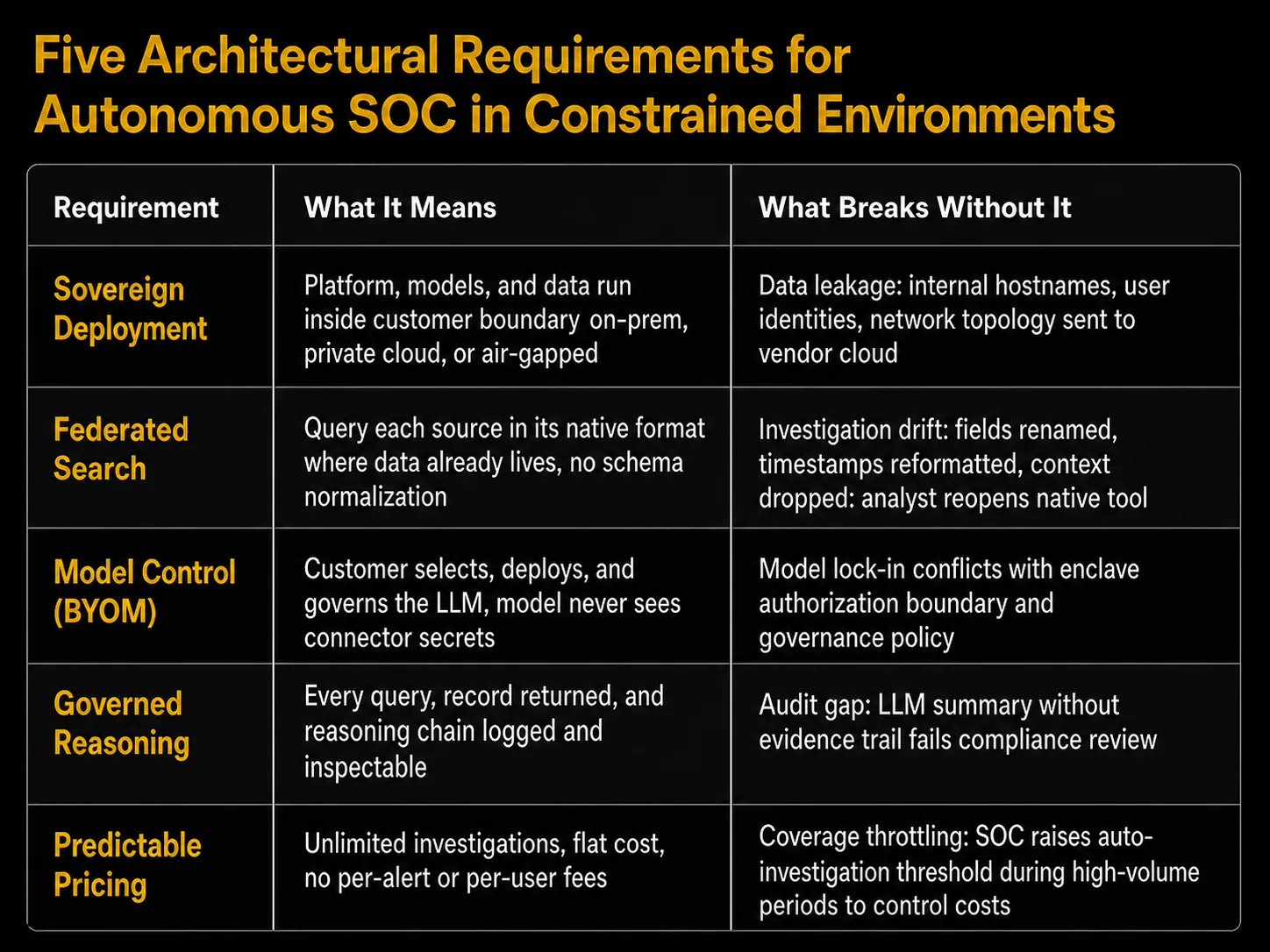
For an autonomous SOC to function where data residency, classification, or regulatory rules apply, it must meet five architectural requirements. Each one determines whether the platform can be deployed and audited in your environment at all, and feature-level comparison sheets rarely ask about them.
1. Sovereign Deployment: On-Prem, Private Cloud, or Air-Gapped
An autonomous SOC that requires sending alert data, investigation context, or LLM prompts to a vendor cloud fails the first test for defense, intelligence, critical infrastructure, and regulated financial environments. Sovereign deployment means the entire platform, including the models and all investigation data, runs inside the customer's controlled boundary.
This requirement is absolute for many federal civilian, DoD/IC, and defense industrial base buyers, for whom it functions as a procurement prerequisite. The platform must support on-premises, private cloud, and fully air-gapped deployments without requiring any data to leave the enclave for processing, model inference, or telemetry.
2. Federated Search Without Schema Normalization
Many autonomous SOC platforms require customers to normalize data into a vendor-defined schema or copy logs into a unified data lake before an investigation can begin. This approach creates a new data pipeline, a persistent maintenance burden, and a significant delay between deployment and the first useful investigation.
A more effective architecture uses federated search to query each connected source where its data already lives, using that system's native language and format. This allows the platform to investigate across the SIEM, EDR, ticketing systems, identity providers, and data lakes without moving data or forcing a schema change. It reduces the hidden query-per-tool tax and avoids the brittleness of maintaining a separate normalization pipeline.
3. Model Control: Bring Your Own LLM
Locking the customer into a single, vendor-selected LLM creates a dependency that conflicts with model governance policies and operational flexibility. Bring-your-own-model (BYOM) means the customer selects, deploys, and governs the LLM used for investigation reasoning. In air-gapped and classified environments, this is often a deployment prerequisite, because the authorization boundary determines which models are approved for use inside a given enclave.
This architecture also provides a critical security separation. The platform's reasoning harness and connectors should be separate from the model, ensuring that the LLM never sees connector secrets like API keys or credentials. Because of this separation, model control is evaluated as its own requirement, apart from where the platform is deployed.
Read more: Do Your Agents Know Your Secrets? | Crogl
4. Governed, Inspectable Reasoning
A conclusion delivered without its reasoning path creates an unacceptable audit gap. Audit teams in regulated environments do not accept an LLM-generated summary as investigation evidence. They require the specific queries issued, the raw records returned, and the logical chain connecting those records to the conclusion.
Governed reasoning means the LLM operates inside a harness, often backed by a knowledge graph , so every investigative step is logged and inspectable. The result is an auditable, repeatable, inspectable path from alert to finding. The resulting evidence packet pairs each logged query and record with the closure disposition, so an auditor or incident review board can trace how the investigation reached its conclusion.
5. Predictable Pricing at Investigation Scale
Per-alert, per-investigation, or per-user pricing models create a perverse incentive: the more alerts the platform investigates, the higher the cost. This directly conflicts with the promise of investigating every alert. As a result, SOC managers are forced to throttle coverage to control costs, often by raising the auto-investigation threshold during high-volume periods.
A flat commercial structure with unlimited investigations removes that incentive. This allows the SOC to increase threat coverage and investigate every alert without triggering a budget conversation every quarter. Because pricing determines whether a team uses the system at full capacity, it belongs in the architectural evaluation alongside deployment and model control.
What Breaks When You Skip These Requirements
Many teams adopt autonomous SOC platforms without fully evaluating these requirements. The vendor demo looks compelling, and the alert backlog is urgent. The consequences, however, often appear within the first quarter of deployment. Three failure modes are common.
First is data leakage and compliance violation. An autonomous SOC that sends investigation context to a vendor cloud exposes internal hostnames, user identities, and network topology. In classified or regulated environments, that exposure is a compliance breach that can force the entire deployment to be halted, regardless of the organization's risk tolerance.
Second is investigation drift. When a platform normalizes data into its own schema, it can lose fidelity. Fields get renamed, timestamps are reformatted, or context is dropped. When this happens, an analyst cannot verify the finding against the original source without opening the native tool anyway, which recreates the exact swivel-chair problem the platform was supposed to solve.
Third is cost unpredictability and throttled coverage. A per-alert pricing model means the SOC either investigates fewer alerts during a major incident exactly when coverage matters most or faces an unplanned budget spike. The cost model ends up dictating security posture. While some organizations may accept these tradeoffs, federal agencies, defense contractors, and critical infrastructure operators typically cannot.
How Crogl Meets These Five Requirements
The tension is clear: autonomous SOC platforms promise to investigate every alert, but most require customers to move data, normalize schemas, accept a locked model, trust opaque reasoning, and pay per investigation. The details below describe how Crogl's architecture handles each of the five requirements.
- Sovereign Deployment: Crogl runs on-premises, in a private cloud, or fully air-gapped. Customer data and models never leave the customer's controlled environment. A U.S. defense agency uses Crogl in an air-gapped deployment to investigate 60,000 alerts per month across 3 SIEMs and 2 SOARs, with about 6 FTE-equivalent productivity gain.
- Federated Search: Crogl queries SIEM, EDR, ticketing systems, and data lakes in their native formats without requiring schema normalization.
- Model Control: Customers can bring their own model. The LLM operates inside Crogl's harness and never sees the secrets behind connectors, so API keys and credentials stay outside the model's context.
- Governed Reasoning: Crogl's LLM runs inside a governable harness backed by a semantic knowledge graph. Every investigative action is logged in the customer's own case management system, creating a complete, inspectable audit trail .
- Predictable Pricing: Crogl offers unlimited investigations with no per-alert, per-investigation, or per-user fees. A public energy utility uses Crogl to achieve a 75% reduction in analyst time per alert and 3x throughput, at a cost that does not rise with alert volume.
In every deployment above, Crogl delivers the finding with its evidence attached, and the analyst reviews it before any escalation or containment action runs.
Download Crogl to run investigations inside your environment
From Feature Checklists to Architectural Readiness
Evaluating an autonomous SOC platform based on its AI capabilities alone misses the requirements that determine whether it will actually work in your environment. The industry's operational gap is real, with nearly two-thirds of alerts going uninvestigated. Closing that gap in a regulated environment depends on how the platform is built and where it runs. A platform that misses one of the five requirements above can be halted in compliance review or fail its first audit.
The promise of investigating every alert is achievable, but only with an architecture designed for the constraints of sensitive and regulated operations. Before evaluating any autonomous SOC platform, map these five requirements against your deployment boundary, your governance policy, and your budget model. The answers will show which platforms can operate inside your constraints. If your team already maintains evaluation criteria or runbooks for AI tooling, revise them against these five requirements instead of drafting a new checklist from scratch.
Frequently asked questions
Can an autonomous SOC operate in a fully air-gapped environment without any connection to a vendor cloud?
Yes, some autonomous SOC platforms support fully air-gapped deployment where the platform, models, and investigation data all run inside the customer's network. The key test is whether the vendor requires any outbound connection for model inference, telemetry, or licensing validation.
How does bring-your-own-model work in an autonomous SOC deployment?
The customer selects, deploys, and governs the LLM used for investigation reasoning instead of using a vendor-locked model. The platform provides the reasoning harness and knowledge graph, while the customer provides the model. Because the harness keeps connectors separate from the model, the LLM never sees connector secrets.
What metrics should a SOC director track to measure autonomous SOC effectiveness?
Track investigation coverage rate (percentage of alerts receiving a full investigation), mean time from alert to documented finding, and escalation accuracy. Alert closure rate alone is misleading because it does not distinguish between investigated closures and bulk dismissals based on severity.
How does an autonomous SOC handle alert correlation across SIEM, EDR, and network detection tools?
Federated search queries each tool in its native format and returns evidence to a single investigation. The platform's knowledge graph then maps relationships among users, hosts, and activity across sources, correlating evidence without requiring data normalization into a shared schema.
Does an autonomous SOC produce evidence that satisfies compliance and audit requirements?
It depends on the platform's logging. The system should log every investigative step, query, and piece of evidence in the customer's own case system. If the investigation record lives only inside the vendor's platform, the audit team cannot inspect it independently.