Proactive Threat Hunting: A Practitioner's Guide from Hypothesis to Closure
Mike Dupuis
Marketing, Crogl
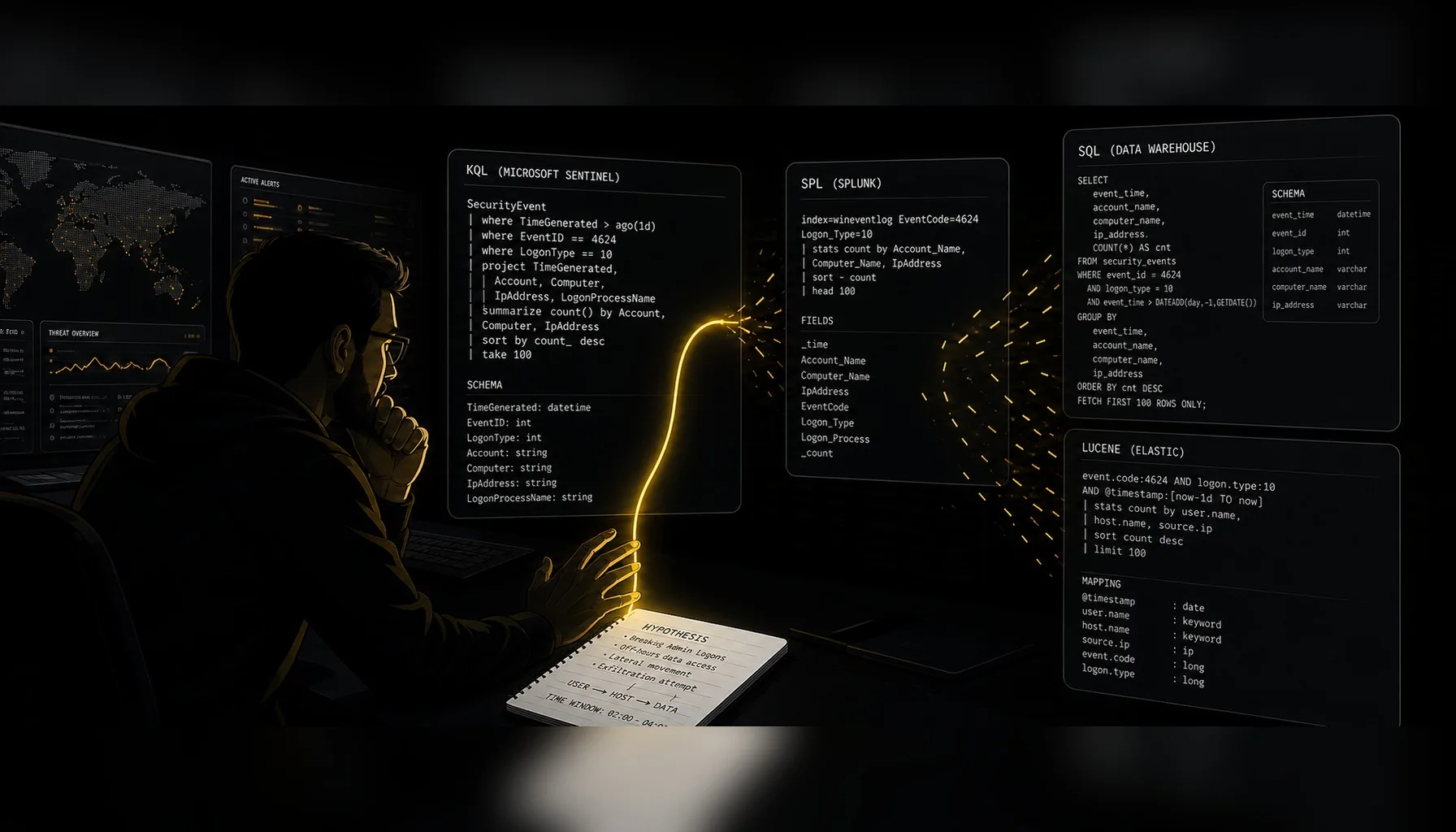 Proactive threat hunting stalls when evidence stays locked behind separate query languages.
Key Takeaways
- Proactive threat hunting is a hypothesis-driven search for adversary activity that has not yet triggered an alert, distinct from reactive alert triage.
- A testable hunt hypothesis specifies the technique (e.g., ATT&CK T-code), expected evidence (log source and event ID), scope, and refutation conditions.
- The primary bottleneck for most hunt programs is the operational cost of gathering evidence across fragmented security tools, each with its own query language.
- A null hunt result does not mean the environment is clean; it means the hypothesis was not confirmed in the visible data, and documentation must note any telemetry gaps.
- Mature hunt programs measure success by coverage against prioritized threats, hunt cadence, and detection conversion rate, not only by the number of threats found.
A hunt team receives a CRISP advisory on WMI event subscription persistence, a technique known as T1546.003, targeting energy sector environments. The hunter writes a testable hypothesis in under ten minutes. The next ninety minutes are spent translating that single hypothesis into three different query dialects for Splunk, Microsoft Sentinel, and a legacy Elastic cluster. By the time the queries run, the hunt window for that shift is gone. Ten minutes went to the question. Ninety went to asking it three times.
Proactive threat hunting is the practice of forming and testing hypotheses about adversary presence before an alert fires, using internal telemetry and external intelligence to find threats that automated detection missed. Yet these programs frequently stall because the operational friction of collecting cross-source evidence consumes the time that should be spent on analysis.
This guide explains how to build and sustain a proactive threat hunting program by focusing on what matters: writing testable hypotheses, mapping them to available data, gathering evidence efficiently across fragmented tools, and documenting every outcome for audit and improvement. We will cover hypothesis construction, data source requirements, cross-source evidence gathering, null-result interpretation, and hunting in air-gapped networks.
What Is Proactive Threat Hunting and How Does It Differ from Alert Triage
Proactive threat hunting is a hypothesis-driven search for adversary activity that has not triggered a detection. Its fundamental purpose is to find threats that have bypassed existing security controls by looking for the subtle behaviors, patterns, and indicators of attack that automated systems were not configured to see. This practice is distinct from alert triage, which is reactive. Triage begins when a detection fires; hunting begins with a question the analyst asks before any detection exists.
Independent research by Ponemon Institute, commissioned by Crogl, found that organizations face an average of 4,330 daily alerts and investigate only 37% of them. The 63% of alerts that go uninvestigated are not where hunting happens. They represent the capacity squeeze that prevents hunting from happening at all, as analysts who cannot keep up with reactive triage have no hours left for proactive work.
Hunts typically originate from one of three starting points, sometimes structured by frameworks like PEAK:
- Intelligence-led: A CISA advisory, threat report, or partner intelligence describes a specific adversary technique, prompting the team to hunt for it.
- Hypothesis-driven: An analyst uses their knowledge of the environment and adversary tradecraft to form a testable question, such as "Could an adversary be using living-off-the-land binaries for lateral movement between our development and production networks?"
- Baseline-deviation: A hunter performs frequency analysis or other statistical methods to find anomalies in telemetry, like a rare process execution or an unusual parent-child process relationship, that deviate from a known good baseline.
To make the distinction concrete, contrast a triage workflow where an analyst investigates a fired alert from your EDR with a hunt workflow. In the hunt, a practitioner reads a new advisory on lateral movement, writes a specific hypothesis about how that technique would appear in WMI or PowerShell logs, and then queries that telemetry to test the hypothesis. One reacts to a known event; the other searches for an unknown one. For more on the reactive side of SOC work, see our guide on what is alert triage.
How to Write a Testable Threat Hunt Hypothesis
The quality of a hunt depends entirely on the testability of its hypothesis. A vague hypothesis like "look for lateral movement" produces unfocused queries, ambiguous results, and wasted analyst time. A testable hypothesis, in contrast, specifies the exact technique, the expected evidence, the data source where that evidence would live, and the condition that would confirm or refute it. This is the operational difference between a cold hunt, which is purely exploratory, and an intelligence-driven hunt anchored to a specific piece of adversary tradecraft.
Consider a hypothesis for WMI event subscription persistence (T1546.003): “If an adversary established WMI persistence on a Windows endpoint, a new event subscription will appear outside a known change window.” On hosts with Sysmon, the evidence is events 19, 20, and 21. On hosts without it, look for Event ID 5861 in the WMI-Activity operational log.
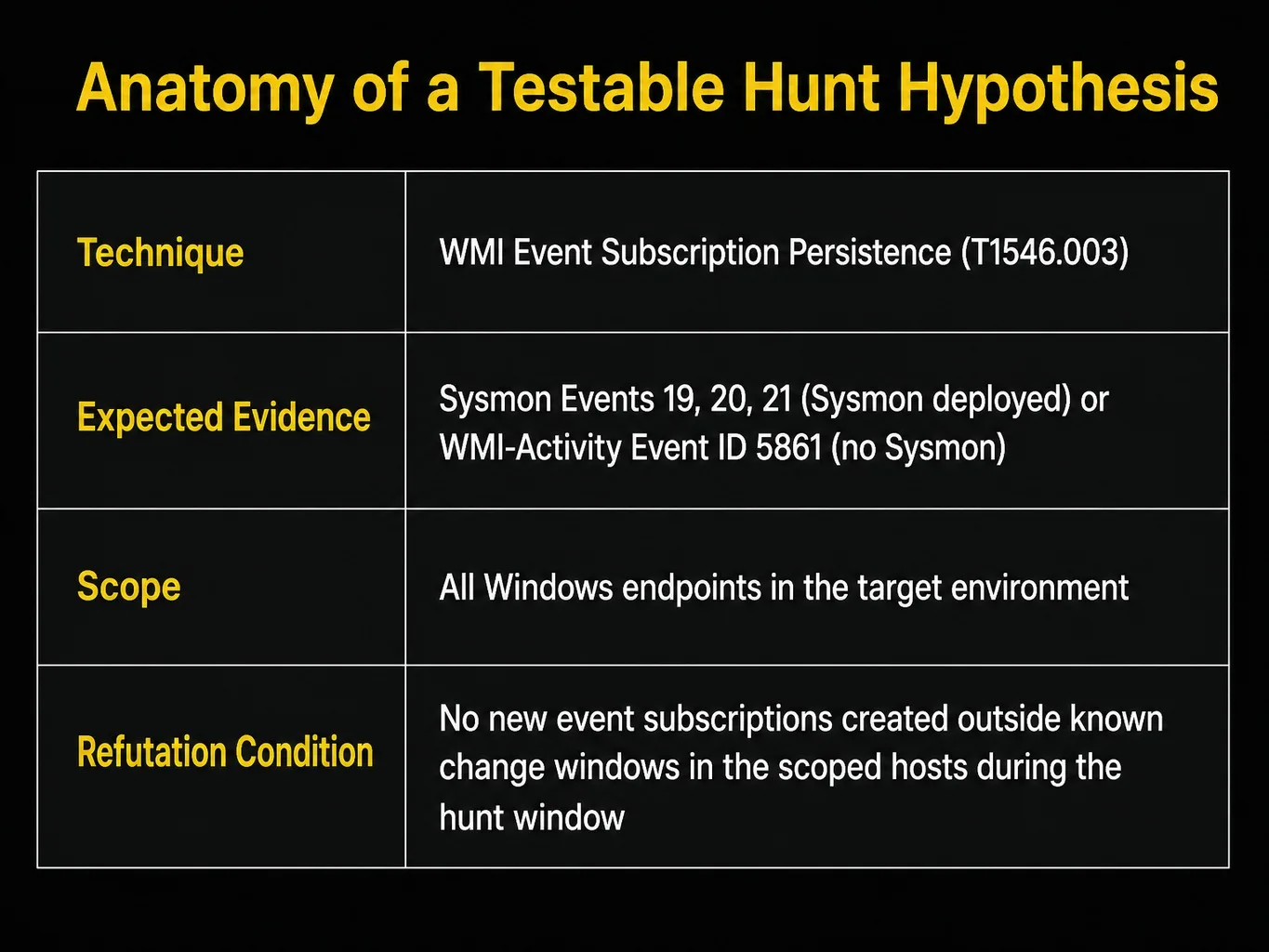
Every testable hunt hypothesis needs these four components before queries begin.
Anatomy of a Testable Hypothesis
A strong hypothesis contains four components that make it operationally useful.
- Technique: The specific adversary behavior, ideally mapped to a framework like MITRE ATT&CK. This provides a common language and focuses the search.
- Expected Evidence: The log source, event ID, or artifact that would be generated if the technique were used. This is the "fingerprint" the hunter will search for.
- Scope: The systems, network segments, or user populations where the hunt will be conducted. This constrains the search to the most relevant assets.
- Refutation Condition: The outcome that would indicate the hypothesis did not hold in the visible data. This is critical for interpreting null results correctly.
Using our WMI example, the WMI persistence mechanism itself uses event subscriptions. The subscription's consumer is what launches a script or living-off-the-land binary (LOLBin), so it is important not to conflate the two when querying. For environments where Sysmon is not deployed, the native Windows WMI-Activity operational log provides a fallback, with Event ID 5861 capturing the creation of a permanent event subscription.
Prioritizing Which ATT&CK Techniques to Hunt First
With over 200 techniques in the ATT&CK Enterprise Matrix, teams cannot hunt for everything. Prioritization should start with an analysis of your organization's unique risk profile, not by reading the matrix from left to right. A defense industrial base contractor exposed to nation-state actors should prioritize hunts for credential access and living-off-the-land techniques over commodity ransomware delivery methods. An energy utility, by contrast, should focus on techniques known to be used in campaigns targeting industrial control systems.
This process involves two key inputs:
- Crown Jewel Analysis: Identify the systems and data whose compromise would cause the most significant mission or business impact.
- Threat Actor Profiling: Understand the adversaries most likely to target your organization and the tactics, techniques, and procedures (TTPs) they favor.
The Cyber Kill Chain can provide a useful model for sequencing hunts, while ATT&CK provides the specific technique taxonomy. The most effective prioritization heuristic is to start with the techniques your most likely adversaries use, against the assets whose compromise you can least afford.
Read more: Autonomous Threat Hunting | Crogl
What Data Sources Does Proactive Threat Hunting Require
A hypothesis is only as testable as the data sources available to evaluate it. Many promising hunt programs stall because a hunter writes a sound hypothesis and then discovers the required telemetry is not collected, is not forwarded to the SIEM, or is retained for too few days to be useful. Mapping data source coverage is a critical prerequisite to every hunt cycle, not a one-time exercise.
For example, a hunter wants to test a hypothesis about credential dumping from the LSASS process. A strong hypothesis would specify looking for Sysmon Event ID 10 (ProcessAccess) where the TargetImage field matches lsass.exe. If Sysmon is not deployed on the target systems, or if Event ID 10 is not configured for collection, the hypothesis is untestable in that segment. The hunter must document that telemetry gap and either adjust the scope or move to a different hypothesis.
Mapping Data Sources to Each Hypothesis
Mature hunt teams maintain a data source coverage map. This document or repository pairs each prioritized ATT&CK technique in the hunt backlog with the specific log source, event ID, and retention window required to test for it. For our WMI hypothesis (T1546.003), the map lists Sysmon events 19, 20, and 21, or WMI-Activity Event ID 5861. Keep at least 30 days of retention so subscriptions created earlier in an intrusion are still visible.
This mapping must extend to cloud environments as well. For instance, hunting for suspicious mailbox access in Microsoft 365 requires the MailItemsAccessed action in the Unified Audit Log. It is also important to note that many valuable log sources, like Microsoft Graph activity logs, are often off by default until an administrator configures a diagnostic setting in Entra ID. Similarly, while AWS keeps 90 days of management events in CloudTrail by default, a missing organization trail means those logs are not reaching your SIEM or long-term S3 storage for analysis.
Identifying Telemetry Blind Spots Before the Hunt Starts
Telemetry gap analysis is one of the most valuable, and most overlooked, steps in hunt planning. Before committing analyst hours to a hunt cycle, the team lead should confirm that the required data is present for the scoped systems. Common blind spots include endpoints without EDR or Sysmon, network segments without full packet capture or DNS logging, and cloud tenants without audit log forwarding enabled.
This analysis must also account for benign activity that can mimic adversary behavior. Vague baselines of "known administrative behavior" are operationally useless. A proper baseline names the specific tools, such as SCCM, Intune, or Ansible, that generate legitimate WMI or PowerShell activity in your environment. By baselining the expected process lineage, command-line arguments, and execution times for these tools, the hunter can more reliably distinguish legitimate administrative noise from a potential threat.
How to Hunt Across Multiple SIEMs Without Normalizing Data
In most large enterprises, security and event data does not live in one place. It is fragmented across multiple SIEMs, EDR platforms, data lakes, and legacy log repositories. This fragmentation creates the single biggest bottleneck for proactive threat hunting: the evidence-gathering tax.
Recall the opening scenario: a hunter spends ten minutes on a hypothesis and ninety minutes translating it into three different query dialects. This is the core problem. The dominant cost of hunting is evidence collection. Each source has its own query language, its own field names, and its own retention model. To test a single hypothesis, the hunter must either master every dialect or write the query once and ask other analysts to translate it, a process that can add days to the hunt cycle.
Sigma helps, and teams that use it should keep using it. A Sigma rule still converts through a separate backend for each platform, and the output only works if your field mappings match how each source names its data. Pivots are the harder part. The indicator you find at minute twenty was not in the original rule, so every pivot means a new query in a new dialect.
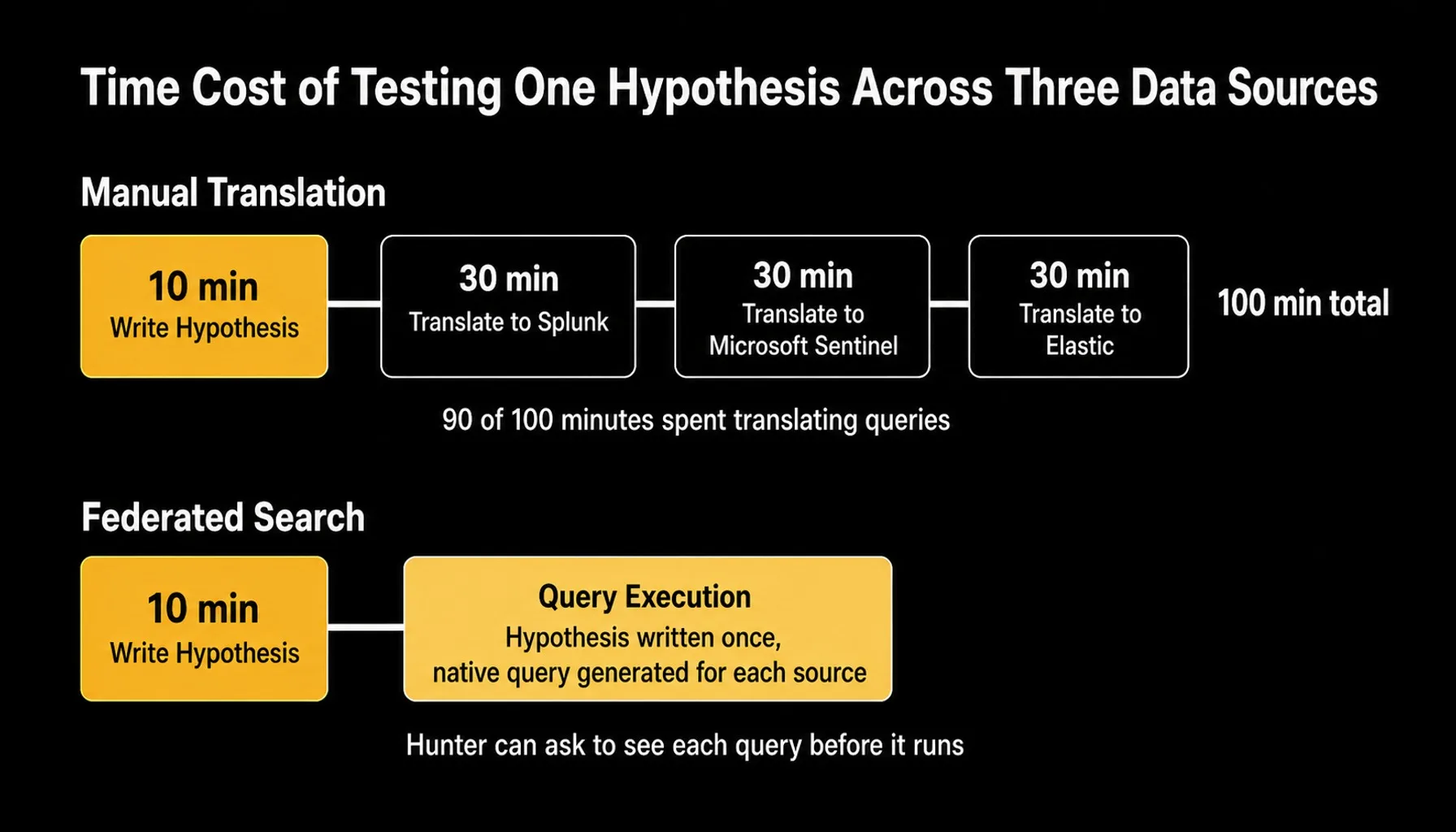
Where a hunt cycle’s time actually goes.
The architectural approach that collapses this cost is federated search. This capability queries each data source in its native format, with no normalization step required. The hunter defines the evidence they need, such as a process execution with a specific command line, and the system executes that search against each connected source without a manual translation step. The hunter can ask to see each query before it runs, without writing any of them.
This becomes even more critical at pivot points in a hunt. When an indicator surfaces in one source, like a suspicious IP address (e.g., 203.0.113.55) in firewall logs, the hunter needs to pivot to other sources to build context. They might check EDR logs for connections to that IP, then query DNS logs to find the associated domain. If each pivot requires writing a new query in a different dialect, the investigative chain breaks, and momentum is lost.
How to Document Hunt Findings for Compliance and Audit
A hunt without a documented closure report is operationally invisible and provides no lasting value. If the hunt found a threat, the finding must be captured to drive incident response and feed the detection engineering loop. If the hunt found nothing, the null result must still be recorded with the hypothesis, sources queried, time window covered, and any telemetry gaps encountered. In regulated industries like defense, energy, and financial services, this documentation is the auditable proof of due diligence.
Hunt documentation is the bridge between the hunt team and three downstream consumers:
- Detection Engineers: They need the finding's logic to write a new Sigma rule, YARA rule, or SIEM correlation rule.
- Compliance and Audit Teams: They need evidence that the organization actively searched for specific threats relevant to its risk profile.
- Future Hunters: They need to know which hypotheses have already been tested, when they were tested, and what the results were to avoid redundant work.
For teams in regulated industries, maintaining this documentation is essential for audit readiness. A standard hunt closure report should include:
- The original hypothesis statement
- The associated ATT&CK technique ID
- Data sources queried and the time window covered
- Findings, including specific evidence, or a null result with interpretation
- Any telemetry gaps or other limitations
- A recommended detection rule or other mitigation
- The assigned owner for any follow-up actions
Imagine a hunt for WMI persistence finds three benign subscriptions created by SCCM and zero adversary subscriptions. The hunter documents the null result, notes that two critical server segments lacked Sysmon coverage, and recommends deploying Sysmon to those segments before the hypothesis can be considered fully tested. That documentation converts a single hunt into durable, organizational learning.
What a Null Hunt Result Means and Does Not Mean
One of the most common and dangerous misinterpretations in a security operations center is treating a null hunt result as confirmation that the environment is clean. A null result means only that the hypothesis did not hold in the visible data. It does not confirm the absence of the threat. The result is a statement about your telemetry, not a statement about the adversary.
A null result can occur for several reasons:
- Coverage Gaps: The adversary was active on a host or segment where you lacked the required telemetry.
- Retention Limits: The adversary's activity occurred before your log retention window began.
- Technique Variation: The adversary used a variant of the technique that your query was not designed to find.
- Correct Hypothesis, Clean Environment: The adversary was not, in fact, present on the scoped systems during the hunt window.
When documenting a null result, the interpretation must be precise. If the hypothesis was "adversary used WMI event subscriptions for persistence on domain controllers," and the hunt queried Sysmon events 19, 20, and 21 on all domain controllers for the past 90 days and found nothing, the closure report should state exactly that. The finding is that no WMI subscriptions were created on those specific hosts during that specific window. It says nothing about other persistence mechanisms, or about hosts outside the domain controllers. Honest documentation of limitations is a hallmark of a mature hunt program.
Measuring Threat Hunting Program Effectiveness
Teams often measure hunt programs by the wrong metric: the number of threats found. This can create perverse incentives, punishing teams for running hunts that come back empty, even if those hunts validate the security of critical assets. A mature program measures its effectiveness based on coverage, cadence, and the velocity of its feedback loop to detection engineering. SOC directors and CISOs should consider four more meaningful metrics:
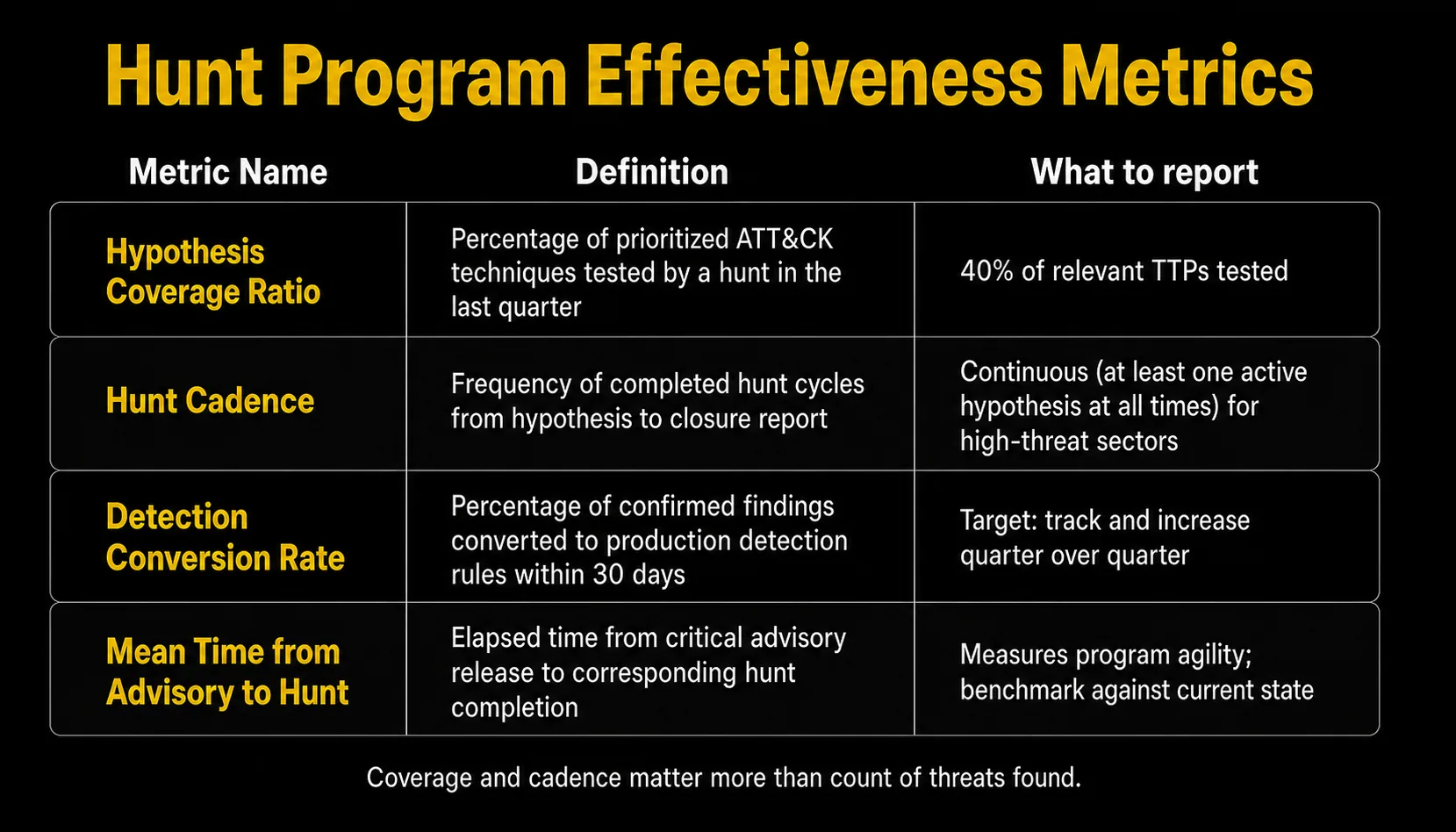
Four numbers a hunt program can defend.
- Hypothesis Coverage Ratio: Of the ATT&CK techniques prioritized for your top threat actors, what percentage has been tested by a hunt in the last quarter? This measures how well your hunt program is covering your known threat landscape.
- Hunt Cadence: How frequently does the team complete a full hunt cycle, from hypothesis to closure report? This measures the program's throughput.
- Detection Conversion Rate: What percentage of confirmed hunt findings result in a new production detection rule within 30 days? This measures the effectiveness of the feedback loop to your SOC automation and detection engineering teams.
- Mean Time from Advisory to Hunt: When a critical CISA advisory is released, how quickly can the team execute a corresponding hunt? This measures the program's agility.
These metrics align with a threat hunting maturity model, where organizations progress from ad hoc, reactive searches to a repeatable, documented process, and finally to an optimized state of continuous hunting with automated evidence gathering and a closed feedback loop. Reporting that your team tested hypotheses covering 40% of relevant TTPs is a more powerful statement of progress than reporting that you found two threats.
Proactive Threat Hunting in Air-Gapped and Classified Networks
Hunting in air-gapped and classified networks imposes a unique set of constraints that most commercial security guidance ignores. In these environments, there are no cloud-based threat intelligence feeds, no SaaS-hosted analysis platforms, and no ability to send telemetry outside the enclave for enrichment. The hunter must operate with locally hosted tools, locally cached intelligence, and, when applicable, locally deployed models.
Three constraints shape every hunt:
- Intelligence Latency: Threat intelligence must be imported through a formal cross-domain solution or manual media transfer, introducing a delay between advisory publication and hunt execution.
- Tool Deployment Locality: All analysis tools must be deployed and maintained inside the secure boundary, including in private cloud partitions.
- Data Movement Restrictions: Evidence cannot be exfiltrated for analysis. All queries, correlation, and documentation must occur within the enclave.
Consider a defense industrial base SOC that receives a CISA advisory. The team must first get the advisory's indicators through a sanctioned transfer process, then map them to locally available telemetry sources, and finally execute the hunt entirely within their network. The time from advisory to hunt completion is often measured in days, not hours, unless the hunt platform is already deployed inside the boundary and designed for sovereign operation. A platform that can be deployed air-gapped, even via a free download, gives these teams a way to begin testing hypotheses without a lengthy procurement cycle.
Read more: Autonomous SOC: 5 Requirements for On-Prem and Air-Gapped | Crogl
How Crogl Reduces the Evidence-Gathering Cost That Throttles Hunt Programs
Proactive threat hunting stalls when gathering evidence eats the hours meant for analysis. Crogl is built to take that work off the hunter.
It starts with the advisory. Crogl ingests intelligence from CRISP, ISACs, vendors, and open sources, and generates hunt hypotheses from it. In an air-gapped enclave, the hunter uploads the advisory as a PDF. Nothing reaches out to the web.
Federated search then queries each connected SIEM, EDR, and data lake in its native format, with no schema normalization. The hunter asks the question once, and Crogl writes the query for each source. Hunters can ask to see every generated query before it runs. When Crogl hunts autonomously, it executes the queries, shows the full evidence chain, and logs every action to your case system.
Pivots hold together because Crogl builds and maintains a semantic knowledge graph when a connector is added. An IP that surfaces in firewall logs connects to the host, the user, and the DNS record without a new query in a new dialect.
Crogl runs on-premises, in a private cloud, or fully air-gapped, so sensitive data never leaves your environment. A major U.S. electric utility cut the time to hunt on a CRISP advisory from over 24 hours to under one hour. Pricing is fixed, with no per-alert, per-investigation, or per-user fees, so hunt cadence stops being a budget decision. Crogl handles the evidence gathering. The hunter makes the call.
Download Crogl, connect your first source, and test a hunt hypothesis against your own data.
Measure the Gap from Advisory to Hunt
A hunter’s expertise is only as fast as the evidence behind it. When one hypothesis needs three query languages, translation time sets the hunt cadence, and the best hunter on the team waits on it like everyone else.
A mature hunt program moves methodically from a testable hypothesis to mapped data sources. It understands that the time spent translating queries across a fragmented tool stack is the primary factor limiting hunt cadence. It documents every closure report, converting individual hunts into durable organizational knowledge and auditable proof of due diligence.
The next time your team receives a threat advisory, measure the elapsed time from its receipt to the completion of the corresponding hunt. That number tells you more about your hunt program's maturity and its operational friction than the number of threats you find in a quarter.
Frequently asked questions
What is the difference between a cold hunt and an intelligence-driven hunt?
A cold hunt starts without a specific intelligence trigger, where a hunter explores telemetry for anomalies based on environmental knowledge. An intelligence-driven hunt starts from a named threat report or advisory, testing whether the described adversary activity is present. Intelligence-driven hunts are typically faster to scope because the hypothesis is already partially defined by the external intelligence.
How do you turn a completed threat hunt into a new detection rule?
The hunt closure report should contain the precise query logic, data source, and conditions that distinguished malicious activity from the benign baseline. A detection engineer uses that logic to write and validate a new Sigma rule, YARA rule, or SIEM correlation rule. Tracking the conversion rate from hunt finding to production rule is a key metric for the hunt program's feedback loop.
How do you hunt for WMI event subscription persistence without Sysmon deployed?
The native Windows WMI-Activity operational log records new WMI event subscriptions without requiring Sysmon. Query the Microsoft-Windows-WMI-Activity/Operational log for Event ID 5861 entries created outside known change windows. The Consumer field within the event details will show what executable or script the subscription is configured to launch, which is where the payload or LOLBin appears.
How does federated search reduce the time cost of proactive threat hunting?
Federated search queries each connected source in its native format, removing the need for a hunter to manually translate a hypothesis into multiple SIEM or EDR query dialects. The hunter defines the evidence needed once, and the search executes across all sources. This collapses the per-source translation cost that consumes the majority of a hunt cycle's time in fragmented environments.
How do you baseline legitimate administrative tool usage before hunting for anomalies?
Identify and name the specific tools that generate activity resembling adversary techniques in your environment, such as SCCM, Intune, or Ansible for WMI and PowerShell activity. Build a baseline of their expected process lineage, command-line arguments, execution times, and target hosts. Any activity that falls outside this specific, tool-aware baseline becomes a strong lead for a hunt.
How often should a SOC run proactive threat hunts?
Hunt cadence depends on the team's threat exposure and available capacity. Organizations in high-threat sectors like defense, energy, and financial services benefit from a continuous cadence where at least one hypothesis is active at all times. Teams with fewer resources can start with a quarterly cycle tied to major advisory releases and increase frequency as evidence-gathering costs decrease.