AI for Enterprise Security
Automate Alert Triage. End to End.
Crogl automates alert triage inside your environment. A knowledge graph reasons through every alert with your own tools, so your analysts spend their time on decisions, not data gathering.
Crogl handles the investigation. The analyst makes the call.
New to alert triage? Start with the primer.
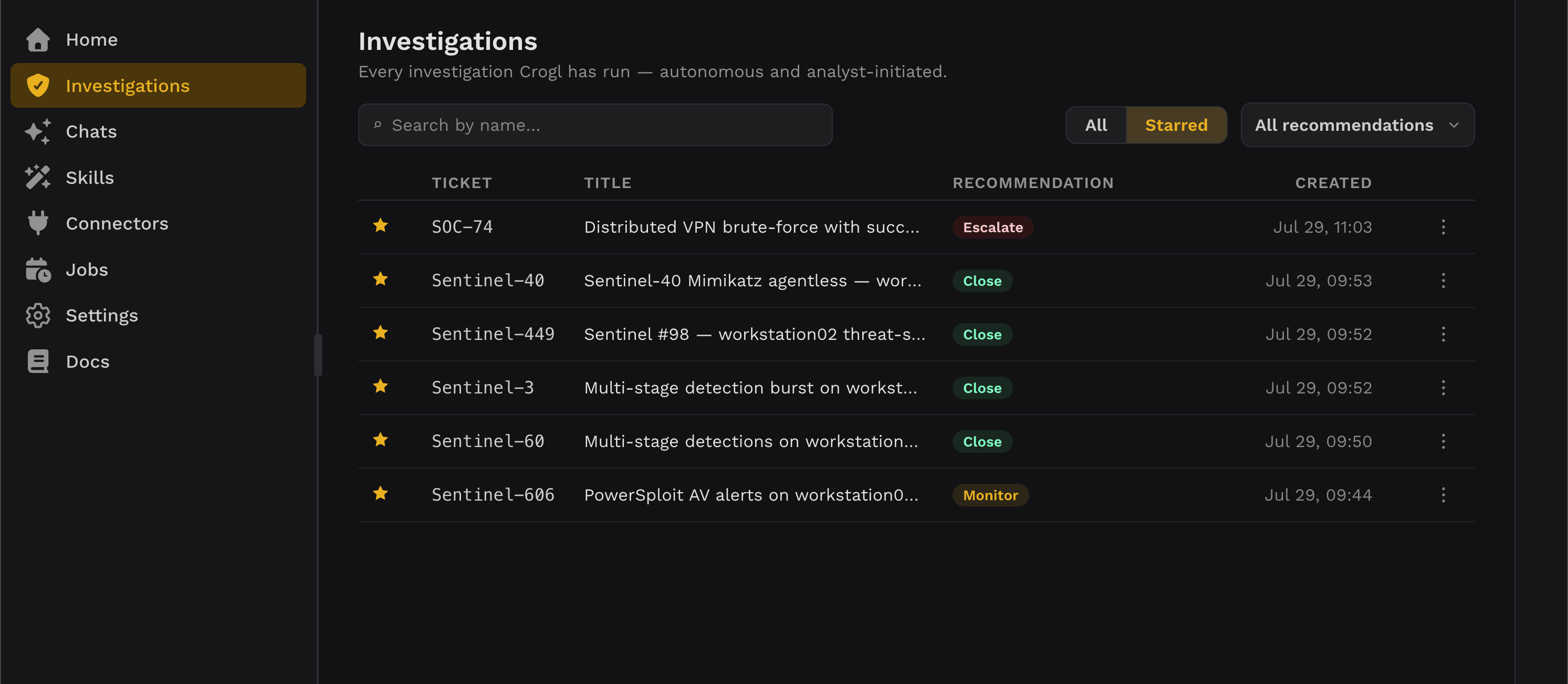
Every investigation, autonomous or analyst-initiated, in one queue.
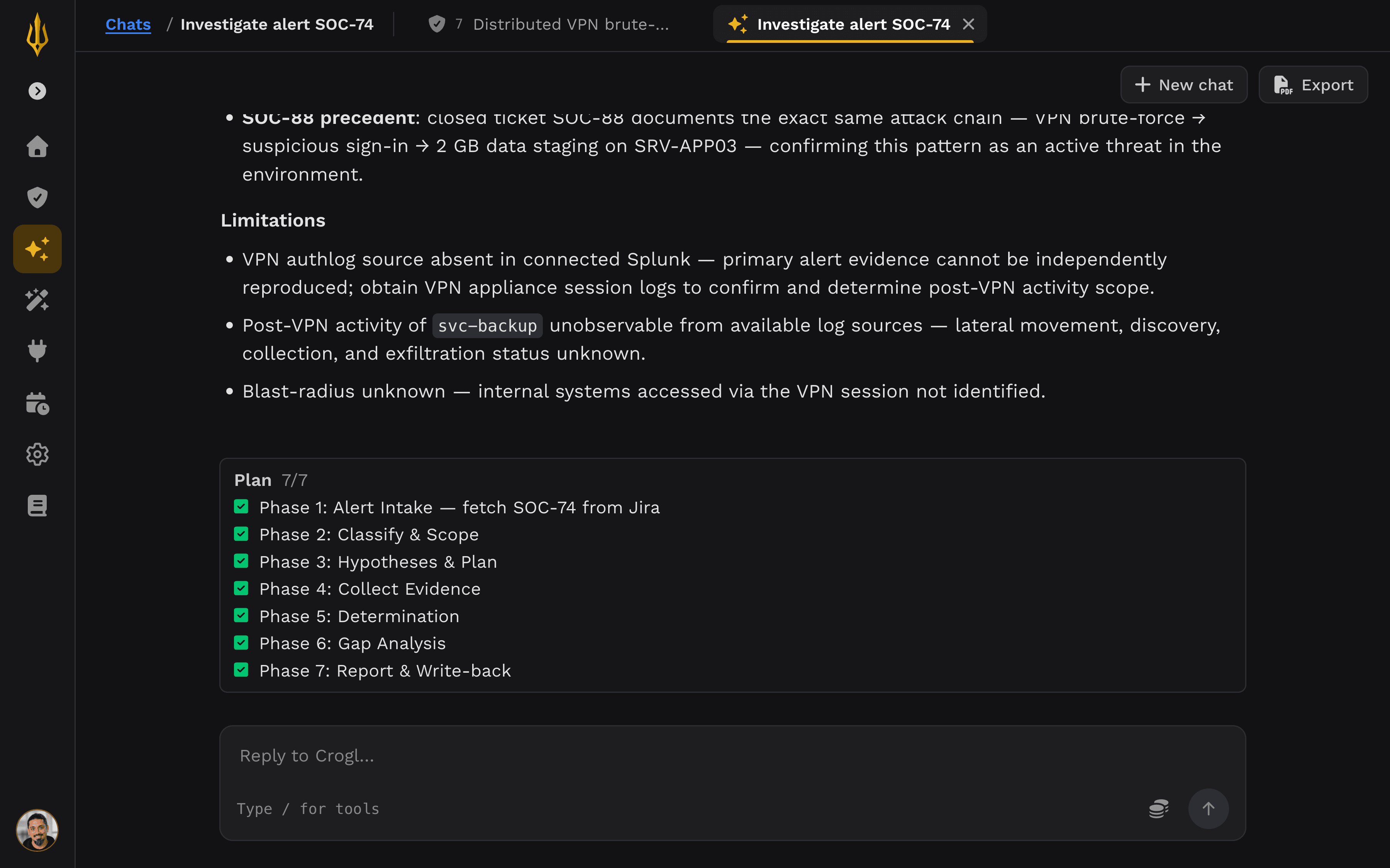
The agent works the full investigation plan, phase by phase.
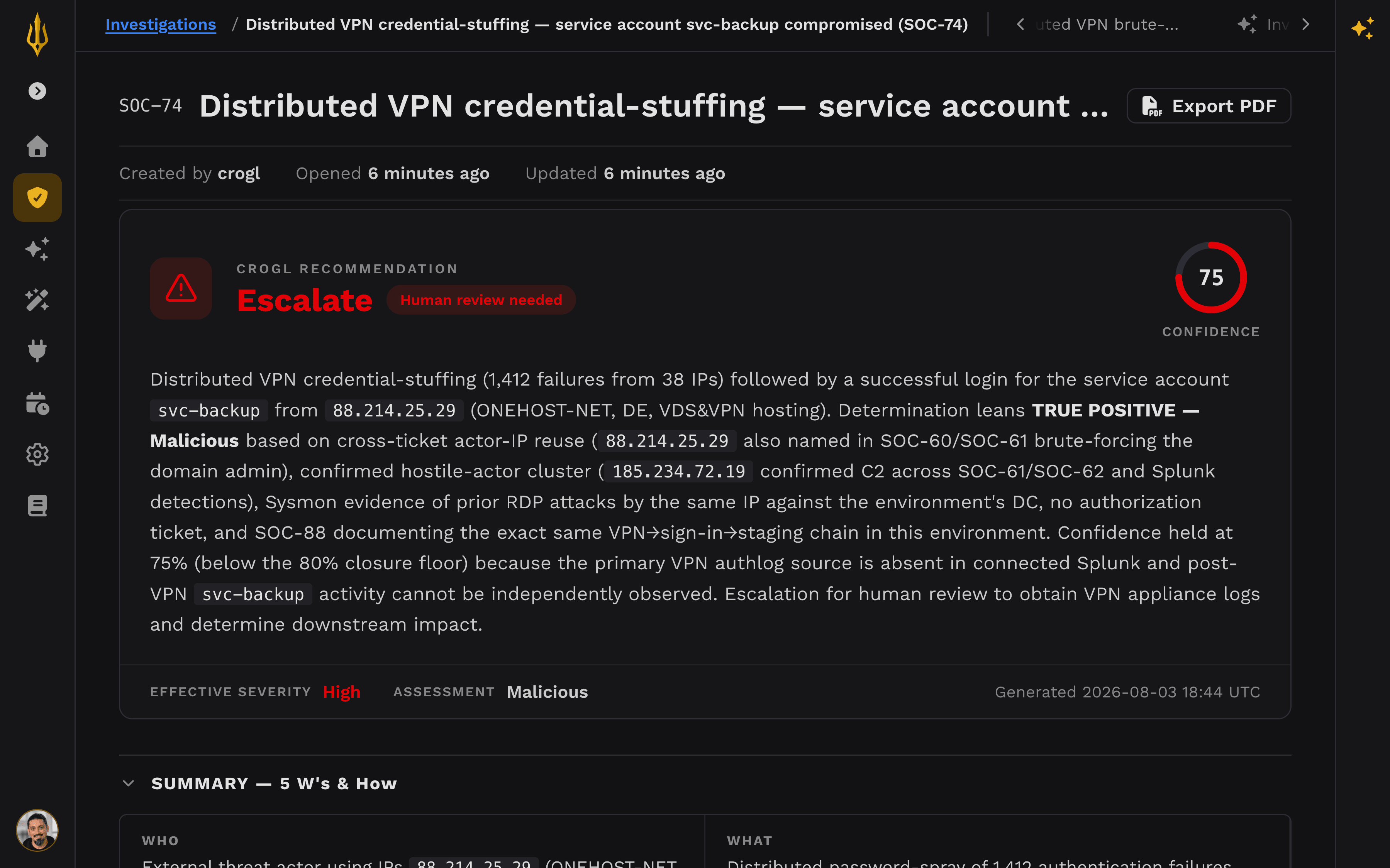
A complete, auditable report — confidence score included.
The Cost of Manual Triage
The work is critical. It shouldn't require your best people.
The average enterprise SOC receives thousands of alerts daily. Most require the same investigative steps:
- Gather context from multiple tools
- Query across data sources
- Cross-reference threat intelligence
- Make a determination
This work is essential, but mechanical. Your most experienced analysts burn hours on repeatable patterns while genuinely complex threats sit in the queue, waiting.
1,000+
Alerts investigated a day, across 3 SIEMs and 2 SOARs
Hours
Of analyst time consumed daily by repeatable, mechanical investigation work
Zero
Documentation on alerts quietly closed without a full investigation
The Crogl Approach
Every alert investigated. Every one documented.
Alert Detected
Crogl monitors your SIEM, SOAR, and ticketing queues continuously. The moment an alert arrives. ServiceNow, Jira, Splunk, Sentinel. Crogl begins. No polling delay. No queue position. No alert left unattended.
Full Investigation Executed
Crogl agents query your tools in their native format, no schema normalization required. The knowledge graph enriches the alert with full environmental context: user behavior, asset history, peer group anomalies, threat intelligence matches. The investigation follows your organization's workflows, adapted in real time to what the data shows.
Analyst Receives a Decision, Not a Queue Item
Every investigation closes with a complete, auditable record in your ticketing system. Benign alerts close with documentation. Complex or high-confidence threats escalate to your analysts, with full context already assembled. Your team makes the call. The work is already done.
See It In Action
Watch Crogl investigate an alert end to end.
In Production Today
Department of War
1,000+
Alerts investigated a day, across 3 SIEMs and 2 SOARs
Previously
Hundreds uninvestigated every day. Investigations taking hours.
After
1,000+ alerts investigated a day. 100TB of security data across 3 SIEMs and 2 SOARs. Every investigation documented. 6 FTE equivalent productivity gain.
Operating in a classified, air-gapped environment with extreme security requirements. Crogl investigates every alert without a single byte leaving the environment.
What Crogl Delivers
Handles Alerts It's Never Seen Before
No playbook required for novel threats. Crogl's knowledge graph provides full environmental context so the investigation is as thorough on a new threat pattern as it is on a known one.
Works Across Every Data Source
Queries your SIEM, EDR, data lakes, and threat intelligence feeds in their native format. No schema normalization. No recoding. No missed context because a source wasn't mapped.
Follows Your Workflows
Crogl learns from your team's actions, escalations, and feedback, continuously refining its investigations to match how your organization operates.
Every Alert Documented
Whether an alert closes as benign or escalates, the complete investigation record is in your ticketing system. Auditable, compliant, and complete.
Works With Your Alert Sources
“No schema normalization. Connects on day one.”
Frequently asked questions
Does Crogl need a playbook for every alert type?
No. Crogl handles alerts it has never seen before without a playbook. Its knowledge graph supplies full environmental context, including user behavior, asset history, peer group anomalies, and threat intelligence matches. An investigation of a new threat pattern is as thorough as one of a known pattern. Crogl also learns from your team's actions, escalations, and feedback to follow your workflows.
What happens to alerts Crogl closes as benign?
Benign alerts close with a complete, auditable investigation record in your ticketing system, such as ServiceNow or Jira. The record shows what Crogl queried, what it found, and why it reached its determination, so no alert closes quietly without documentation. Complex or high-confidence threats escalate to an analyst with the context already assembled, and the analyst makes the call.
Is autonomous triage in the free download?
Autonomous triage is part of Crogl Enterprise. In Enterprise, Crogl picks up every alert from your SIEM, SOAR, and ticketing queues the moment it arrives and investigates it end to end. The free download runs on-premises, in your own cloud, or fully air-gapped, so you can connect your data sources and run investigations against real alerts first.
See It Work on Your Alert Queue
What would Crogl do with your backlog?
We'll show you exactly how Crogl investigates, using your SIEM, your tools, your alert types.
Deployed in air-gapped federal environments, critical infrastructure, and Fortune 500 financial services institutions.