Blast Radius in Cybersecurity: How to Scope, Measure, and Contain Compromise
Mike Dupuis
Marketing, Crogl
 Blast radius extends far beyond the compromised host. Investigation reveals the true scope.
Key Takeaways
- You can only confirm as much blast radius as your evidence sources and analyst time let you query.
- Identity compromise bypasses signature-based detections by generating legitimate-looking authentication events, expanding blast radius faster than malware.
- Scoping blast radius requires querying multiple, fragmented evidence sources, including SIEMs, EDR platforms, and identity provider logs, often in different query languages.
- Architecture controls like microsegmentation and tiered administration reduce potential blast radius, but only evidence-based investigation can confirm the actual scope of a compromise.
- The high volume of daily alerts means many go uninvestigated, leaving the blast radius of potential compromises unknown and creating unmeasured organizational risk.
Blast radius in cybersecurity is the total scope of systems, identities, and data an attacker can access or affect from a single point of compromise. A security operations center receives an alert for credential dumping on a single workstation, and the analyst confirms the host is compromised. The first question is how far the attacker moved before the alert fired, because that answer sets the scope of containment.
Consider a scenario where an analyst confirms a Cobalt Strike beacon and isolates the host within twelve minutes. Two days later, queries against EDR telemetry, SIEM authentication logs, and Active Directory audit logs reveal that the operator had already harvested a cached domain admin credential. The same evidence shows authentications to four domain controllers and persistence on a file server in a separate VLAN. In that scenario, the blast radius extends to the full trust boundary of that credential.
That gap between the isolated host and the credential's reach is the central challenge for security teams. Segmentation and zero trust reduce potential attack paths over time. During an active incident, however, the blast radius you can scope is limited by the evidence sources you can query and the analyst capacity you have to query them. This guide explains how to measure blast radius, why identity compromise expands it fastest, and the investigation steps required to determine its true scope.
What Blast Radius Means in Cybersecurity and How It Is Measured
In practice, blast radius covers systems touched, credentials harvested, data exposed, and trust relationships abused. It maps what an attacker can reach, while a subsequent impact assessment evaluates what they did with that access. When a SOC confirms a beachhead host, the blast radius is every system that host's credentials, sessions, and network position could reach.
Practitioners measure it as a map of access scope, built from evidence across identity stores, network logs, endpoint telemetry, and authentication records. In regulated critical infrastructure and defense environments, an inability to scope blast radius across air-gapped networks and multiple SIEMs leaves a compliance gap that auditors can cite. The decision trail has gaps wherever an analyst could not query a source.
Teams working on vulnerability-driven exposure should use the dedicated vulnerability blast radius page. This guide stays focused on blast radius in cybersecurity as an incident-scoping and post-compromise investigation problem.
What Blast Radius Includes
An analyst scoping blast radius must look for a specific set of exposure dimensions. The scope is bounded by the effective privilege of the compromised credential, which often reaches well beyond the network segment of the compromised host. The assessment includes:
- Systems: All endpoints, servers, and devices with active sessions from the compromised identity or reachable from the initial pivot point.
- Credentials: All cached or harvested credential artifacts, including Kerberos tickets, NTLM hashes, service account tokens, and API keys.
- Data: All file shares, databases, and object stores accessible from the compromised host or identity, based on DACL permissions and network access.
- Trusts: All trust relationships that extend access across Active Directory domains or forests, or between on-premises and cloud environments.
- Networks: All network segments and VLANs reachable from the compromised host, which define the limits of potential lateral movement.
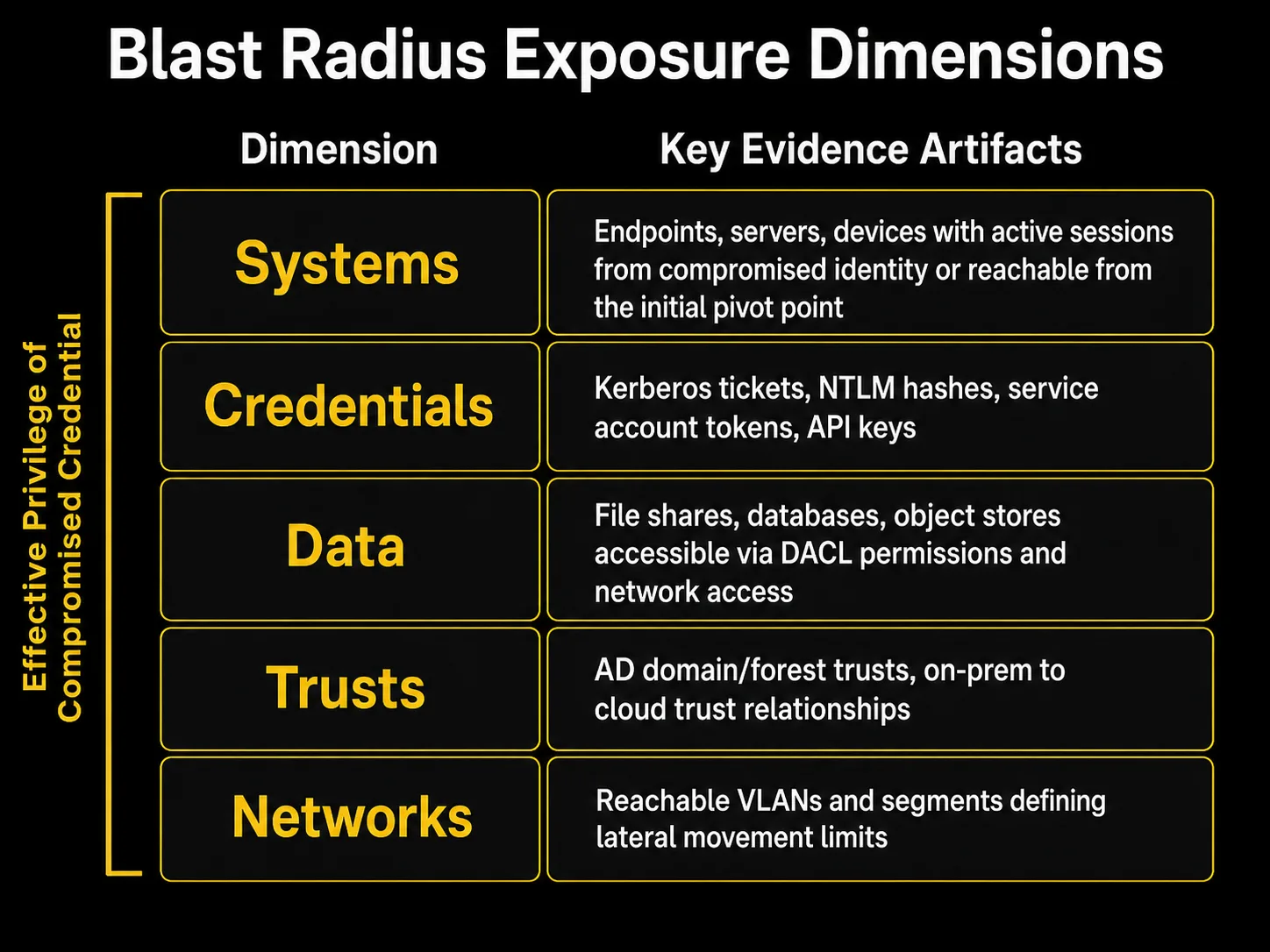
Blast radius scope spans five dimensions, all bounded by the compromised credential's privilege.
How Practitioners Measure Blast Radius During an Incident
Measuring blast radius is an iterative investigation that repeats as each new piece of evidence widens or narrows the scope. The analyst starts from the confirmed point of compromise and works outward by correlating evidence across fragmented systems. The process involves querying authentication logs for network logon (type 3) and remote interactive logon (type 10) events. It requires checking EDR process telemetry for signs of credential dumping, such as unexpected access to the lsass.exe process or patterns associated with tools like the Impacket toolkit.
Attack path analysis tools like BloodHound Community Edition can map potential lateral movement paths from a compromised identity. However, these potential paths must be validated against confirmed paths found in log evidence. A null result when querying for lateral movement confirms only that the available log sources, within their retention windows, did not record evidence of further movement. Confirmed blast radius requires log evidence for each path that the topology suggests.
Why Identity Compromise Expands Blast Radius Faster Than Malware Propagation
In enterprise environments, identity compromise expands blast radius faster and more silently than malware because a valid credential generates legitimate-looking authentication events that bypass many signature-based detections. A compromised service account with domain-wide permissions can access hundreds of systems without triggering a single endpoint detection. Google Cloud's Cloud Threat Horizons Report H1 2026 shows both sides of this. In Google Cloud incidents, software exploitation (44.5%) overtook weak or missing credentials (27.2%) as the top initial access vector for the first time. In Mandiant incident response engagements involving major cloud and SaaS environments, attackers still exploited identity issues to gain initial access in 83% of incidents.
Consider an attacker who gains access to a workstation and uses Kerberoasting (T1558.003) to crack a service account password offline. Using that valid credential, the attacker authenticates to file servers, databases, and management consoles across three network segments. Each authentication is a legitimate logon type 3 event that blends with normal operations.
Service account blast radius often outpaces that of user accounts because service principals frequently cross trust boundaries silently, have over-permissioned DACLs, lack MFA enforcement, and rotate passwords infrequently. Attackers use these credentials with lateral movement techniques (MITRE ATT&CK tactic TA0008) like pass-the-hash or pass-the-ticket to move across the environment. Scoping that blast radius depends on correlating authentication events across every system the account can reach.
Five Investigation Steps to Scope Blast Radius After Initial Access
After confirming initial access on a beachhead host, an analyst must follow a sequence of scoping steps. These steps determine how far the compromise reached before containment decisions are made. Blast radius containment and full incident remediation are different activities. Containment is the immediate action to stop expansion; remediation is the longer process of removal. Each step must record the evidence, the decision, and the owner to create an auditable evidence chain for compliance and review.
-
Identify All Credentials on the Compromised Host. The first step is to determine which credentials the attacker could have harvested. Query EDR telemetry for access to the Local Security Authority Subsystem Service (lsass.exe) and other credential dumping artifacts. Check for cached Kerberos tickets and NTLM hashes that could be used in pass-the-ticket or pass-the-hash attacks. The set of credentials found on this host defines the starting point for the rest of the investigation.
-
Map Every System the Compromised Identities Authenticated To. Using the list of compromised identities, query SIEM authentication logs for all logon events originating from those accounts within the incident timeframe. Focus on network (logon type 3) and remote interactive (logon type 10) events, as these indicate lateral movement. In many enterprise environments, the SIEM that ingests endpoint telemetry is not the same one that ingests identity logs, meaning this step often requires querying multiple platforms in their native languages.
-
Check for Privilege Escalation and Persistence. An expanded blast radius often involves privilege escalation. Query Active Directory logs for indicators of a DCSync attack, which involves a non-domain controller requesting replication data. Look for artifacts of golden ticket or silver ticket creation, which grant long-term persistence. Also, check for modifications to DACLs on sensitive AD objects, which could indicate an attacker granting themselves permissions.
-
Trace Lateral Movement Paths. With a list of potentially compromised systems, trace the attacker's movement between them. Query EDR and Sysmon telemetry for evidence of remote service creation over SMB admin shares (T1021.002, T1569.002), remote WMI process execution, or named pipe activity consistent with tools like PsExec. Where Sysmon is not deployed, the WMI-Activity Operational log Event ID 5861 records new permanent WMI event subscriptions natively. Baseline benign subscriptions first, such as the built-in SCM Event Log Consumer, so expected activity is not mistaken for attacker persistence. While Sigma detection rules provide a good starting point for queries, they often require conversion and field mapping for each specific SIEM or EDR backend. Teams running a hypothesis-led search for these paths can go deeper in the threat hunting use case page.
-
Assess Data Exposure. Finally, determine what data the attacker accessed. Query file access audit logs on compromised servers, database audit logs for unusual queries, and, in hybrid environments, cloud audit logs. For Microsoft 365, the
MailItemsAccessedevent in the Unified Audit Log is the primary evidence of mailbox access. Microsoft Graph activity logs are off by default until an Entra diagnostic setting is configured, so they cannot cover activity that predates that setting.
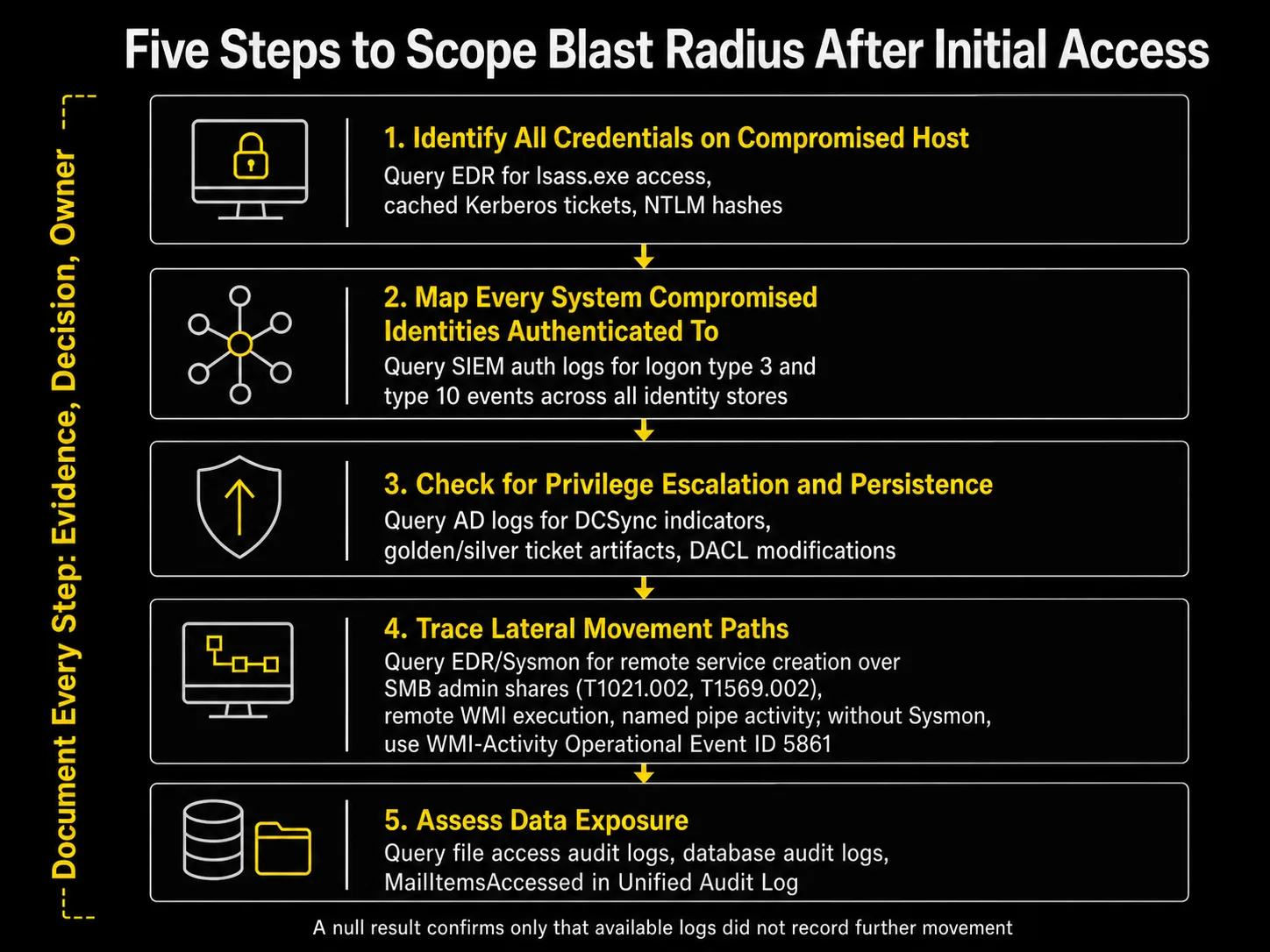
Scoping blast radius in cybersecurity follows five evidence-driven investigation steps, each recording the evidence, decision, and owner.
Architecture Controls That Limit Blast Radius Before an Incident
The five investigation steps become faster and the resulting blast radius smaller when effective architecture controls are in place. These controls reduce the scope of what an investigation must cover once an alert fires. In practice, these controls are often partially deployed or contain exceptions that create gaps an attacker can exploit.
Network Microsegmentation and Trust Boundaries
Network microsegmentation limits blast radius by restricting which systems can communicate, reducing the number of pivot points available after initial access. Frameworks like the NIST SP 800-207 Zero Trust Architecture and the CISA Zero Trust Maturity Model guide federal agencies and other organizations in implementing these controls.
However, a practical gap often emerges. In some converged OT and IT environments, for instance, segmentation exists between the zones, but investigation tooling does not span both. An analyst might confirm the IT blast radius is contained but have no visibility into whether the attacker crossed the trust boundary into the OT network. Without evidence from both sides of the boundary, the analyst cannot confirm that segmentation contained the attacker.
Tiered Administration and Least Privilege for Identity Blast Radius
Tiered administration in Active Directory directly reduces identity blast radius by separating high-privilege Tier 0 domain admin credentials from Tier 1 server admin and Tier 2 workstation admin credentials. If a Tier 2 credential from a compromised workstation is stolen, it cannot be used to log on to or administer Tier 0 systems such as domain controllers. It still authenticates through them, because every domain account gets its Kerberos tickets from a domain controller, so routine authentication to a DC is not on its own evidence of Tier 0 compromise.
The common exception is service account sprawl. In many enterprises, service accounts bypass tiered controls because they were created before the model was implemented or require cross-tier access for an application to function. These over-permissioned service principals often hold persistent access, making them the fastest path to an expanded blast radius when compromised. Tiering has to be enforced for every identity type, service accounts included, or it leaves that path open.
The Uninvestigated Alert Gap and Unscoped Blast Radius
Alert volume sets a hard limit on how much blast radius a team can scope. According to independent research by Ponemon Institute, commissioned by Crogl, organizations face an average of 4,330 daily alerts but investigate only 37% of them. For the 63% of alerts that go uninvestigated, the blast radius is unknown. If any of those alerts represent an actual compromise, the organization cannot scope the damage because no investigation occurred.
The constraint is investigation capacity. The five investigation steps described earlier take time and expertise. Each step requires querying multiple systems, often in different languages. The work stalls whenever access must be requested from another team. When the alert queue exceeds analyst capacity, blast radius scoping is the activity that gets deferred. An organization with strong segmentation but insufficient investigation capacity still has unscoped blast radius for every alert it cannot examine. That exposure goes unmeasured, so reports to security leaders and boards describe only the alerts that were investigated.
Read more: Security Teams Investigate Only 37% of Daily Alerts
Scoping Blast Radius Across Fragmented Systems at Scale
Scoping blast radius at scale requires querying authentication logs, EDR telemetry, Active Directory audit logs, and cloud records across multiple platforms, each with its own query language. Manually sustaining this effort across thousands of daily alerts is beyond what many security teams can manage.
Crogl works where the data lives. From a single investigative question, it generates a native query for each connected source, with no normalization step. The analyst can ask to see the generated queries before they run, and Crogl then executes them while showing the full evidence chain. Crogl runs on-prem, in a private cloud, or fully air-gapped. This allows blast radius investigation in classified or regulated environments without sending evidence outside the organization's boundary.
A Department of War deployment runs Crogl air-gapped and classified across three SIEMs and two SOARs, investigating more than 1,000 alerts per day against 100TB of data. Every investigation step is logged in the customer's own case system, creating the auditable record that compliance teams require. Crogl handles the investigation. The analyst makes the call.
Download Crogl to scope blast radius across your SIEMs, EDR platforms, and identity logs without building a normalization pipeline first.
Conclusion
The blast radius you can confirm is set by what you can investigate. Architecture controls like microsegmentation and tiered administration reduce the potential blast radius. The actual scope of an incident is known only when an analyst can query the evidence across every relevant system and identity store. A team that can scope compromise across fragmented sources for every alert that warrants investigation can base each containment decision on evidence. As environments add more identity providers, cloud services, and OT connections, the number of potential blast radius paths grows. The investigation capacity to scope those paths must grow with it.
Frequently asked questions
How do you scope blast radius across multiple SIEMs without normalizing data into a single schema?
Each SIEM stores events in its own format. Scoping blast radius requires querying each one for the same indicators, such as logon events from a compromised identity, using that SIEM's native query syntax. Normalization into a common schema risks dropping fields that matter for assessment, such as logon type. Federated search addresses this by generating a native query for each source from a single investigative question, preserving data fidelity.
What is the difference between blast radius containment and full incident remediation?
Containment stops an attacker from expanding access further by isolating compromised hosts, disabling credentials, and blocking lateral movement paths. Remediation removes the attacker's presence entirely by rebuilding systems, rotating all exposed credentials, and closing the initial access vector. Containment is a time-sensitive action scoped to the known blast radius, while remediation is a more thorough process that follows the initial containment.
Why does 90-day CloudTrail retention create invisible blast radius in hybrid cloud investigations?
AWS retains 90 days of management events by default in CloudTrail Event History. If an organization has not configured a trail to send logs to a SIEM or S3 bucket, events older than 90 days are gone. An attacker who established persistence 120 days ago leaves no evidence in the default view. The blast radius from that initial access becomes invisible because the evidence no longer exists.
How do you investigate blast radius in an air-gapped classified environment?
Air-gapped environments restrict data movement, so investigation tools must run inside the enclave. The analyst needs endpoint telemetry, authentication logs, and network data to be queryable from within the air gap. Platforms that require cloud connectivity cannot operate in these settings. Investigation platforms deployed on-premises within the classified boundary can query local SIEMs and EDR instances without moving any data outside the secure perimeter.
Which MITRE ATT&CK techniques are most relevant to blast radius expansion?
The Lateral Movement tactic (TA0008) contains the techniques most directly tied to blast radius expansion. Key techniques include Remote Services (T1021), such as RDP (T1021.001) and SMB/Windows Admin Shares (T1021.002), and Pass the Hash (T1550.002) and Pass the Ticket (T1550.003). Credential Access techniques like Kerberoasting (T1558.003) and OS Credential Dumping (T1003) are also critical, as they provide the credentials attackers use to expand their reach across the network.
How do you build an auditable record of blast radius investigation steps for compliance?
Each investigation step should record the evidence source queried, the query performed, the results returned, the analyst's interpretation, the decision made, and the owner of that decision. This record should be logged in the organization's own case management or ticketing system. This allows auditors to review the chain of reasoning without accessing the security tools directly.
What is the difference between blast radius and attack surface?
Attack surface is every entry point an attacker could use to get in. Blast radius is everything they can reach after they are in, bounded by the privilege of the credentials and network position they gain. Attack surface describes how an attacker gets in; blast radius describes how far they can go once inside.
How do you reduce blast radius?
Before an incident, reduce blast radius with tiered administration enforced for every identity type, service accounts included, microsegmentation, short credential lifetimes, and log retention long enough to cover dwell time. During an incident, scope with evidence first, then disable the exposed credentials and isolate the systems the evidence places in scope.