Did Someone Get In Before You Patched?
Monzy Merza
Founder & CEO, Crogl
When CISA adds a CVE to its Known Exploited Vulnerabilities (KEV) catalog, someone has already exploited it. Your first job is to find out whether that someone got into your network before you patched. That job is a compromise assessment: a hunt through your own logs for the attacker's tracks.
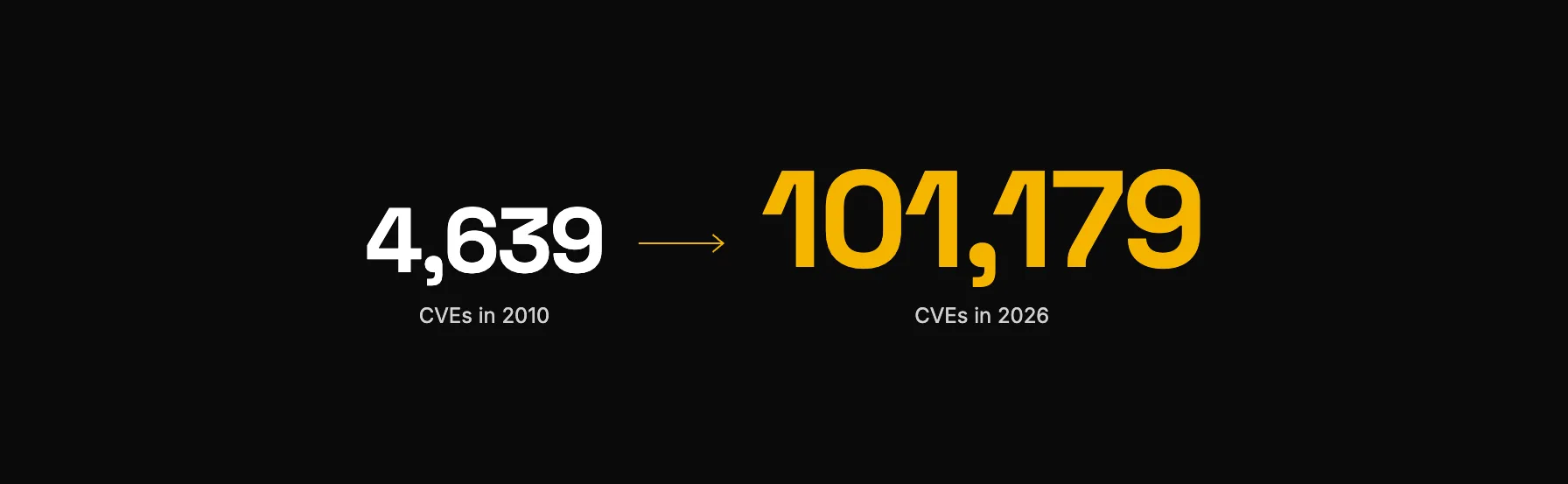
I worked on the vulnerability management team at a National Lab. My team ran scans, validated results, wrote reports, and handed them off. I am going to sound like an old timer. In 2010 things were better. 4,639 CVEs were published that year. Cloud wasn’t a thing and the IT admins were in the building across from us. Fast forward to 2026. CVE issuers have published over 100,000 CVEs this year.
CVE count has more than doubled
From January 1 through October 31, in 2025 and 2026, published CVEs went from 39,638 to 89,860, up 127%. CVE issuers published 17,060 in October 2026 alone, almost as many as in the previous seven Octobers combined. CVEs their issuers scored high or critical (CVSS 7.0 or above) went from 13,044 to 38,153, up 192%. CISA added 282 CVEs to KEV, up 32% from 214.
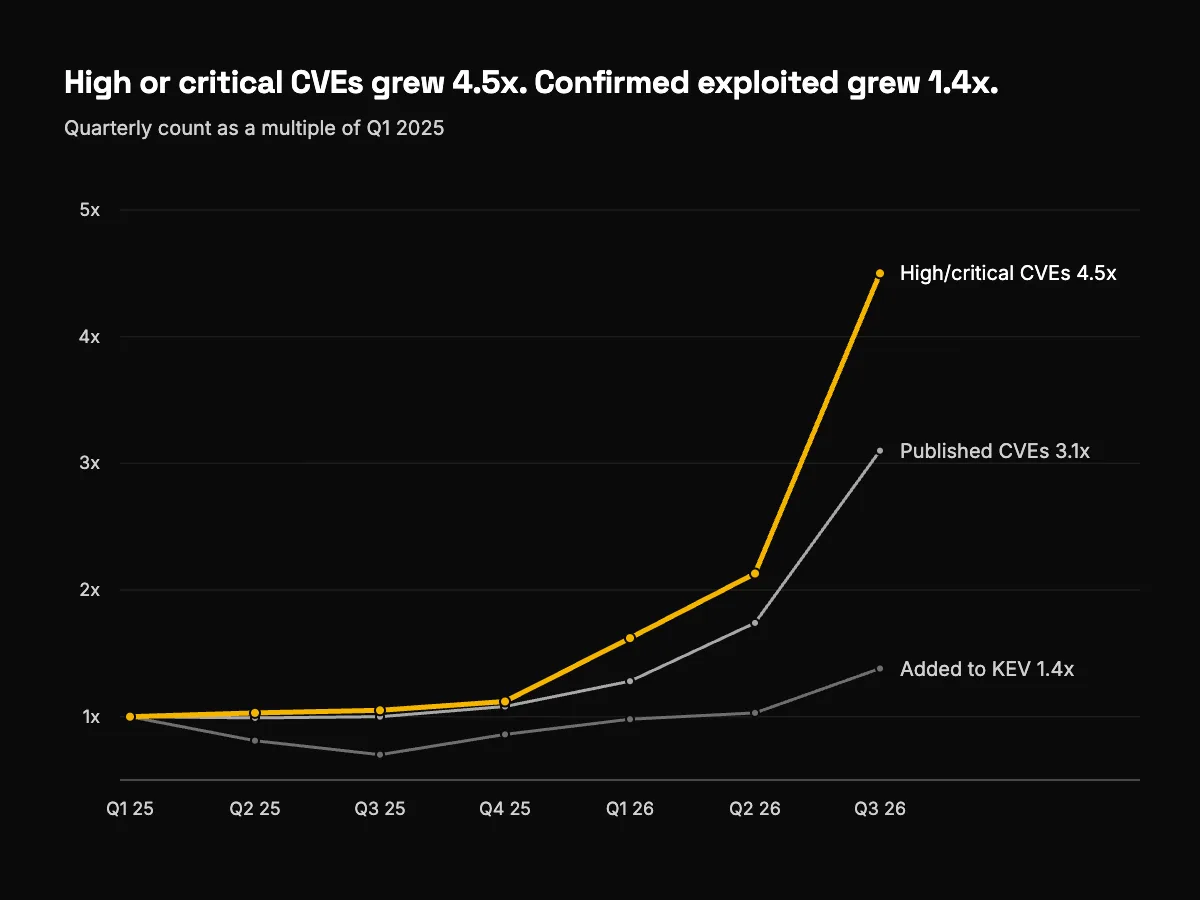
Source: Crogl analysis of the official CVE list (CVE.org) and CISA's KEV catalog, Q1 2025 to Q3 2026. High/critical = CVSS 7.0 or above, as scored by the CVE's issuer.
Attackers got there first
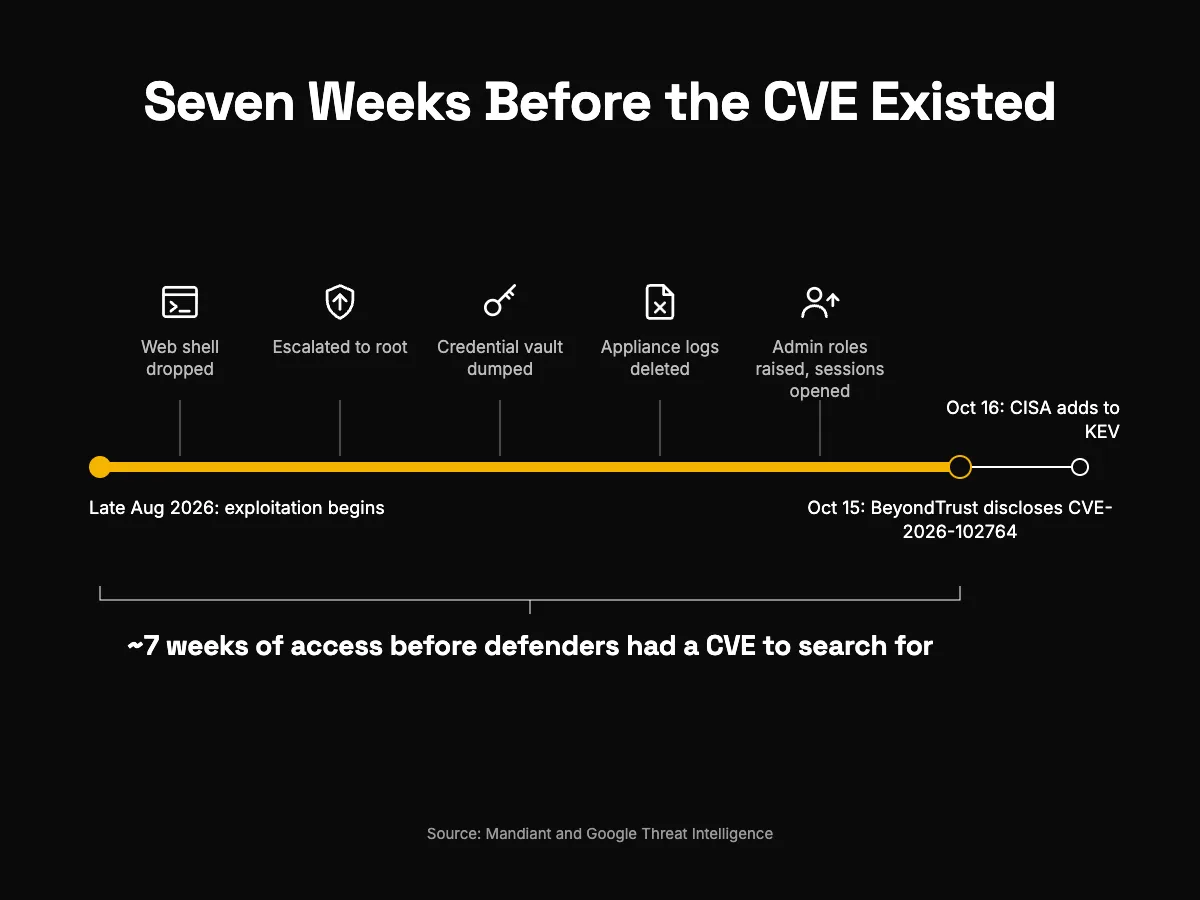
Of the 282 CVEs CISA added to KEV through October, it added 79 (28%) within a day of the CVE's publication, up from 23% in 2025. For those, CISA had evidence of exploitation within a day of the CVE’s publication. Sometimes the attacker was working well before you had a CVE number to search for.
For example, CVE-2026-102764 in BeyondTrust Remote Support: Mandiant observed a suspected China-nexus espionage group exploiting it from late August 2026. BeyondTrust disclosed the flaw on October 15, and CISA added it to KEV the next day. The group had about seven weeks. Per Mandiant, the group dropped a web shell, escalated to root, and dumped the appliance's credential vault. Then the group deleted the appliance's logs, raised an administrator account's roles, and opened remote support sessions into internal endpoints. Mandiant's guidance: "Any appliance that was reachable from the internet on a vulnerable version during the exploitation window should be treated as potentially compromised until it has been reviewed."
What is vulnerability operations?
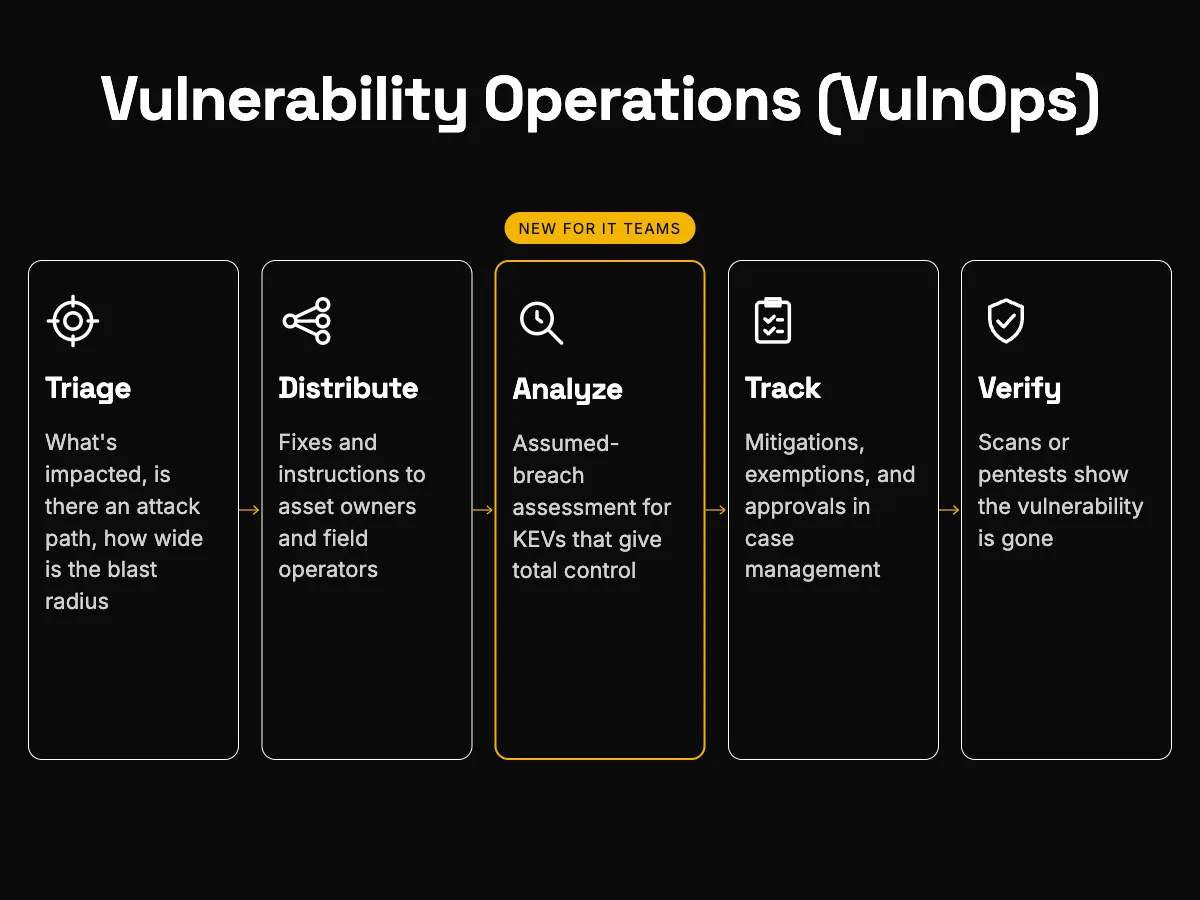
Vulnerability operations, or VulnOps, is the work a security team does to address a vulnerability that applies to its environment:
- Triage. What’s impacted? Is it relevant? Is there an attack path? Then rank what to fix first. Find the blast radius. Identify what other systems the fix may impact, for example, after an API update or an auth mechanism change.
- Distribute. Identify the asset and app owners. Send fixes, caveats, and instructions to the teams that own those assets. Sometimes those teams include remote operators in the field who may not know anything about the application or system.
- Analyze. Check whether an attacker exploited the vulnerability before you fixed it. For US federal civilian agencies, this is a mandate: if the vulnerability is a KEV entry that gives the attacker total control, CISA’s Binding Operational Directive (BOD) 26-04 requires the agency to show evidence that it ran an assumed breach assessment, which is the compromise assessment I described above. That requirement is new for most IT teams, because patching historically didn't include forensics or security analysis. It also adds pressure on your security team.
- Track. Communicate and track the mitigations and fixes. For your team, that can mean a lot of manual work: entering updates in case management systems and chasing exemptions or approvals.
- Verify. Confirm the fix. Run scans or pentests to show the vulnerability is gone.
BOD 26-04 puts evidence before the patch
I spoke to some colleagues in the public sector about CISA's BOD 26-04. The directive applies to US federal civilian agencies. It sets their remediation deadlines from four inputs: KEV status, whether an attacker can automate the exploit, how much control the attacker gains, and the asset's exposure.
For KEV entries that give an attacker total control, the directive also requires forensic triage. For those agencies, that requirement makes step 3, Analyze, critical. CISA's implementation guidance tells agencies to collect evidence before they patch, because "patching may jeopardize the availability of artifacts," and then to check whether the indicators of compromise "exist elsewhere in the environment."
How to run a compromise assessment on a KEV entry
Crogl helps with all five steps above. Here I’ll focus on step 3, Analyze, because it’s new for most IT teams and adds work for your security team. Take the BeyondTrust vulnerability from earlier, CVE-2026-102764. You run the assessment in Crogl as a threat hunt.
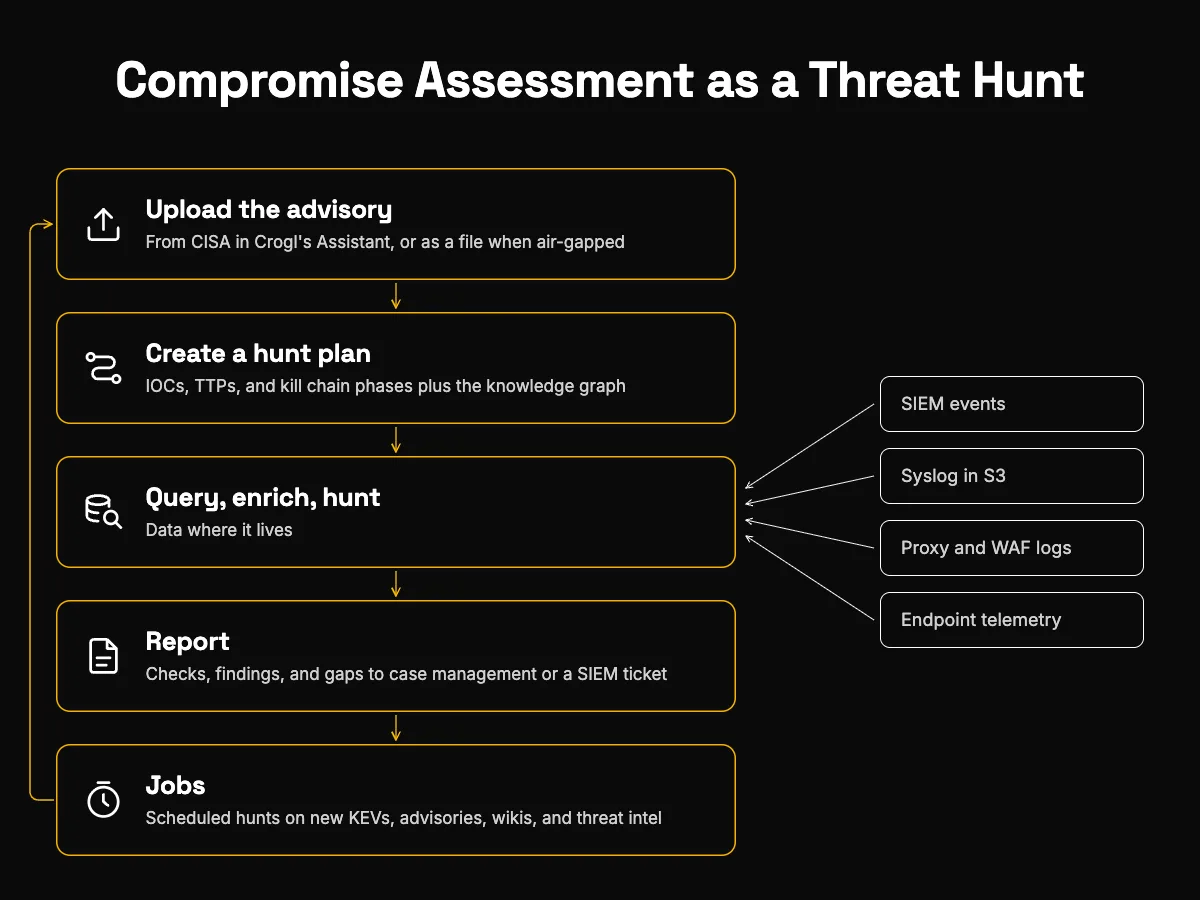
- Upload the advisory. In Crogl’s Assistant, you pull the advisory from the CISA site. In an air-gapped environment, you upload the advisory file in the Crogl UI.
- Create a hunt plan. Crogl extracts any IOCs, TTPs, and kill chain phases from the advisory. Often there is little to extract. KEV entries rarely carry indicators: of the 282 entries CISA added to KEV through October, only 2 mention indicators in their notes. So Crogl’s hunt skill combines the advisory with Crogl’s knowledge graph (KG) to build the hunt plan. The KG is critical here: because of it, you don’t have to normalize your data first.
- Query, enrich, hunt across your data. Crogl searches your data where it lives. For this vulnerability, that means syslog the appliance forwarded before the attacker deleted its local logs, syslog data in S3 buckets, events in your SIEM, reverse proxy and WAF logs, and endpoint telemetry.
- Report. Crogl writes a final report with every check it ran, the results, the findings, and any gaps in the analysis. And, wait for it … if you want, Crogl can add all of it to your case management system or SIEM ticket. Documentation done.
- Jobs. Wait, there’s more. You can automate this flow with Crogl’s job scheduler. Crogl watches CISA KEVs and advisories, your internal wikis, or your threat intel platforms, and hunts automatically on criteria you define.
Get started with the Free Crogl download
We built Crogl because we want to serve the community. Useful and governed SI should be accessible to you whenever, wherever, and however you want it, air-gapped included.
Pick one KEV entry CISA added this month. Download Crogl, look back 90 days in your own logs, and read what Crogl found and what it couldn't check. Then read Table 1 of CISA's BOD 26-04. If your organization is a federal civilian agency, that table is the clock your team runs against. If it isn't, use it to size the clock your team would run against.
Related reading
- 80,000 Machines, Every Three Days, on running a three-day patch clock at scale
- When Every Day Is Patch Tuesday, on why the monthly patch cycle no longer fits
- A Practical Vulnerability Prioritization Framework for 2026, on combining KEV, EPSS, and SSVC with your own context
Sources
- CVE Program, official CVE list, counted by Crogl November 1, 2026 (published records only)
- CISA, Known Exploited Vulnerabilities catalog, version 2026.10.30
- NIST, NVD operations update
- CISA, BOD 26-04: Prioritizing Security Updates Based on Risk (June 10, 2026), and its Implementation Guidance (updated August 25, 2026)
- Mandiant and Google Threat Intelligence, ARMORY CASTLE exploitation of BeyondTrust Remote Support
Frequently asked questions
What is the CISA KEV catalog?
CISA's Known Exploited Vulnerabilities (KEV) catalog lists CVEs that attackers have exploited in the wild. CISA added 282 entries from January 1 through October 31, 2026, up from 214 in the same window of 2025. BOD 26-04 uses KEV status as one input to remediation deadlines for federal civilian agencies.
What does BOD 26-04 require?
BOD 26-04 sets remediation deadlines for federal civilian agencies from four inputs: KEV status, whether an attacker can automate the exploit, how much control the attacker gains, and the asset's exposure. For KEV entries that give an attacker total control, the directive requires those agencies to run forensic triage, and CISA's guidance says to collect evidence before patching.
How do I check whether someone exploited a KEV vulnerability before I patched?
Run a compromise assessment. Look back past the disclosure date, match the published indicators, hunt for the attacker's behavior, and query the logs that survived outside the affected system. List every search you couldn't run, so anyone reading the result knows its gaps. Crogl runs these steps as a threat hunt across your data where it lives, and its report lists every search it couldn’t run.
How far back should a compromise assessment look?
Far enough to cover exploitation before disclosure. For CVE-2026-102764, exploitation began in late August, about seven weeks before disclosure, so a 90-day lookback from the KEV date covers it. Mandiant advises treating any appliance that was reachable from the internet on a vulnerable version during that window as potentially compromised until it has been reviewed.
Can you run a compromise assessment in an air-gapped environment?
Yes. Crogl runs entirely inside your environment, including air-gapped networks. You upload the CISA advisory as a file, and Crogl hunts across your data without it leaving your boundary. Crogl's free download includes air-gapped deployment, so you can run the same 90-day lookback on a KEV entry inside the enclave.