Threat Hunting Frameworks: Why Most Programs Stall at Data Collection
Mike Dupuis
Marketing, Crogl
 PEAK, TaHiTI, Sqrrl, and MITRE ATT&CK plan hunts well. Execution breaks when the evidence lives in three systems.
Key Takeaways
- Threat hunting frameworks are sound methodologies, but they stall in practice because they assume efficient access to data that is often fragmented across multiple systems.
- The execute phase of any hunt becomes a manual data collection exercise when hunters must write separate queries in different languages for each SIEM, EDR, and data lake.
- Mature teams often adapt by narrowing hunt scope or reducing cadence, which means the framework is no longer operating as designed and coverage gaps persist.
- Federated search offers an alternative to costly data normalization projects by querying data where it lives, in its native format, which reduces the time hunters spend translating queries and moving data.
- A defensible hunt requires an auditable trail of every query, pivot, and decision, logged automatically during the investigation so compliance reviews do not depend on the hunter's memory.
A hunt team builds a sound hypothesis around lateral movement via PsExec across a hybrid environment. The MITRE technique mapping is clean, and the team knows what telemetry they need. But the EDR logs sit in one platform with its own query syntax, and the Windows event logs are in a SIEM with a different schema. The firewall data lives in a third system accessible only through a rate-limited API. The team spends the first three hours of a four-hour hunt window getting data into a comparable format. By the time they can correlate, the hunt window closes and the hypothesis goes unresolved. Data collection consumed three of the four hours, and the analysis never got the time it needed.
This scenario is the daily reality for security operations teams in complex enterprise and government environments. Threat hunting frameworks are well-designed methodologies, but they operate on an implicit assumption that most SOCs cannot meet: that analysts can efficiently access and reason over all relevant evidence. When evidence lives in three or more systems with different schemas and query languages, the execute phase of every framework collapses into a manual integration exercise.
This guide compares four major threat hunting frameworks, diagnoses where they break in practice, and offers guidance on hunting across fragmented sources without normalizing everything first.
For the tooling side of the same problem, see Threat Hunting Tools: A 2026 Buyer's Guide .
What a Threat Hunting Framework Does
A threat hunting framework is a structured methodology that guides how a security team generates hypotheses, collects and analyzes evidence, and documents findings. While specific phases differ between models, any effective framework must serve three core functions:
- Hypothesis Management: It provides a repeatable process for deciding what to look for and why. This could be based on threat intelligence, anomaly detection, or mapping gaps in MITRE ATT&CK coverage.
- Evidence Collection and Analysis: It defines the steps for gathering data from relevant sources, reasoning over the evidence, and pivoting between data sets to test the hypothesis.
- Finding Disposition: It establishes a clear path for what to do with results. This includes escalating confirmed threats, converting findings into new automated detections, or documenting a disproven hypothesis for the audit record.
A framework also differs from a playbook. A playbook executes a known, linear response to an anticipated condition, like isolating a host when a specific malware alert fires. A framework supports reasoning through unfamiliar evidence and following investigative paths that exceed predefined logic. Published frameworks generally handle hypothesis generation well.
Four Threat Hunting Frameworks Worth Knowing
No single threat hunting framework fits every environment. The right choice depends on a team's maturity, data access model, and whether the organization prioritizes hypothesis rigor, intelligence integration, or operational repeatability. The following four models provide different starting points for building a program.
The MITRE ATT&CK Framework for Threat Hunting
MITRE ATT&CK is a globally accessible knowledge base of adversary tactics and techniques based on real-world observations. Although ATT&CK prescribes no hunting process of its own, it serves as the most common foundation for a threat hunting framework. Teams use it for coverage mapping, identifying which adversary techniques their current detections cover and, more importantly, which ones represent visibility gaps that are prime candidates for a hunt. Execution is where it stops short. ATT&CK tells teams what to look for, but it leaves the collection and analysis of evidence across fragmented systems to them. PEAK, TaHiTI, and many other frameworks reference ATT&CK as a primary input for scoping hunts.
The PEAK Threat Hunting Framework: Prepare, Execute, Act with Knowledge
Developed by David Bianco at Splunk's SURGe team, with Ryan Fetterman, PEAK organizes hunting into a three-phase loop: Prepare, Execute, and Act with Knowledge. Its key contribution is defining three distinct hunt types: hypothesis-driven, baseline, and model-assisted. This gives teams a structured path to move beyond purely hypothesis-based work and into hunts that establish normal activity or use machine learning models to find outliers. Where PEAK runs into trouble is the Execute phase, which assumes the hunter can efficiently query relevant data sources, a step that becomes the main bottleneck in any multi-SIEM environment.
The TaHiTI Threat Hunting Framework: Targeted Hunting Integrating Threat Intelligence
The TaHiTI framework was developed jointly by Dutch financial institutions, including de Volksbank, Rabobank, ING, and ABN AMRO, with the methodology document hosted by Betaalvereniging. Its core contribution is integrating threat intelligence throughout the hunt, from trigger to hypothesis to findings. Hunt triggers can come from several sources, including MITRE ATT&CK, which gives teams a disciplined way to scope hunts without assuming every investigation begins with a finished intelligence lead. That makes the model particularly relevant for financial services and other sectors that want a formal hunt methodology tied closely to known adversary behavior. The tradeoff is that it depends on a working threat intelligence function to keep the hunt backlog current.
The Sqrrl Threat Hunting Loop and Hunting Maturity Model
Published by Sqrrl in 2015, the Hunting Loop follows a four-stage cycle: hypothesis generation, tool-enabled investigation, pattern and TTP discovery, and automated analytics. What sets it apart is the explicit link between hunt findings and detection engineering: successful hunts feed the creation of new automated analytics, so a confirmed finding can become a standing detection. The accompanying Hunting Maturity Model (HMM), developed by David Bianco while he was at Sqrrl, remains a widely used benchmark for assessing hunt program growth. Used carelessly, the maturity model becomes a checkbox exercise in which level advancement turns into the goal and the quality and impact of findings go unexamined.
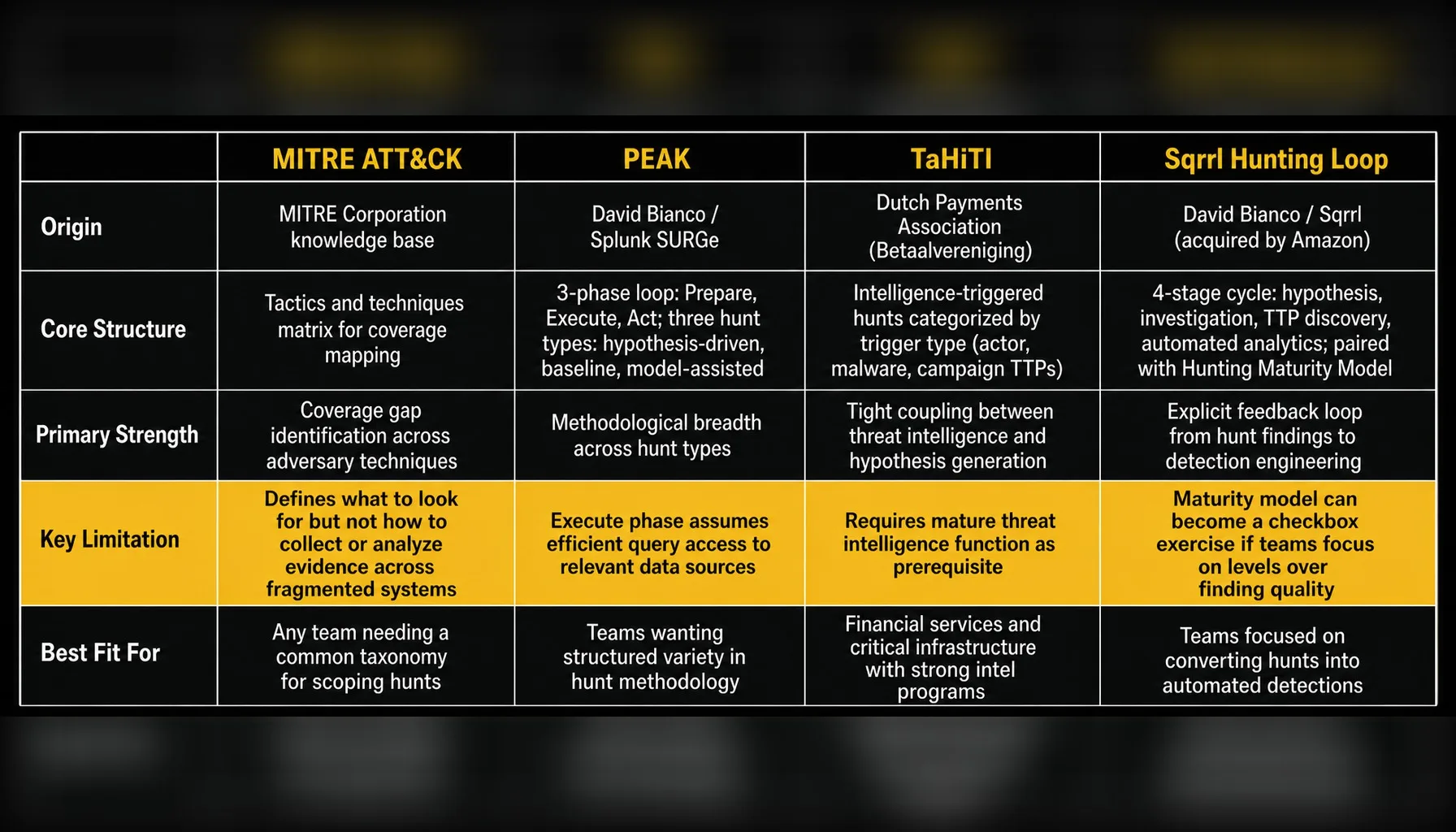
Each threat hunting framework has a distinct strength and a shared limitation around data access.
Where Threat Hunting Frameworks Stall: The Data Collection Bottleneck
Every framework described above assumes the hunter can reach the data they need within a reasonable time. In practice, this assumption breaks down in any environment running more than one SIEM, a separate EDR console, a ticketing system, and a data lake. The execute phase turns into translation work: the hunter writes the same hypothesis as three or four different queries, waits for results from cold storage, and correlates findings across tabs by hand.
Consider a hunt for a threat actor using LOLBins (living-off-the-land binaries) to stage payloads before moving laterally. The hypothesis maps certutil.exe download and decode activity to ATT&CK T1105 (Ingress Tool Transfer) and T1140 (Deobfuscate/Decode Files or Information), and mshta.exe execution to T1218.005 (Mshta). A hunter needs to check Sysmon Event ID 1 process creation logs in Splunk, cross-reference with CrowdStrike Falcon for endpoint detections, and verify lateral movement paths in Microsoft Sentinel. In this illustrative case, a manual investigation can take 40 minutes or more even with immediate data access. When access is gated or slow, the investigation stalls entirely.
Why Multi-SIEM Environments Break the Execute Phase
The LOLBins scenario makes the friction tangible. The hunter writes an SPL query in Splunk to look for suspicious executions of mshta.exe or certutil.exe . Then, they pivot to Microsoft Sentinel and write a different query in KQL to check for the same binaries in a different log format. Finally, they open CrowdStrike's event search to look for related detections. Each query returns results in a different structure with different field names. The hunter is now manually correlating timestamps, hostnames, and user accounts across three browser tabs, performing stack counting and frequency analysis in their head. Three systems mean three query languages for a single hypothesis, and that translation and correlation work repeats for every artifact the hunter needs to verify.
If any of these systems stores relevant logs in cold storage, the query latency adds minutes or even hours to the investigation. Even with a strong hypothesis and a skilled hunter, the cost of reaching evidence across fragmented systems sets the pace of the hunt. Normalizing every source into one schema is the usual proposed fix, but those projects often stall on semantic disagreement as well as field mapping. Two SIEMs may both have a field called source_ip , but one populates it with the NAT address and the other with the internal RFC 1918 address. No normalization layer resolves that without analyst judgment. Crogl's patent for analyzing non-normalized data covers one approach to this class of problem.
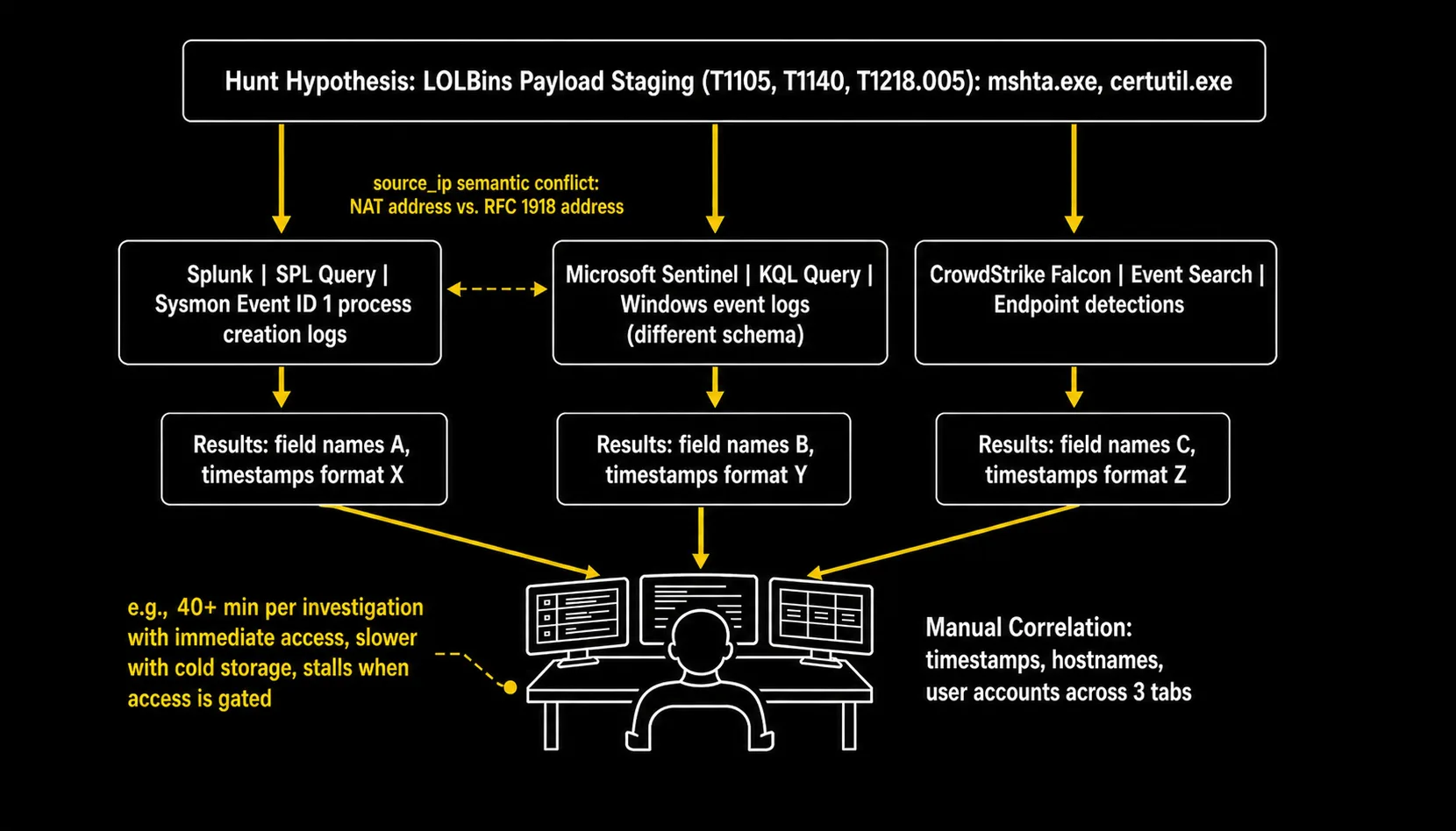
The execute phase of a threat hunting framework fragments across systems, schemas, and query languages.
What Teams Do When Hunts Take Too Long
When data collection consistently consumes most of the hunt session, teams make rational adaptations that quietly degrade the program. There are three common patterns:
- They narrow scope. Hunts are limited to the one SIEM or EDR that is fastest to query, leaving other data sources unexamined and creating blind spots.
- They reduce cadence. Weekly hunts become monthly or quarterly. Hypotheses pile up in the backlog, but the team lacks the capacity to test them.
- They limit methodology. Teams stick to narrower, hypothesis-driven hunts and abandon more complex baseline or model-assisted hunts that require broader data sets.
Over time, these adaptations pull the hunt program away from its design, because hunters cannot reach evidence across systems at the pace the framework assumes. A similar constraint shows up in alert handling: independent research by Ponemon Institute, commissioned by Crogl, found that organizations average 4,330 daily alerts but investigate only 37% . The same capacity ceiling that limits alert triage also limits threat hunting.
Hunting Across Sources Without Normalizing Everything First
The conventional solution to the data collection bottleneck is to normalize all security data into a common schema within a central data lake. While logical on paper, this approach creates its own significant problems. Normalization pipelines take months or years to build and require constant maintenance as log sources evolve. They also strip away source-specific details that hunters need, such as unique fields in Sysmon logs or proprietary detection metadata from an EDR.
Federated search takes a different approach. It queries each data source where it already lives, using that system's native format, and returns only the relevant evidence to a single investigation. The data stays in place and keeps its original schema.
When the team revisits the LOLBins hunt with federated search, the workflow changes. The hunter issues one investigation that simultaneously queries Splunk in SPL, Sentinel in KQL, and CrowdStrike via its API. The investigation platform handles the query translation and returns a unified set of findings. Correlation happens at the entity level, connecting common artifacts like a hostname, user account, IP address, or process hash across the disparate data sets. The hunter's time goes to analyzing the correlated evidence. If the results tie certutil.exe and mshta.exe executions on two hosts to the same unexpected account, the hunter escalates the case to incident response. If the activity traces back to sanctioned administration, the hunter closes the hypothesis and records the negative findings for the audit trail.
Documenting Hunt Findings for Audit and Compliance
Frameworks generally include a documentation step, but teams often treat it as an afterthought. In regulated environments like defense, energy, and financial services, hunt findings must be defensible. An auditor or compliance officer needs to see exactly what was searched, what was found, what was ruled out, and who made the final disposition decision.
A complete, auditable hunt trail contains:
- The initial hypothesis and its intelligence source.
- Every query issued to every system.
- The evidence returned from each query.
- The analyst's reasoning for the final disposition (escalate, close, or convert to detection).
- The timestamp and identity of the person who made the decision.
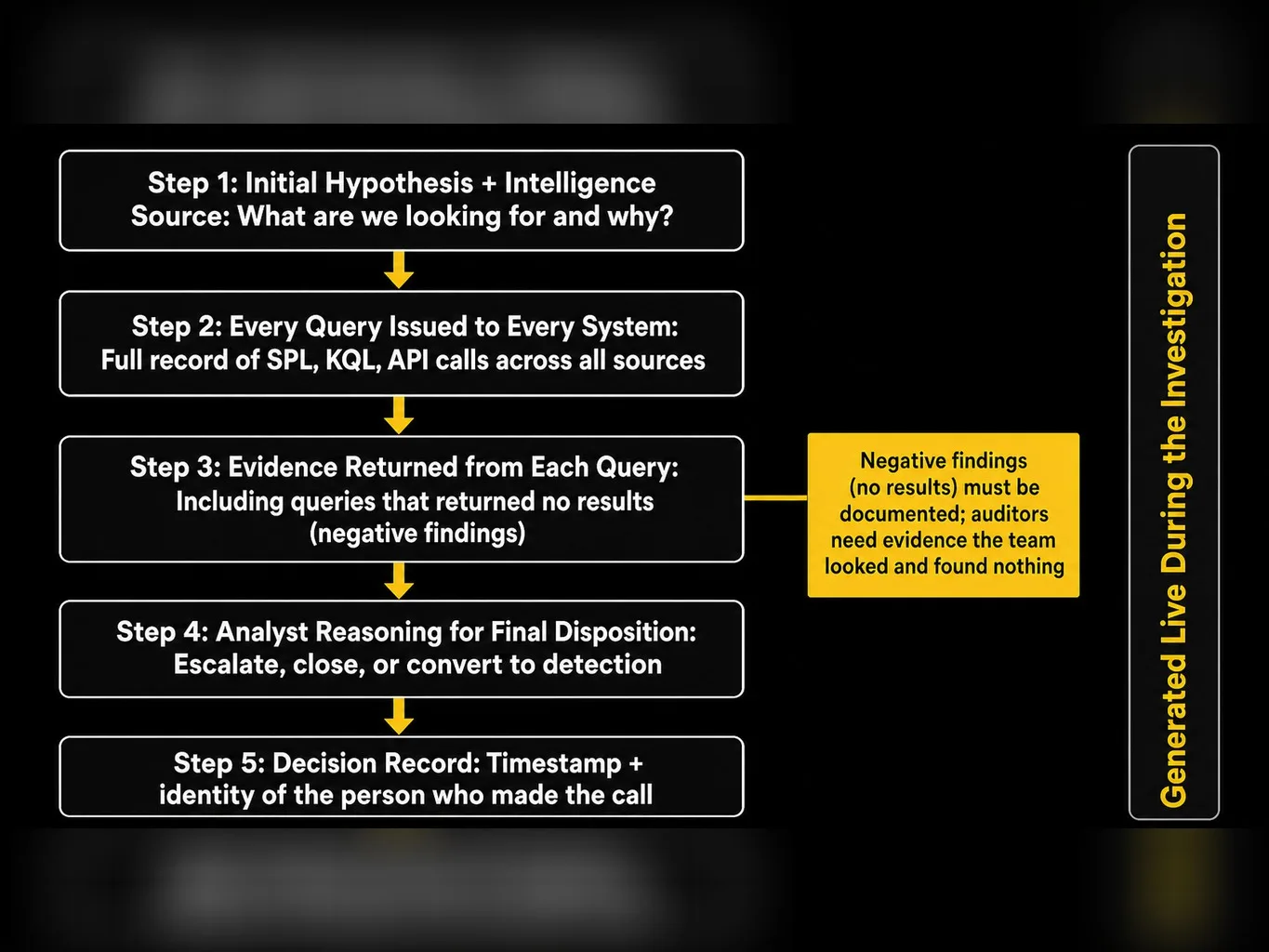
A defensible threat hunting framework requires audit trails generated during the investigation.
Many teams fail to produce this trail because documentation happens after the hunt, in a separate system like a wiki or ticketing tool. It depends on the hunter's memory and willingness to write up findings after spending the session fighting with data access. Hunt documentation that records only the conclusion and omits negative findings, such as queries that returned no results, can fail review because auditors need evidence that the team looked and found nothing. For an investigation to be defensible, the audit trail must be generated during the investigation itself, as each query and pivot happens. Organizations subject to recurring compliance reviews should evaluate how their hunt documentation maps to audit readiness requirements.
How Crogl Supports Threat Hunting Across Fragmented Environments
Two constraints recur throughout this guide: fragmented evidence and manual documentation. Crogl is designed to address both constraints.
Crogl's federated search queries SIEM, EDR, ticketing, and data lake systems in their native formats, without requiring schema normalization. During the execute phase, the hunter states the hypothesis once and Crogl handles the translation into each system's query language. For air-gapped and classified environments where cloud-native hunting tools do not apply, Crogl offers a sovereign deployment model that runs entirely on-premises or in a private cloud. Customers can bring their own model, and neither customer data nor models leave the controlled environment.
Every query, pivot, and finding is logged in Crogl and automatically pushed to the customer's own case management or ticketing system. The record that auditors and compliance teams review already exists when the hunt ends. A public energy utility, for example, uses Crogl to run hunts for threats flagged in CRISP advisories across its Microsoft Sentinel, CrowdStrike, and Nozomi OT monitoring stack. Investigations that previously took over 24 hours of manual correlation now complete in under an hour. A Department of War deployment runs air-gapped and classified across three SIEMs, two SOARs, and 100TB of data, investigating more than 1,000 alerts per day.
Crogl handles the investigation. The analyst makes the call.
Download Crogl to run federated hunts across your SIEM, EDR, and data lake without normalizing the data first.
Before You Pick a Framework
Choosing between PEAK, TaHiTI, Sqrrl, and ATT&CK settles how you plan hunts. Your data access model settles how many of them you finish. Before evaluating another threat hunting framework, measure one ratio: hours your team spends collecting evidence versus hours spent analyzing it. That number says more about program health than any maturity level.
Download Crogl and run your next hunt across your SIEM, EDR, and data lake from one investigation, with the audit trail written as you go.
Frequently asked questions
What is the difference between the PEAK threat hunting framework and the Sqrrl Hunting Loop?
PEAK, developed by David Bianco on Splunk's SURGe team, defines three hunt types (hypothesis-driven, baseline, and model-assisted) within a Prepare, Execute, and Act with Knowledge loop. The Sqrrl Hunting Loop runs a four-stage cycle (hypothesis, investigation, TTP discovery, and automated analytics) and pairs with the Hunting Maturity Model for benchmarking program growth. PEAK covers more hunt types. The Sqrrl model ties findings more directly to detection engineering.
How do you build a threat hunting framework for an air-gapped or classified environment?
The core methodology of a framework like PEAK or TaHiTI does not change, but the tooling and data access model must support on-prem or fully air-gapped deployment. Cloud-native hunting platforms and SaaS-based threat intelligence feeds are unavailable. Teams require locally deployed query tools, on-prem threat intelligence ingestion, and investigation platforms that run entirely within the security boundary. Every hunt artifact, including queries and evidence, must remain inside the classified enclave.
What does a realistic hunt cadence look like for a 10-person SOC?
A typical 10-person SOC does not have a dedicated hunter. More often, one analyst rotates into hunting. With efficient data access, that analyst can typically complete one or two structured hunts per month. When every hunt requires manual queries across multiple systems, cadence often falls to one or fewer. The constraint is the time it takes to reach and correlate evidence across fragmented sources.
How do you run threat hunts across OT and IT environments simultaneously?
OT environments often lack standard endpoint telemetry, so hunters rely on network-level data from OT monitoring platforms like Nozomi Networks, combined with IT-side SIEM and EDR data. The hypothesis must account for these telemetry types, using process execution data from IT endpoints and network flow or protocol anomaly data from OT segments. Correlation happens at shared entities like IP addresses, DNS queries, and user accounts that cross the IT/OT boundary.
What metrics should a SOC director track to evaluate threat hunting effectiveness?
Track findings per hypothesis to see how often hunts produce actionable evidence, and new detections generated to measure how hunts improve automation. Monitor coverage delta, which shows how many MITRE ATT&CK techniques moved from unmonitored to monitored after a hunt cycle. Track time to evidence for each hunt and watch whether it falls as data access improves. Report these measures every hunt cycle so the trend is visible.