The Right Pivot, at the Right Moment: Crogl's Knowledge Graph
Lipyeow Lim
Head of AI, Crogl

Security investigations rarely fail because the data does not exist. They fail because the analyst cannot quickly see how the data connects.
An alert in one system may identify a person by email address. The identity platform may use a user principal name. A ticketing system may store the same person as a reporter. An endpoint platform, cloud service, or custom internal tool may use another identifier entirely.
The facts are present. The challenge is knowing which system to query next, which field carries the same identity, and whether the apparent connection is meaningful.
Today, that knowledge often lives in the heads of a few experienced analysts. It is distributed across schema notes, detection logic, scripts, runbooks, and hard-won operational memory. It does not reliably scale to every analyst, every shift, or every autonomous investigation.
Crogl's Knowledge Graph turns that operational memory into something persistent and usable.
Watch Lipyeow Lim, Head of AI at Crogl, explain how it works:
It remembers what your analysts had to memorize
The Crogl Knowledge Graph learns relationships between fields across the systems connected to Crogl. Its first job is deliberately concrete: recognize when fields in different sources carry the same identity.
For example, Crogl may learn that:
- a Splunk
recipient_emailcorresponds to an identity provider'suserPrincipalName; - a Jira
reporter.emailAddressis another representation of that person; - a file hash, endpoint identifier, cloud principal, or Windows SID appears in more than one connected system.
This is not a threat-intelligence graph, a replacement SIEM, or another search interface that an analyst needs to learn. It is operational memory for Crogl's investigating agent.
When an investigation touches a known field, Crogl can surface the related fields and systems at that moment. The agent receives the next useful pivot as part of its normal workflow.
Crogl does not merely find data. It remembers where the investigation can go next.
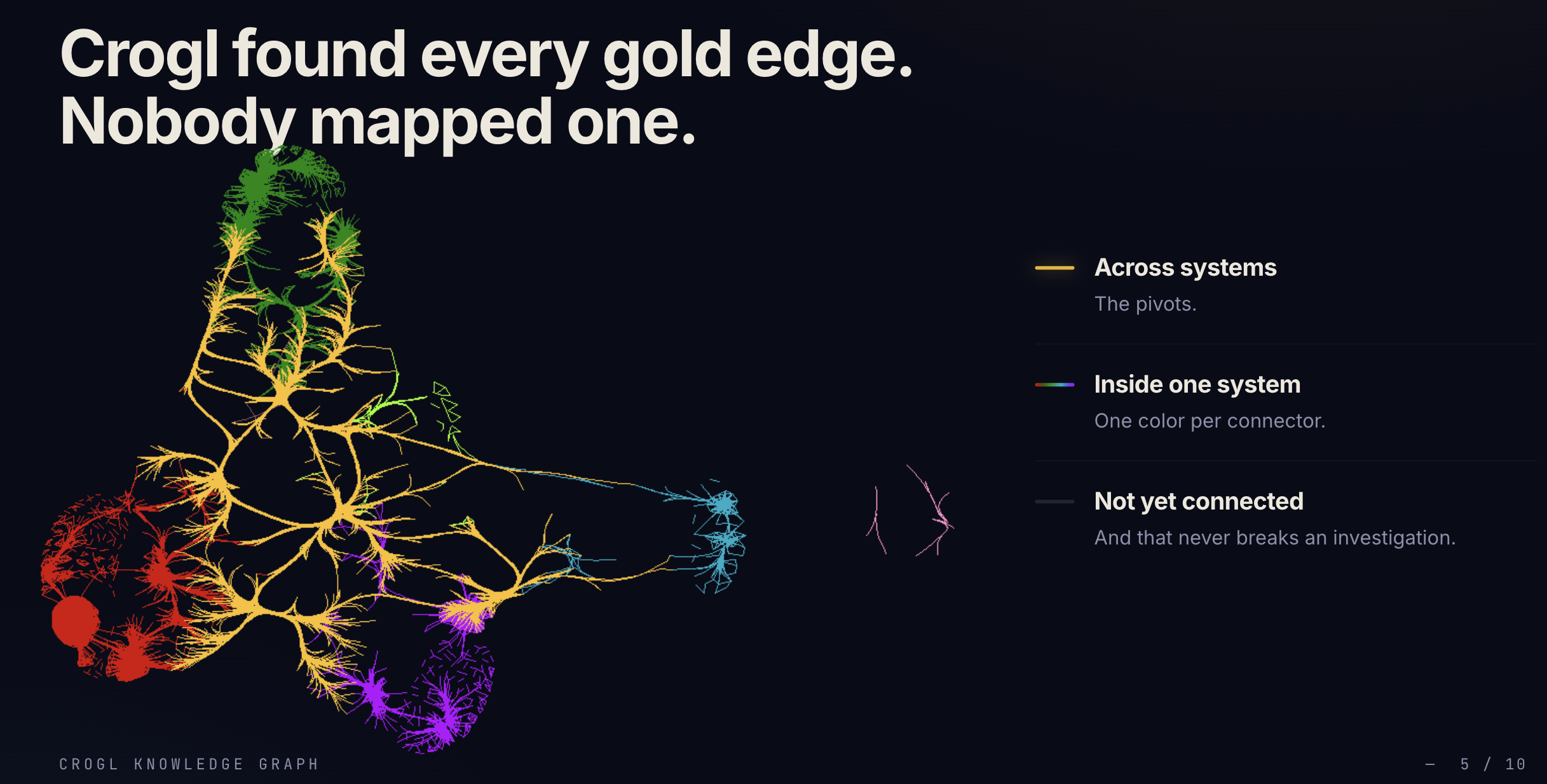
In a rendered graph from a Crogl operating environment, the gold edges are those learned cross-connector relationships. They are not a manually maintained integration map. The other colored edges describe relationships inside their respective connectors, and not every system needs to be connected to every other system before the graph becomes useful. Crogl learns useful relationships as it observes evidence.
Your data strategy, not ours
Organizations have different and valid approaches to security data.
Some centralize and normalize a high-value core of telemetry in a SIEM or data lake. Others intentionally keep data in the systems that produce it, because centralization can introduce cost, latency, duplicated data, loss of source context, or governance constraints. Most organizations operate somewhere between those poles.
Crogl does not require a customer to choose one architecture before it can investigate across the environment.
Lake-first
If an organization has a normalized core, Crogl can work alongside it and help connect investigation paths that extend beyond the lake's current coverage. That may include identity systems, ticketing platforms, SaaS applications, cloud APIs, proprietary tooling, and newly introduced sources.
Source-first
If an organization keeps data in native systems, Crogl can learn relationships through those systems' connectors and native query interfaces. There is no requirement to centralize the full operational datasets before cross-system investigation can begin.
The shared outcome is the same: an analyst or agent can follow the right pivot at the right moment.
Normalization is optional. Cross-system investigation is not.
The mechanism behind that claim is federated search, which explains what Crogl can query, what it requires, and where the data stays.
How Crogl learns relationships
Crogl builds the Knowledge Graph in the background through a practical cycle:
- Connect. Crogl works through connectors for the security and business systems a customer already operates.
- Observe. It explores available catalogs and captures representative samples needed to understand fields and identities.
- Validate. Crogl looks for real value overlap in the specific fields that may be related, then evaluates whether the relationship is semantically meaningful.
- Remember. Confirmed relationships and their supporting evidence become persistent knowledge for future investigations.
The data itself remains in the operational systems that own it. Crogl retains representative samples locally as evidence for learned relationships; it does not require a full copy of the customer's operational estate.
This approach also makes the graph useful in an environment that is never finished. New systems arrive, custom fields appear, schemas change, and security teams continually adjust the data they prioritize. Crogl can learn as the environment evolves rather than waiting for complete normalization coverage.
Evidence must prove
Cross-system correlation has to earn trust. A shared value alone is not always meaningful, and an AI system should not be allowed to invent connections.
Crogl treats an observed relationship as a claim that must be supported by evidence. It requires real, non-junk value overlap in the specific fields under consideration. Candidate relationships can be judged for semantic meaning, but server-side rules determine whether a relationship is accepted. The resulting relationship retains supporting evidence and an auditable history.
The principle is simple:
The model can propose. Evidence must prove.
Crogl also keeps the knowledge graph out of the critical path of an investigation. A missing or unavailable hint does not interrupt the underlying query or investigation. It simply means Crogl has one less piece of context to offer on that turn.
Five sources. One narrative.
The value of the graph is not a visualization of nodes and edges. The value is what happens when an investigation gets better.
Consider an investigation that begins with a Jira ticket and its
reporter.emailAddress. The graph can identify the related
userPrincipalName in an identity provider and recipient_email in Splunk,
then guide the investigating agent to the relevant next systems. The analyst
still receives the evidence and makes the final call.
At that point, the graph's value is not the graph itself. It is an evidence- backed investigation outcome: cloud instance context, VPC Flow Logs, CloudTrail activity, endpoint coverage, and threat intelligence can become one narrative, one recommendation, and a report an analyst can review, challenge, and act on.
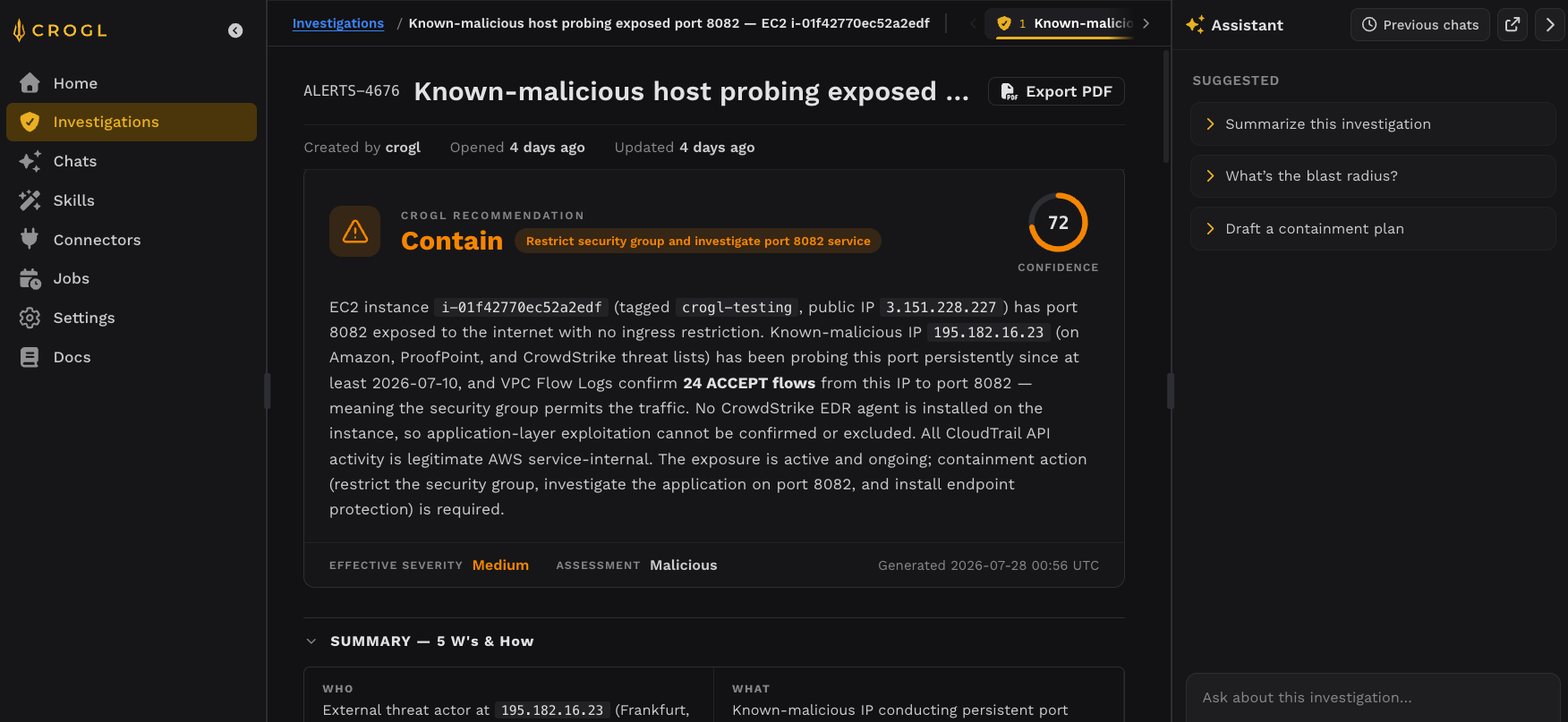
Not more data. A decision, with its evidence.
That creates three practical benefits:
- Faster investigations. Analysts and agents spend less time rediscovering field names, source boundaries, and manual pivots.
- More consistent investigations. Useful relationships are not limited to the person on shift who happens to know the environment best.
- Compounding operational knowledge. Each learned relationship can improve the next investigation.
Useful pivots stop depending on who is on shift.
Built for your infrastructure
The Knowledge Graph runs in the customer environment, including on-premises, private-cloud, and air-gapped deployments. Credentials remain outside the agent, and relationship history is auditable.
The operational controls matter because a useful graph must also be a trustworthy one: relationships can be inspected and removed, and learning can continue as sources and schemas change.
Try it with the systems you already have
The most useful way to evaluate the Crogl Knowledge Graph is with real sources that share identities. Connect two systems, let Crogl learn their catalogs and relationships — often in hours, not months — and then run an investigation.
You do not need to finish a data-lake program first. You do not need to abandon one if you already have it. Crogl meets the environment as it exists today and helps turn scattered security data into evidence-backed operational memory.
Download Crogl to get started.
Frequently asked questions
What is the Crogl Knowledge Graph?
The Crogl Knowledge Graph is operational memory for Crogl's investigating agent. It learns evidence-backed relationships between fields across connected security systems, so an investigation can follow the right pivot at the right moment. It is not a threat-intelligence graph, a SIEM replacement, or another search interface an analyst has to learn.
Does Crogl require data normalization or a central data lake?
No. Crogl investigates across the environment without forcing one data architecture. It can work lake-first alongside a normalized core, or source-first through native connectors and query interfaces, with no requirement to centralize full operational datasets first. The data itself remains in the operational systems that own it. Normalization is optional. Cross-system investigation is not.
How does Crogl learn relationships across security systems?
Crogl runs a background cycle. It connects through existing connectors, observes catalogs and representative samples, validates real value overlap and semantic meaning, then remembers confirmed relationships with their supporting evidence. The underlying data stays in the operational systems that own it.
How does Crogl make sure cross-system correlations are accurate?
Crogl treats every observed relationship as a claim that must be proven. It requires real, non-junk value overlap in the specific fields under consideration, and server-side rules decide acceptance. Each accepted relationship keeps supporting evidence and an auditable history. The model can propose. Evidence must prove.
Can the Crogl Knowledge Graph run in air-gapped or on-premises environments?
Yes. The Crogl Knowledge Graph runs inside the customer environment, including on-premises, private-cloud, and air-gapped deployments. Credentials stay outside the agent, and relationship history is auditable. Relationships can be inspected and removed, and learning continues as sources and schemas change. Crogl retains representative samples locally as evidence rather than requiring a full copy of the operational estate.
How long does it take to get value from the Crogl Knowledge Graph?
Connect two systems that share identities, let Crogl learn their catalogs and relationships, often in hours rather than months, then run an investigation. You do not need to finish a data-lake program first, and you do not need to abandon one you already have.