A Practical Vulnerability Prioritization Framework for 2026
Mike Dupuis
Marketing, Crogl
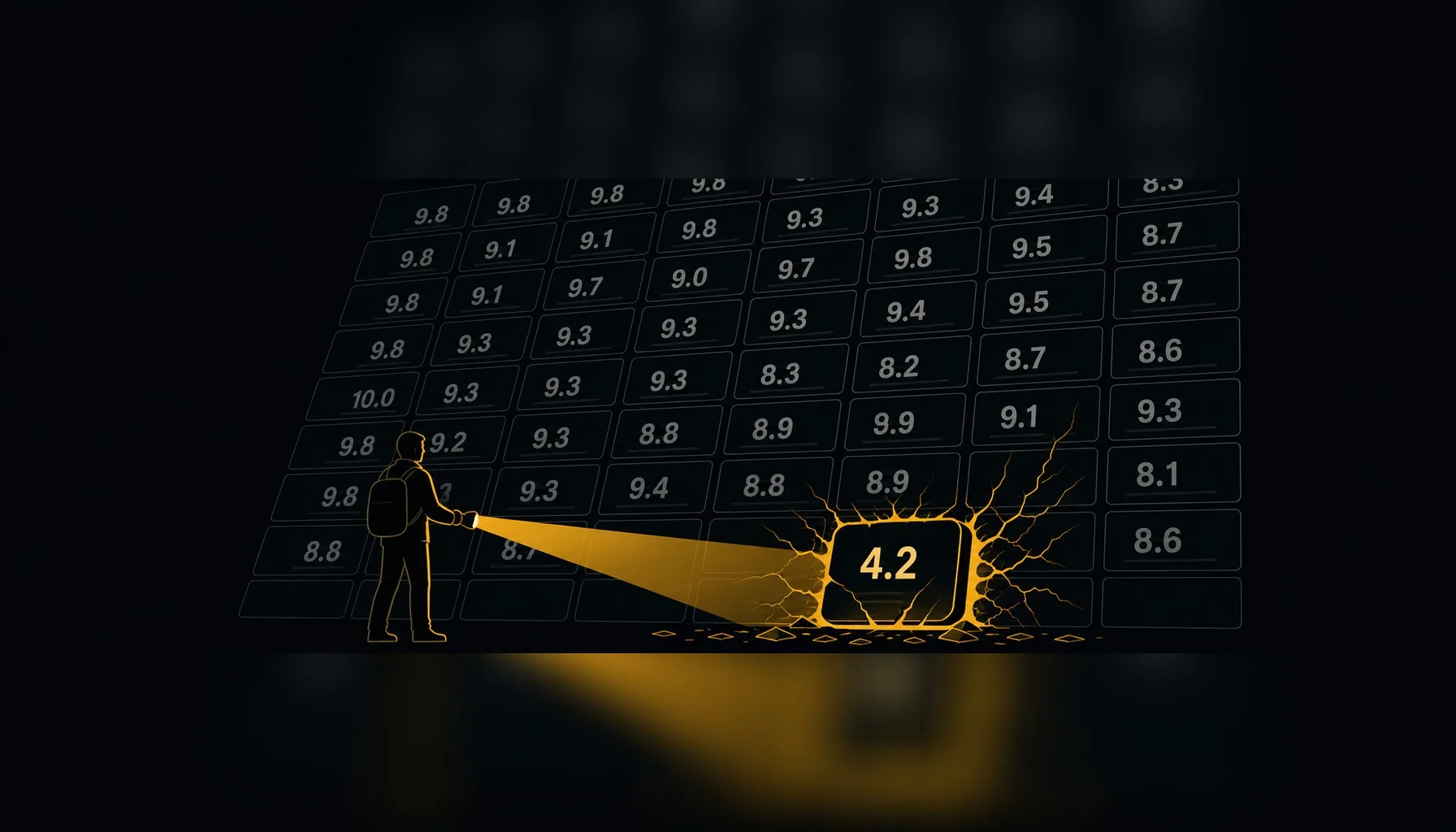 Vulnerability prioritization fails when scores hide the real threat.
Key Takeaways
- Sorting vulnerabilities by CVSS score alone produces a remediation order that does not match actual risk because it ignores environmental context, exploitability, and asset value.
- A practical decision framework combines CISA's KEV catalog (what is exploited now), EPSS (what is likely to be exploited soon), and SSVC (what action to take).
- Prioritization quality depends on blast radius evidence, which requires investigating reachability, privilege context, and compensating controls across your SIEM, EDR, and identity tools.
- For unpatchable vulnerabilities in OT or regulated environments, treat compensating controls as a first-class remediation and document the risk acceptance decision for auditors.
- The primary bottleneck in vulnerability prioritization is not the scoring model; it is the manual effort required to gather cross-source evidence for thousands of findings.
Your quarterly vulnerability scan finishes, delivering a report with over 12,000 findings. The team sorts the list by CVSS score, exports every 9.0 and higher, and begins the remediation work. It feels like progress. Three weeks later, an attacker chains a CVSS 6.5 vulnerability with a misconfigured service account to reach a domain controller. The high-severity findings the team patched were on isolated systems, already mitigated by compensating controls.
This scenario is common because sorting by a score is not the same as vulnerability prioritization. A score is static metadata. Prioritization is a dynamic decision that requires evidence from the environment where the vulnerability exists. It demands context that scanners alone cannot provide.
Treating every critical-rated finding as an emergency is a recipe for burnout and high residual risk. This guide provides a practical framework for combining exploitability data from EPSS, decision guidance from SSVC, confirmed threats from the KEV catalog, and environmental evidence to prioritize remediation when patching everything is impossible.
What Is Vulnerability Prioritization?
Vulnerability prioritization is the process of deciding which known vulnerabilities to remediate first based on exploitability, asset criticality, environmental context, and organizational risk tolerance. It is one critical stage within the broader vulnerability management lifecycle, not a synonym for it. Most security teams must distinguish between three related activities: vulnerability scanning (discovery), vulnerability prioritization (decision), and vulnerability remediation (action).
Prioritization sits between discovery and action. Its quality determines whether remediation resources are spent on the right findings. Most organizations discover far more vulnerabilities than they can patch, a gap that creates significant security debt. As a result, the prioritization decision directly controls the organization's residual risk. Effective prioritization uses inputs like the CISA Known Exploited Vulnerabilities (KEV) catalog and the Exploit Prediction Scoring System (EPSS) to focus on a small subset of findings that pose a genuine threat. The goal is to create a remediation order that reflects actual risk, not just theoretical severity.
Why CVSS Alone Produces the Wrong Remediation Order
The Common Vulnerability Scoring System (CVSS) measures the theoretical severity of a vulnerability in isolation. It does not measure the probability of exploitation in your environment, the value of the asset it sits on, or whether compensating controls already block the attack path. Relying on CVSS alone for vulnerability prioritization is a common mistake that creates a false sense of security.
Consider an illustrative quarterly review at a critical infrastructure operator. A scan produces over 4,200 findings with a CVSS score of 9.0 or higher. Sorting by CVSS places an OpenSSL vulnerability on an internal-only server above a known-exploited deserialization flaw on an internet-facing application. The deserialization flaw has a lower CVSS score because its attack complexity is rated higher, but it is already in the CISA KEV catalog and has public exploit code available. The remediation team patches the OpenSSL issue first because it is at the top of their sorted list, leaving the real threat active for another eleven days.
This happens for three structural reasons:
- CVSS scores the vulnerability, not the exposure. It cannot see your network topology, identity relationships, or business context. A CVSS 10.0 on an air-gapped system may be less urgent than a 6.5 on a server with a reachable attack path to crown jewel assets.
- It ignores compensating controls. A web application firewall (WAF) rule blocking an SQL injection attack path or network segmentation isolating a vulnerable server effectively reduces risk, but the CVSS score remains unchanged.
- Environmental and temporal scores are rarely used. While CVSS v3.1 includes temporal and environmental metrics, most scanners only provide the base score. Teams default to sorting by this number, which lacks all environmental context.
While the newer CVSS v4.0 standard includes attributes that can improve context, its adoption remains uneven. CVSS is a useful input for understanding a vulnerability's inherent characteristics, but treating it as the final prioritization decision produces a remediation order that does not match actual risk.
A Practical Decision Framework: EPSS, SSVC, and KEV Together
No single scoring system provides enough context for a reliable prioritization decision. However, three publicly available frameworks, when used together, cover most of the gap that CVSS leaves. This combination creates a decision tree that moves from confirmed active threats to probable future threats, then applies organizational context to determine the right action. The goal is to use these frameworks to build a defensible rationale for every remediation decision.
A practical workflow combines these inputs to answer three questions in order:
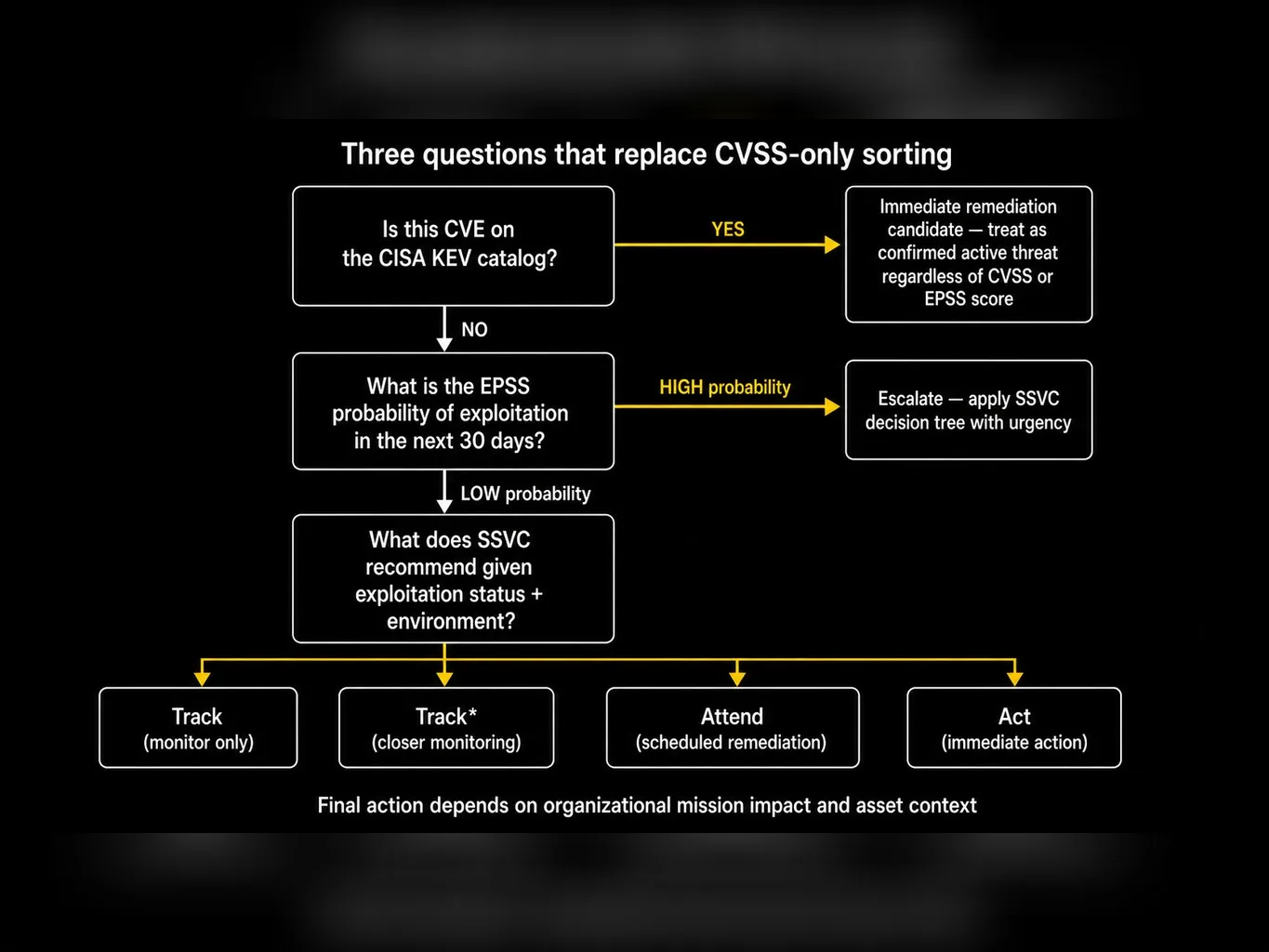
How to prioritize vulnerabilities using KEV, EPSS, and SSVC together.
- Is this vulnerability confirmed to be exploited in the wild right now? (KEV)
- If not, how likely is it to be exploited soon? (EPSS)
- Given the exploitation status and our environment, what action should we take? (SSVC)
This approach helps teams focus on the small subset of vulnerabilities that pose a clear and present danger or are on the immediate horizon of threat actor interest.
EPSS: Probability of Exploitation in the Next 30 Days
The Exploit Prediction Scoring System (EPSS) estimates the probability, from 0% to 100%, that a CVE will be exploited in the wild within the next 30 days. It uses machine learning models trained on observed threat activity and vulnerability characteristics to produce this forecast. EPSS adds a forward-looking probability that CVSS lacks, helping teams distinguish between theoretically severe vulnerabilities and those actively being weaponized by attackers.
However, EPSS scores must be used with care. The score reflects global exploitation probability, not the specific probability of exploitation in your environment. A vulnerability with a low EPSS score can still be your highest-priority item if it sits on a reachable, high-value asset that is being targeted by a threat actor focused on your sector.
SSVC: Stakeholder-Specific Decisions, Not Universal Scores
The Stakeholder-Specific Vulnerability Categorization (SSVC) framework produces a decision, not a numeric score. Developed by CISA and Carnegie Mellon University, it guides an organization to one of four outcomes: Track, Track*, Attend, or Act. The decision is based on a tree that evaluates exploitation status, technical impact, automatability, and mission impact.
SSVC's power comes from forcing the prioritization decision to account for who you are and what you operate. A vulnerability that warrants an "Act" decision for a public utility might only warrant "Track" for an internal development team. The framework's value, however, depends entirely on the quality of its inputs. SSVC requires an organization to define its own mission impact and exposure levels, which means it only works when the underlying asset inventory and business context are accurate and up to date.
KEV: What Is Confirmed Exploited Right Now
The CISA Known Exploited Vulnerabilities (KEV) catalog is a curated list of CVEs with confirmed evidence of active exploitation. For U.S. federal agencies, remediation of KEV-listed vulnerabilities is mandatory within a specific timeline. For all other organizations, the KEV catalog serves as an unambiguous signal. These are not predictions; they are confirmed threats.
Any vulnerability on the KEV list that exists in your environment and is reachable from an untrusted network segment should be treated as an immediate remediation candidate, regardless of its CVSS or EPSS score. The primary limitation of the KEV catalog is that it is not comprehensive. Many exploited vulnerabilities never appear on the list, so absence from KEV does not mean a finding is safe.
Blast Radius and Reachability: The Evidence Layer Scores Cannot Provide
Frameworks like EPSS, SSVC, and KEV improve the inputs to a prioritization decision, but they still operate on metadata about the vulnerability. The missing layer is evidence from your own environment. Can an attacker actually reach the vulnerability? What do they gain if they exploit it? How far can they move from there? Answering these questions requires determining the vulnerability's blast radius.
Blast radius is the set of systems, data, and privileges an attacker can access after exploiting a specific vulnerability, given the network topology, identity relationships, and access controls in place. Calculating it is an investigation, and in practice it follows a repeatable sequence. No team can run it across 12,000 findings, so start with KEV entries and high-EPSS findings.
- Start with the scanner finding. Confirm the CVE, the affected host, the exposed service, and its CVSS, EPSS, and KEV context. This is the opening signal. The decision comes later.
- Check the asset and business context. Use the CMDB or asset inventory to identify the system's owner, business function, data sensitivity, and whether the host supports a regulated or mission-critical process.
- Verify reachability. Check firewall rules, segmentation policy, or an external attack surface scan to confirm whether the vulnerable service is reachable from an untrusted segment. Then query the SIEM or flow logs for observed connections to and from the host, including paths toward more sensitive systems. No observed traffic does not mean unreachable.
- Inspect privilege relationships. Pull identity and authentication context to see which user and service accounts exist on the host, what privileges they hold, and whether they create a path to domain-level or application-level escalation.
- Review endpoint behavior and controls. Use EDR telemetry to confirm the vulnerable component is installed and running, whether privileged processes are active, and whether existing controls already interrupt the likely attack path.
- Decide and record. Escalate the finding if the host is reachable, connected to sensitive data, or linked to elevated privileges. If it is isolated, tightly controlled, and disconnected from high-value assets, it can take a lower remediation rank even with a high severity score. Either way, record the evidence, the decision, and the owner.
Steps 2 and 3 also supply the mission impact and exposure inputs SSVC asks for, so the investigation and the framework work together. The cost is five systems, and often five query languages, for a single finding, and customers have seen a 75% reduction in analyst time per alert when that evidence gathering is automated.
Consider two findings moving through that process. A Linux server in the DMZ looks urgent: high CVSS, high EPSS. The investigation shows no lateral path to internal assets, no privileged accounts on the host, and no sensitive service dependencies. Its blast radius is contained. It still gets patched, because an internet-facing foothold is still a foothold, but it no longer jumps the queue.
Meanwhile, a medium-severity vulnerability on an internal server looks less urgent in the scanner output. Then the investigation shows a service account with domain admin privileges, an active logon session for that account on the host, and regular connections to a file share holding regulated data. The blast radius is wide. That finding goes first. Without this evidence, vulnerability prioritization is an informed guess. With it, prioritization becomes a defensible decision.
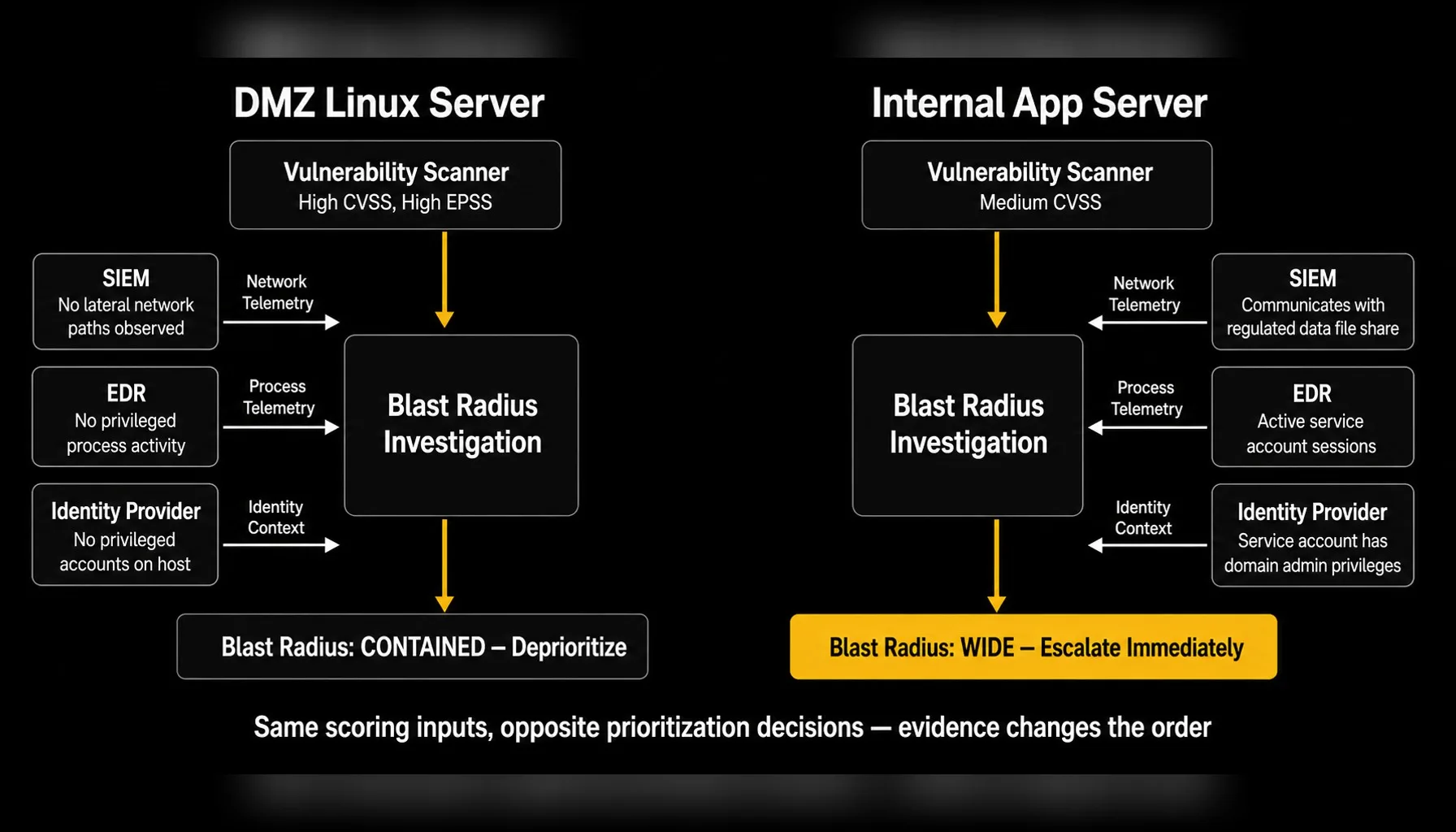
Blast radius evidence reverses the remediation order that scores alone suggest.
Prioritizing When Patching Is Not an Option
In many regulated and operational technology (OT) environments, patching is not a simple option. A system may run a critical process that cannot be interrupted, the vendor may no longer support the software, or a required maintenance window may be months away. Prioritization frameworks that assume patching is always the final action leave these vulnerabilities in a permanent backlog with no resolution.
Consider a historian server in a regulated OT environment running on an OS that can't be patched without a planned outage approved sixty days in advance. The scanner flags it weekly with the same critical findings. The team snoozes the findings, but no compensating control is documented and no risk acceptance is formally recorded. For an auditor, this looks like negligence.
The alternative is to treat compensating controls as a first-class remediation path. Actions like network segmentation, access restrictions, enhanced monitoring, and application-layer controls can reduce the blast radius or block the attack path even when the vulnerability itself remains. Each control must be documented with the specific risk it mitigates and the conditions under which it must be re-evaluated. This creates an auditable record of risk reduction. It is also critical to distinguish between a compensating control, which is a testable mitigation, and risk acceptance, which is a formal business decision to tolerate residual risk. Someone must own that decision, and the rationale must be recorded.
Read more: SOC Audit Readiness | Crogl
Five Vulnerability Prioritization Mistakes That Inflate Your Backlog
-
Sorting by CVSS and calling it prioritization. CVSS is one input among many. A real prioritization decision must combine it with EPSS, KEV status, asset criticality, and environmental evidence before assigning a remediation order.
-
Prioritizing once per scan cycle instead of continuously. Threat intelligence, exploit availability, and your own infrastructure change daily. Re-evaluate priorities whenever new KEV entries are published, EPSS scores shift, or environmental changes occur.
-
Treating every vulnerability as a patching problem. Some vulnerabilities require compensating controls, configuration changes, or architectural isolation. Match the remediation type to the vulnerability and the operational constraints of the asset.
-
Ignoring identity and privilege context. A medium-severity vulnerability on a system with domain admin credentials can be more dangerous than a critical vulnerability on an isolated workstation. Pull privilege data into every prioritization decision.
-
Documenting the remediation but not the prioritization rationale. Auditors and incident responders need to understand why a vulnerability was deprioritized, not just what was patched. Record the evidence, the decision, and the owner for every significant finding.
How Cross-Source Investigation Changes the Prioritization Decision
Blast radius evidence lives in five places: the scanner, the SIEM, the EDR platform, the identity provider, and the CMDB. Security teams still gather it by hand, moving console to console, translating fields, and rebuilding context for every finding. That manual work is where decisions stall: asking the same investigation questions across tools that do not talk to each other.
Crogl’s security automation guide explains why that workflow breaks down as evidence spreads across systems.
Analysts feel that friction immediately. One finding can require separate lookups for observed connections in the SIEM, process or package evidence in EDR, privilege context in the identity provider, and ownership or mission impact in the CMDB. Even when the team knows what to ask, the evidence arrives slowly, in different formats, with no clean way to preserve the reasoning behind the final call.
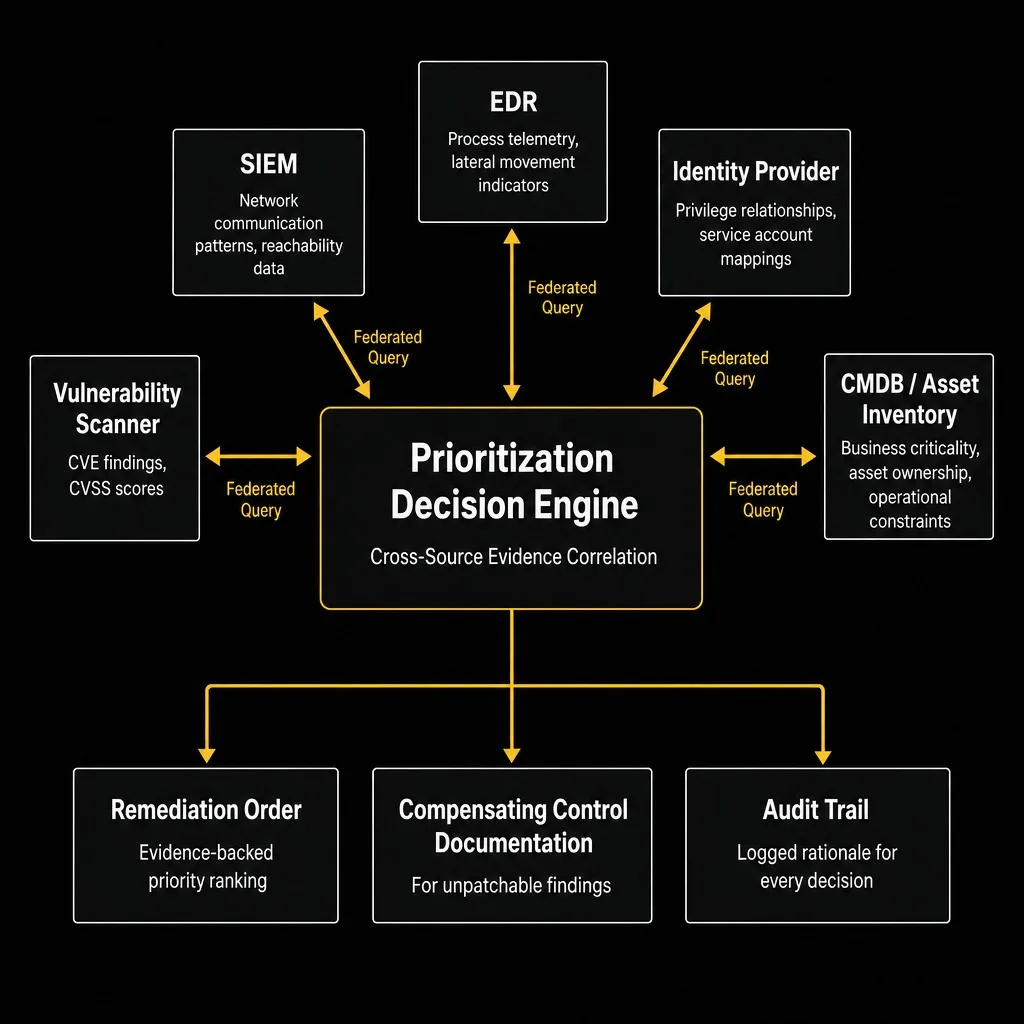
Effective vulnerability prioritization requires evidence from five system types.
This is the gap Crogl is built to close. Crogl uses federated search to query SIEM, EDR, identity, ticketing, and data lake systems in their native formats, with no schema normalization and no data movement. Teams investigate where the data already lives. That matters in environments that cannot take on another migration project before they can fix prioritization.
Crogl runs on-premises, in a private cloud, or fully air-gapped, with the model the customer chooses and hosts. Vulnerability, asset, and identity data stay inside the customer's boundary. Every investigation is auditable, repeatable, and inspectable, so the team can review and defend the reasoning behind each remediation decision. Crogl handles the investigation. The analyst makes the call.
That changes the day-to-day decision. Analysts get cross-source evidence without the console hopping. The rationale lands in the team's existing case process. The team keeps judgment over remediation order, compensating controls, and risk acceptance.
See a vulnerability blast radius investigation, start to finish
Or run it on your own stack: Download Crogl.
Start With the KEV List
A score tells you where to look. Your environment tells you what to fix. CVSS, EPSS, KEV, and SSVC each add signal, but none of them can confirm reachability, privilege exposure, or whether a control already blocks the attack path. That evidence lives in your own tools.
Teams that shrink the backlog without adding risk shorten the path from finding to evidence, and they write down why each decision was made. That record is what operators, managers, and auditors all end up asking for.
Start tomorrow with the KEV entries present in your environment. For each one, answer three questions. Can it be reached from an untrusted segment? What privileges live on that host? What control already sits in the attack path? The findings you can't answer are your real backlog.
Frequently asked questions
What is the difference between CVSS and EPSS?
CVSS measures how severe a vulnerability would be if exploited, based on its technical characteristics. EPSS estimates the probability that it will be exploited in the wild within the next 30 days, based on observed threat activity. A vulnerability can score high on one and low on the other. Use them together: CVSS for impact, EPSS for likelihood, and KEV for confirmed exploitation.
What is risk-based vulnerability management?
Risk-based vulnerability management ranks remediation by actual risk instead of severity alone, combining exploit likelihood, threat intelligence, and asset criticality. Scanner-native risk scores are one form of it. They improve on raw CVSS, but they score the vulnerability from outside your environment. Reachability, privilege context, and compensating controls still have to come from your own telemetry.
How often should vulnerability priorities be reassessed?
Reassess whenever a material input changes: new KEV entries, significant EPSS shifts, infrastructure changes, or changes to compensating controls. Those inputs move fast. EPSS scores update daily, and CISA often adds KEV entries several times a week. A quarterly review is the minimum. Continuous re-evaluation tied to threat intelligence and scan deltas produces a more accurate remediation order.
What is the difference between vulnerability prioritization and vulnerability management?
Vulnerability management is the full lifecycle: discovery, prioritization, remediation, validation, and reporting. Vulnerability prioritization is the stage that decides which findings to remediate first. The quality of that decision determines whether the rest of the lifecycle works on the right findings.
Can AI automate vulnerability prioritization decisions?
AI can automate evidence gathering, cross-source enrichment, and initial risk scoring, which are the most time-consuming parts of prioritization. The final decision, especially on risk acceptance or compensating control selection, still requires human judgment, because it depends on business context and operational constraints that models cannot fully evaluate. Every step the AI takes should be logged so the analyst can inspect it before making the call.
How do you measure whether your vulnerability prioritization process is working?
Track mean time to remediate (MTTR) for exploited-in-the-wild vulnerabilities separately from your overall MTTR. If vulnerabilities that are later exploited consistently sat in your backlog as deprioritized, the process is producing the wrong order. The SLA breach rate for KEV-listed vulnerabilities is another direct signal.
How should vulnerability prioritization differ for cloud-native environments?
Cloud-native environments change the blast radius calculation. A vulnerable container image may run across dozens of clusters, so exposure is counted in running instances. Prioritization must account for image reuse, IAM role permissions attached to workloads, and whether a component is reachable from the internet. A vulnerable package that sits in an image but never executes also changes the picture.