Threat Hunting vs. Incident Response: Where the Handoff Breaks
Mike Dupuis
Marketing, Crogl
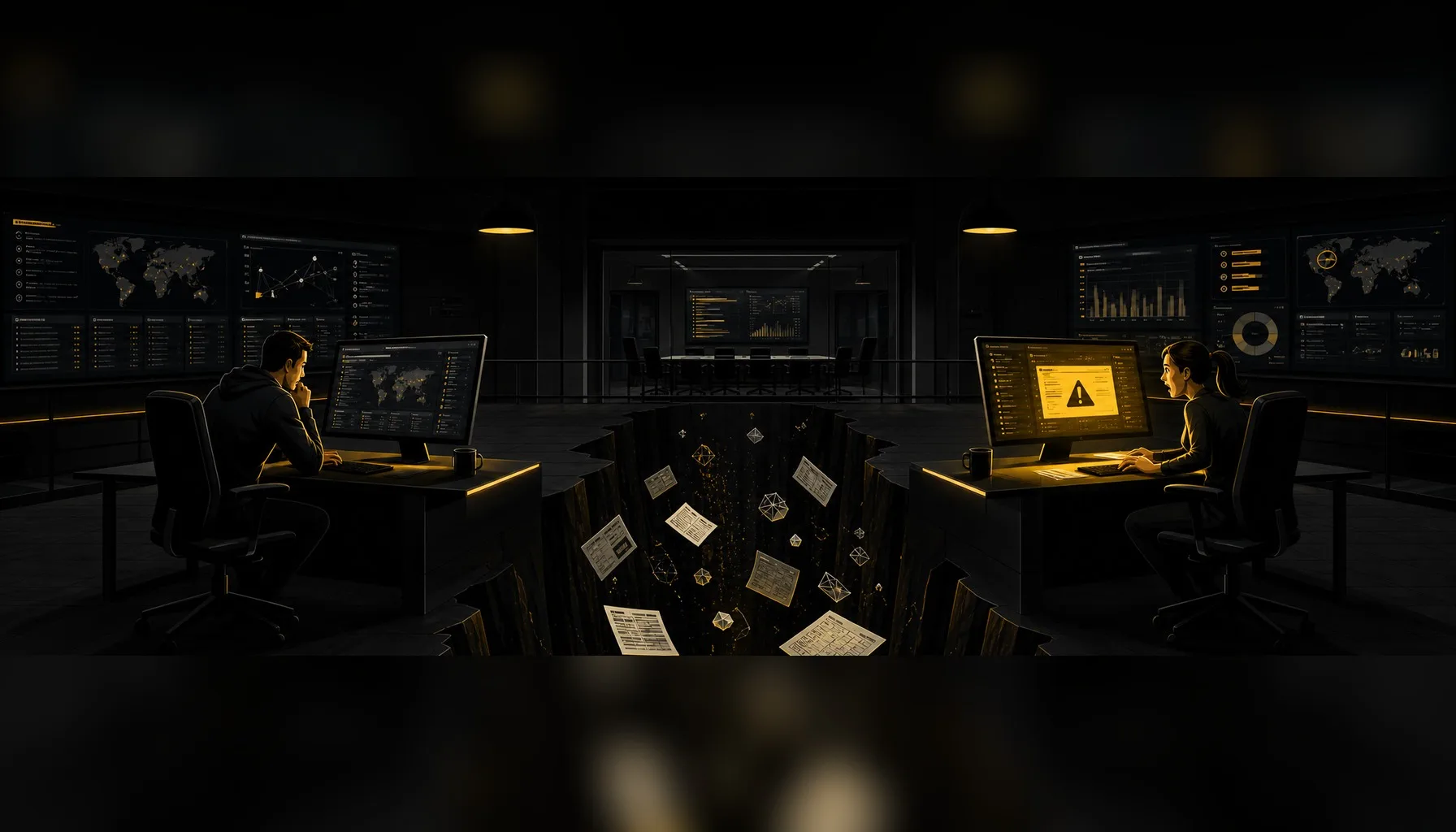
The handoff gap between threat hunting and incident response is where evidence disappears.
Key Takeaways
- Threat hunting is a proactive, hypothesis-driven search for threats that automated detection has missed. Incident response is the reactive, structured process that follows a confirmed alert or event.
- The two disciplines differ across five key dimensions: their trigger, goal, data source usage, staffing model, and operational output.
- The most critical failure point is the "handoff gap," where evidence and context are lost when a hunt finding becomes an incident response case, breaking the audit trail.
- Independent research by Ponemon Institute, commissioned by Crogl, found organizations investigate only 37% of their daily alerts. When triage fills analyst hours, hunting is the first work to slip.
- A shared evidence layer that carries hunt findings into IR cases closes the handoff gap and returns analyst capacity to proactive hunting.
Hunters go looking for threats that automated detection missed, testing hypotheses against telemetry. Incident response takes over once a security event is confirmed or suspected. Both require gathering evidence across multiple systems, and both fail when that evidence is fragmented or undocumented.
Many security operations centers (SOCs) treat hunting and IR as separate programs with different tools and workflows. This separation leaves evidence exposed at the points where the two programs meet. When a hunt uncovers an active intrusion, the finding has to cross into the IR process with its full evidence chain intact. When IR closes a case, the lessons should feed back into new hunt hypotheses.
These two handoffs are where coverage breaks down. This guide explains the five operational differences between threat hunting and incident response, the evidence handoff gap that hurts both, and the capacity squeeze that prevents teams from doing either one well.
What Threat Hunting and Incident Response Mean in Practice
Teams blur the two terms in standups and job titles.
Threat Hunting: Hypothesis-Driven Search for Undetected Threats
A hunt begins with outside intelligence or an internal blind spot. The trigger is a hypothesis that detection logic has not yet tested. A hunt lead might come from a CISA advisory on a new adversary technique, threat intelligence on a specific group's TTPs, or a gap identified in the organization's own detection coverage.
The hunter formulates a testable hypothesis, such as "An adversary is using WMI event subscriptions for persistence (T1546.003) in our environment." They then query telemetry sources like Sysmon event logs (Events 19, 20, and 21), EDR data, and SIEM records to validate or refute it. Where Sysmon is not deployed, the native Windows WMI-Activity operational log (Event ID 5861) serves as the fallback source. This work is shaped by real-world friction; a hunter using a Sigma rule still needs to know whether the target SIEM maps a field like CommandLine to process.command_line or cmd_line, as a failed mapping returns zero results. The output is either an escalation to IR or a detection engineering input, such as a new rule. The hunt documents that the hypothesis did or did not hold in the visible data. That conclusion is narrow by design, because a hunt can only speak to the data it could see.
Incident Response: Structured Reaction to a Confirmed or Suspected Event
IR starts the moment someone or something raises a flag. The trigger is an alert from a security tool, a report from an employee, or an escalation from a threat hunt. The goal is to contain the damage, eradicate the threat, and recover normal operations.
The IR workflow generally follows the four-phase lifecycle from NIST SP 800-61 Rev 2: preparation; detection and analysis; containment, eradication, and recovery; and post-incident activity. Rev 3 now maps incident response to the CSF 2.0 functions, but the Rev 2 phases remain common in IR runbooks. The process requires rigorous evidence preservation, chain of custody, and a defensible decision trail for every action taken. After initial triage, a scoping call and potential handoff to a digital forensics and incident response (DFIR) team help determine the blast radius of the event. The output is a completed case record detailing the root cause, actions taken, and lessons learned to improve future defenses.
Five Operational Differences Between Threat Hunting and Incident Response
Each discipline has its own trigger, goal, data source choices, staffing model, and output, as the table below shows. Those distinctions matter, and they also tempt teams to build separate evidence pipelines. Both disciplines query the same data sources, and both work best from a shared hunt and case record.
| Dimension | Threat Hunting | Incident Response |
|---|---|---|
| Trigger | Hypothesis from intelligence or a coverage gap | Alert, user report, or escalation from a hunt |
| Goal | Find what automated detection missed | Contain, eradicate, and recover from a known event |
| Data Sources | Hunter chooses telemetry based on the hypothesis | Analysts follow the evidence trail from the initial alert |
| Staffing | Senior analysts with deep adversary and baseline knowledge | Broader team, with escalation to senior staff for scoping |
| Output | Escalation to IR or a new detection rule | A case record with containment actions and lessons learned |
Here is how that shared data plays out in a single hunt. Consider a hunter tracking LOLBin activity, such as mshta.exe being launched by a WMI event subscription consumer. When they find lateral movement artifacts, the hunt output becomes an IR escalation. The same EDR and SIEM data the hunter queried now becomes the starting evidence for the IR case. The operational question is whether that evidence chain survives the handoff.
The Handoff Gap: What Breaks When a Hunt Finding Becomes an IR Case
A threat hunt finding is at its most fragile when it crosses into incident response. This is where evidence gets lost, context is stripped, and the audit trail breaks.
Take a WMI persistence hunt (T1546.003) that spans three data sources: Sysmon events on endpoints, SIEM correlation rules, and EDR process telemetry. The hunter finds an active intrusion on a host at 203.0.113.10, documents it in a spreadsheet or chat message, and escalates verbally to the IR lead. The IR team opens a case in their ticketing system but has to re-query the same sources because the hunter's original evidence is not in the case record. The pivot points, the queries that ruled out false positives by baselining against benign tools like the SCM Event Log Consumer, and the reasoning behind the escalation are gone.
The gap tends to open where hunting and IR run through different tools with different data formats. For organizations subject to federal compliance requirements, this is an audit problem. The hunt record is incomplete because the reasoning trail, which is as important as the final detection, has been lost. Recording the evidence, the decision, and the owner is what creates a defensible trail.
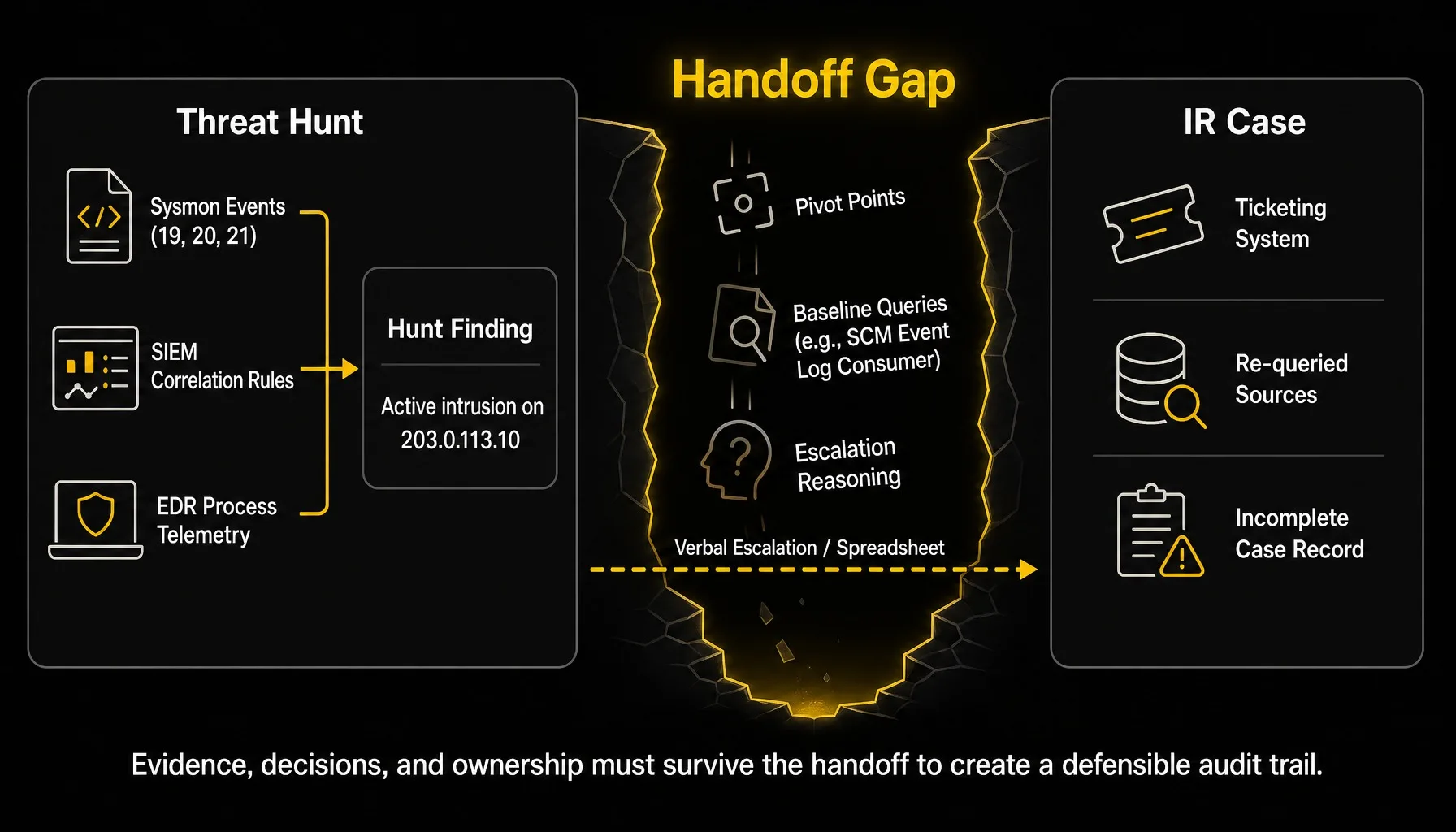
The handoff gap strips context from hunt findings before they reach the IR case record.
Read more: SOC audit readiness
How the Alert Backlog Starves Hunt Programs of Analyst Hours
In many SOCs, the reactive alert triage queue claims analyst hours before hunting gets any. Hunting is the first work to slip, because no alert demands it.
Independent research by Ponemon Institute, commissioned by Crogl, found that organizations face an average of 4,330 daily alerts and investigate only 37% of them. The uninvestigated 63% represents a capacity squeeze that leaves little room for proactive hunting. Hunt cadence depends on analyst availability, so hunts get postponed, shortened, or canceled. The team knows it should be hunting for the TTPs in the latest CISA advisory, but the queue does not stop.
This creates a compounding problem. The threats that detection logic misses stay undetected longer because no one has time to look for them. This increases attacker dwell time, which makes eventual IR cases larger, more expensive, and more damaging. Manual investigation means querying several systems, each in its own query language, before reaching a verdict on one finding. When analysts have to request data from another team, the work stalls until it arrives. Federated search removes that wait by querying each source where the data already lives. Every hour spent waiting on data is an hour that cannot go to proactive hunting.
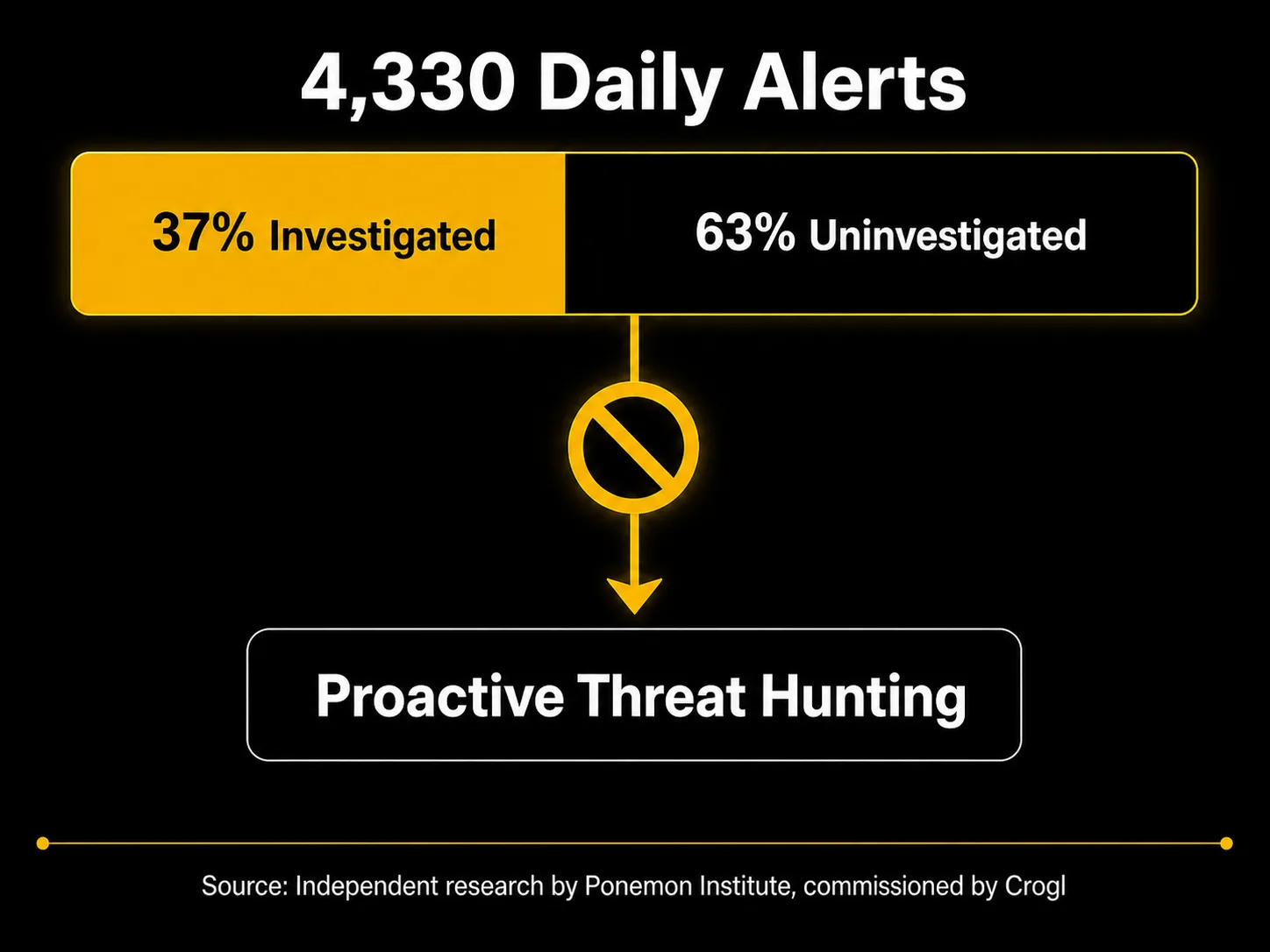
The capacity squeeze from uninvestigated alerts starves threat hunting programs of analyst hours.
Closing the Gap Between Hunting and Response with Cross-Source Hunts
The handoff gap and the capacity squeeze are two sides of the same evidence problem. Crogl addresses both by giving hunting and response one shared hunt and case layer.
Crogl queries each of your security sources in its native format, with no normalization step. A hunter can write a single hypothesis, and Crogl generates a native query for each connected data source. The hunter can ask to see the generated queries before they run, and Crogl then executes them autonomously while showing the full evidence chain behind each result. Hunt findings and IR evidence land in the same inspectable hunt record, which is logged directly into your organization's own ticketing or case system. When a finding escalates, the IR team opens the case with the hunter's queries, pivots, and reasoning already attached. The threat hunting use case walks through this workflow in more detail.
When evidence gathering runs automatically, analysts reclaim hours for proactive hunting. At one major US electric utility, a CRISP advisory that used to take over 24 hours to process now takes under an hour. A Department of War deployment runs Crogl air-gapped and classified across three SIEMs, two SOARs, and 100TB of data, investigating more than 1,000 alerts per day. The platform can be deployed on-premises, in a private cloud, or in a fully air-gapped environment. In each deployment, the division of work stays the same: Crogl handles the evidence gathering. The analyst makes the call.
To run a WMI persistence hunt against your own sources and carry the evidence straight into an IR case, Download Crogl.
Choosing Tools That Serve Both Hunting and IR
Fragmented evidence, manual re-querying, and broken handoffs hurt hunt programs and IR cases in the same way.
Teams that treat hunting and IR as separate programs with separate evidence pipelines lose context at the handoff and lose analyst hours to the alert queue. The path forward is a shared hunt and case layer that preserves evidence, documents reasoning, and gives analysts time back for the work that detection logic cannot do. Your team needs to do both, so the practical question is whether your threat hunting tools and IR workflow support both without forcing analysts to start over every time evidence crosses a boundary.
Frequently asked questions
Can the same analyst perform both threat hunting and incident response?
Yes, and in many SOCs they do. The skills overlap, so time is the constraint. When the alert queue fills every available hour, the same analyst who could be hunting spends all their capacity on reactive IR work. Dedicated hunt roles help, but only if the team has enough headcount to staff both functions without one starving the other.
What happens when a threat hunt uncovers an active incident?
The hunt becomes an IR case. The hunter's hypothesis, the queries that confirmed the finding, and the evidence collected should transfer directly into the IR case record. In practice, this handoff often breaks because the hunt was conducted in different tools than the IR workflow uses. The evidence has to be re-gathered, and the reasoning behind the escalation decision is lost.
Does threat hunting work in air-gapped or classified environments?
Yes, but the tooling constraints are significant. Cloud-native hunting platforms are unavailable, so teams need locally deployed tools that can query multiple data sources without moving data outside the enclave. Endpoint collection agents like Velociraptor handle host-level acquisition; for cross-source hunting, Crogl can be deployed air-gapped, even via its free download, and query on-prem SIEMs, EDR, and data lakes within the enclave.
How do threat hunting findings improve incident response detection rules?
A completed hunt that confirms a TTP produces the query logic, field mappings, and threshold values needed to write a new detection rule. This is called detection gap backfill. The hunt output becomes a Sigma rule or a SIEM correlation rule that fires automatically on future occurrences. This process converts a proactive hunt into a permanent reactive detection, preventing the same threat from requiring a new manual hunt every time.
How do you measure the value of a threat hunting program compared to incident response?
Incident response metrics are well established: mean time to detect, mean time to respond, and cases closed. Threat hunting metrics are harder because a successful hunt might produce no findings, which does not mean it failed. Useful hunt metrics include hypotheses tested per quarter, new detection rules created from hunt outputs, and dwell time reduction for threats discovered through hunting.