Threat Hunting vs. Threat Intelligence: Where They Differ and Where They Break Down
Mike Dupuis
Marketing, Crogl
 Threat hunting vs threat intelligence: two directions, one fragile loop.
Key Takeaways
- Threat intelligence tells your SOC who is likely to come after it and how those adversaries operate. Threat hunting is the proactive search through internal data to find evidence of those threats.
- Intelligence looks outward at adversaries; hunting looks inward at your environment. They require different skills, data sources, and cadences to be effective.
- The two functions create a feedback loop: intelligence informs hunts, and hunt findings inform intelligence. In practice, many security operations centers (SOCs) fail to close this loop.
- In air-gapped or classified environments without external feeds, hunting shifts from being intelligence-led to generating the primary source of local threat intelligence.
- Both functions are limited by analyst capacity. When reactive alert triage consumes all available hours, proactive hunting and intelligence work are the first to be cut.
Threat intelligence and threat hunting run on different inputs and produce different outputs. Intelligence studies adversaries outside the network to tell a SOC who is likely to attack and how. Hunting tests a hypothesis against internal telemetry for threats that detections missed. The trouble starts at the handoff.
When teams treat them as one job, intelligence products never reach the analysts who could act on them. Each function makes the other better only when the team knows what it takes in and what it hands off. The sections below walk through how each discipline works day to day and where the handoff between them fails. They end with the constraint that limits both: analyst capacity.
What Threat Hunting and Threat Intelligence Mean in Practice
The core distinction between the two functions is their starting point and primary focus. Hunting asks what might be happening inside your network, while intelligence tracks what adversaries are doing outside of it.
Threat Hunting Starts from a Hypothesis
Threat hunting is a proactive, human-driven search through an organization's own data for signs of malicious activity that automated detections missed. A hunt begins with a hypothesis, which can be derived from a new intelligence report, an observed anomaly, or an analyst's intuition about a specific MITRE ATT&CK technique. The output is a disposition: the hypothesis is either confirmed with evidence or refuted.
Consider a hunter who reads a CISA advisory on threat actors persisting through Windows Management Instrumentation (WMI). They might hypothesize that an adversary registered a permanent event subscription (ATT&CK T1546.003) whose consumer launches a living-off-the-land binary such as powershell.exe or mshta.exe. The hunter queries Sysmon Event IDs 19, 20, and 21 across the environment, and WMI-Activity Event ID 5861 on hosts that don’t run Sysmon. The target is any filter, consumer, or binding that legitimate management tools like SCCM don’t account for. A successful hunt produces an evidence package for escalation or a new detection rule for engineering.
Threat Intelligence Starts from Collection Requirements
Intelligence work tracks adversary capabilities, infrastructure, and intent so the SOC knows what it is likely to face. The process is guided by priority intelligence requirements (PIRs) that reflect the organization's primary risks. Inputs include raw indicator feeds using formats like STIX/TAXII, open-source reporting, and government advisories. The output is a finished intelligence product, such as an adversary profile or a report on a new malware campaign.
For example, an intelligence analyst at a defense industrial base company might be tasked with tracking a threat group known for supply-chain attacks. The analyst maps the group’s TTPs to MITRE ATT&CK, builds a Diamond Model profile of its infrastructure and targeting, and produces a finished report for the SOC. The report gives the hunt team the context needed to form relevant hypotheses.
Core Differences Between Threat Hunting and Threat Intelligence
The most significant difference is directional, and that direction decides the data each team works in and the skills it hires for. The other differences in this section largely follow from it.
Requests for intelligence usually arrive as collection requirements, often driven by a CISO's concern about a specific threat actor or industry trend. Hunts get going when an analyst writes down a testable hypothesis about what might already be in the network. Intelligence analysts draw on external feeds, vendor reports, and open-source data. Hunters spend their days in internal SIEM logs, EDR telemetry, network captures, and authentication records. Handoffs differ as well: intelligence ships reports, indicator packages, and adversary profiles, and a hunt closes with a confirmed or refuted hypothesis, new detection rules, or evidence for incident response.
Cadence also differs. Hunting often operates in discrete campaigns or sprints tied to a backlog of hypotheses. A hunt that finds nothing is still a result. It shows the hypothesis did not hold in the data the hunter could see, and it is only as strong as that visibility. An intelligence requirement that produces no reporting may signal a collection gap that needs to be addressed.
Finally, threat detection is a third, separate function. Detection engineering takes known, validated patterns from both intelligence and hunting, then operationalizes them into automated rules. Hunting searches for what those rules miss.
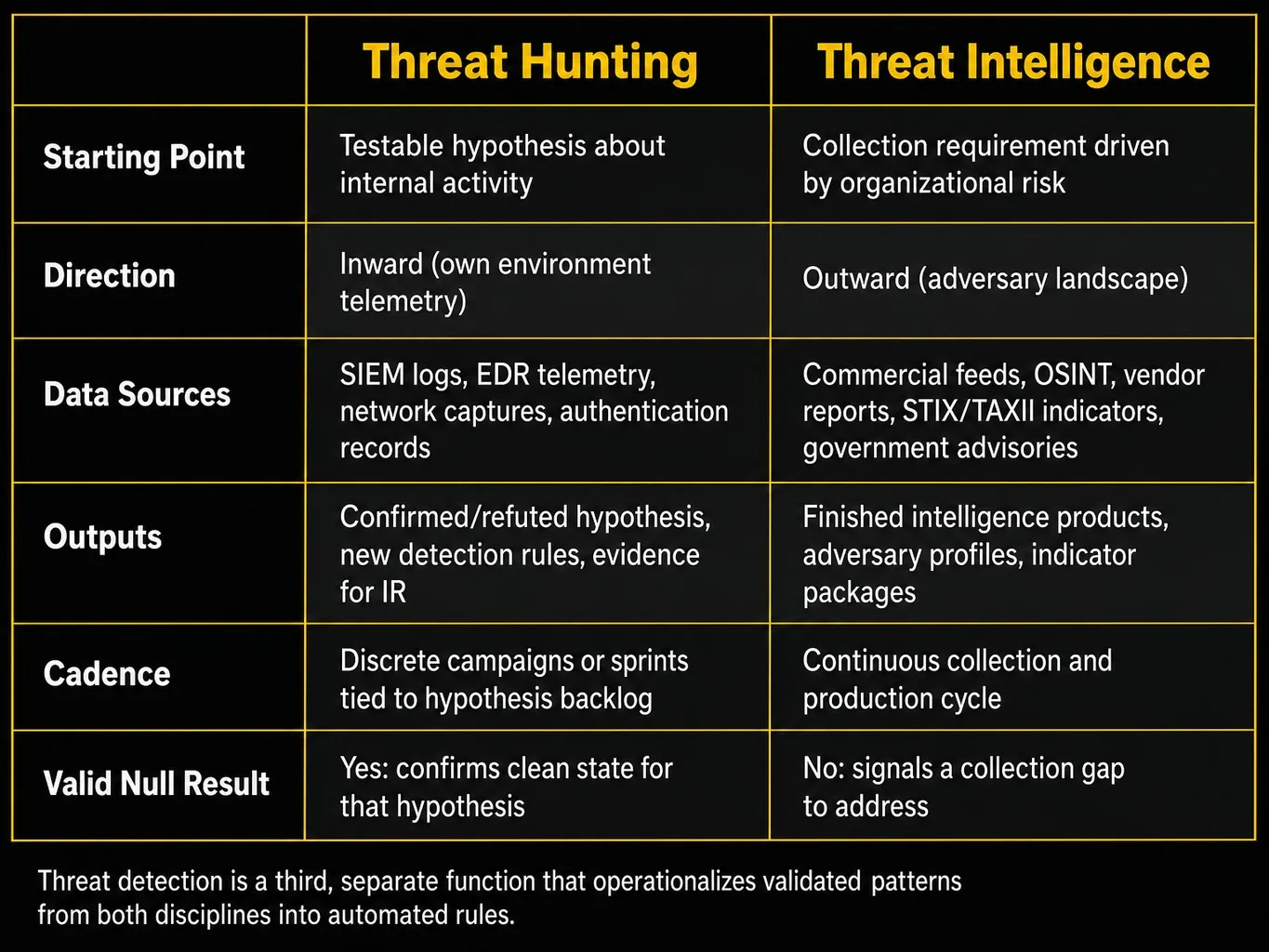
Six operational dimensions where threat hunting and threat intelligence diverge.
Read more: Threat Hunting Frameworks
Where the Feedback Loop Breaks
The break usually happens at the handoff.
Consider a SOC that receives a finished intelligence report identifying credential dumping via LSASS memory access. The hunt team builds a hypothesis, queries EDR process data and Windows authentication logs, and finds hosts where Mimikatz-consistent behavior occurred weeks before the report arrived. The analyst escalates those hosts for containment and credential resets. The intelligence is accurate, and the hunt confirms the activity. But the finding decays into a case note. It is never formatted as a structured intelligence input, so the intelligence team never updates its collection requirements. The next quarterly report still lists the technique as a theoretical risk. The loop never closes.
This breakdown often happens because hunt findings are unstructured, while intelligence teams need structured observables and context to update their products. Without a shared format for this handoff, the relationship becomes one-directional. Intelligence reports go stale, and hunts keep testing yesterday's assumptions.
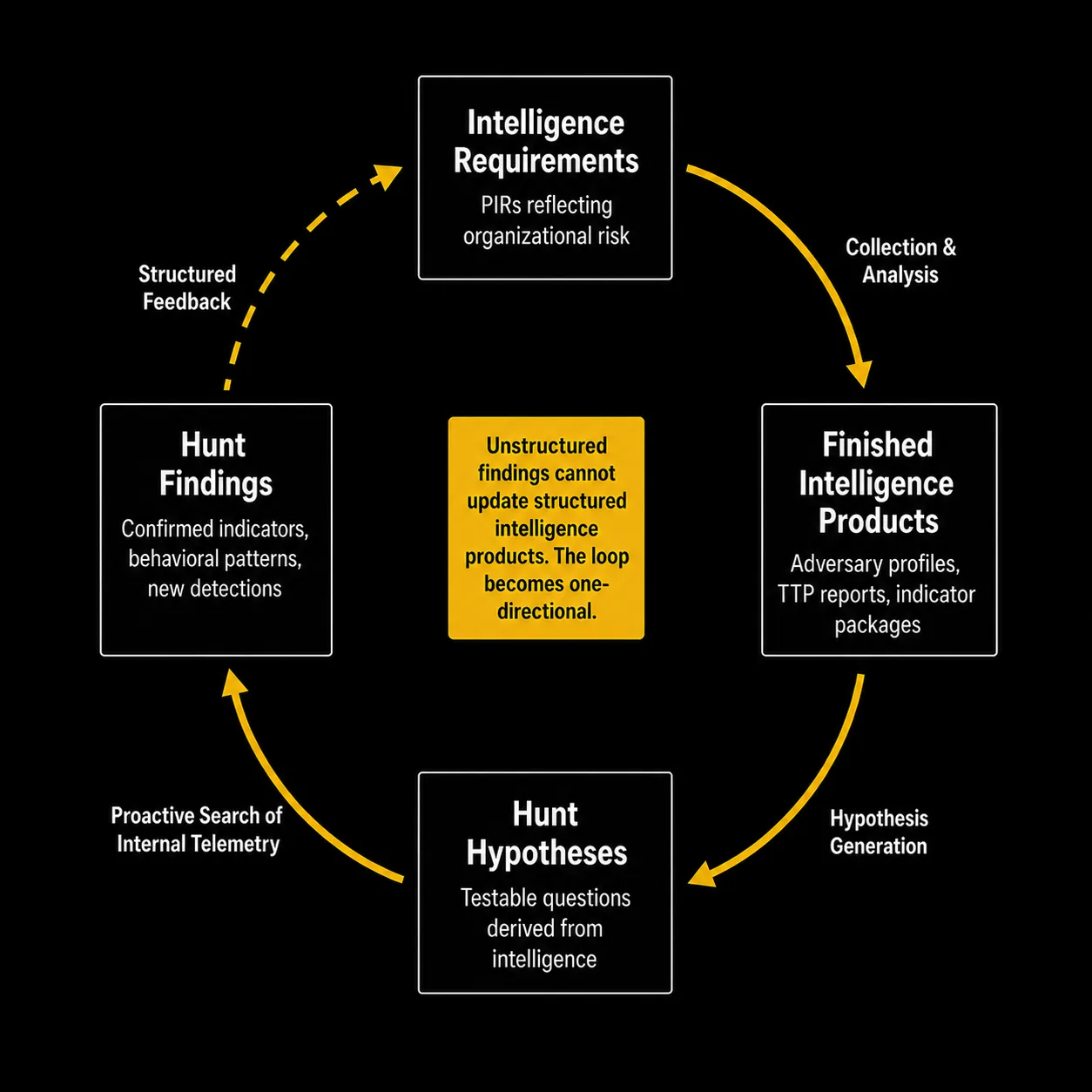
The feedback loop between hunting and intelligence breaks at the findings handoff.
Hunting in Air-Gapped and Classified Environments Without External Feeds
Intelligence-led hunting assumes reliable access to external threat feeds. This assumption fails in air-gapped, classified, and some highly regulated critical infrastructure environments. In a disconnected network, commercial threat intelligence platforms are unavailable, and reports may be delayed by manual transfer processes.
Hunting must adapt. Hunters in these environments rely more on "cold hunts," where hypotheses originate from internal baselines and behavioral anomalies. For example, a team in a classified defense environment cannot ingest a real-time feed of malicious IP addresses. An indicator such as 203.0.113.47 that appears in a commercial feed reaches that network only after a manual transfer, if at all. The team might build a hypothesis from an internal authentication anomaly, such as a service account suddenly accessing a host it has never touched before. This requires deep familiarity with the environment's normal operating patterns.
In these situations, the hunt team's findings become the primary source of local threat intelligence. The feedback loop becomes even more critical, as the organization generates its own intelligence from its own hunts. Teams building capabilities in these settings should understand the requirements for on-prem and air-gapped autonomous SOC deployments.
The Capacity Constraint That Limits Both Functions
The greatest threat to hunting and intelligence programs is reactive alert investigation, which consumes the analyst capacity both functions depend on. When analysts are buried in triage, they have no time for proactive work.
Independent research by Ponemon Institute, commissioned by Crogl, found that organizations face an average of 4,330 daily alerts and only investigate 37% of them. The uninvestigated 63% represents a coverage gap, but it also illustrates the capacity squeeze. Each manual investigation means querying the SIEM, the EDR console, and the ticketing system, often in a different query language for each. When the logs sit with another team, the investigation stalls and the clock keeps running, which is the gap federated search is meant to close. Imagine a SOC with eight analysts that spends six of them on the daily alert triage queue. The remaining two analysts split their time between hunting and intelligence. When alert volume spikes, hunting stops entirely. The organization pays for two programs but gets the value of neither.
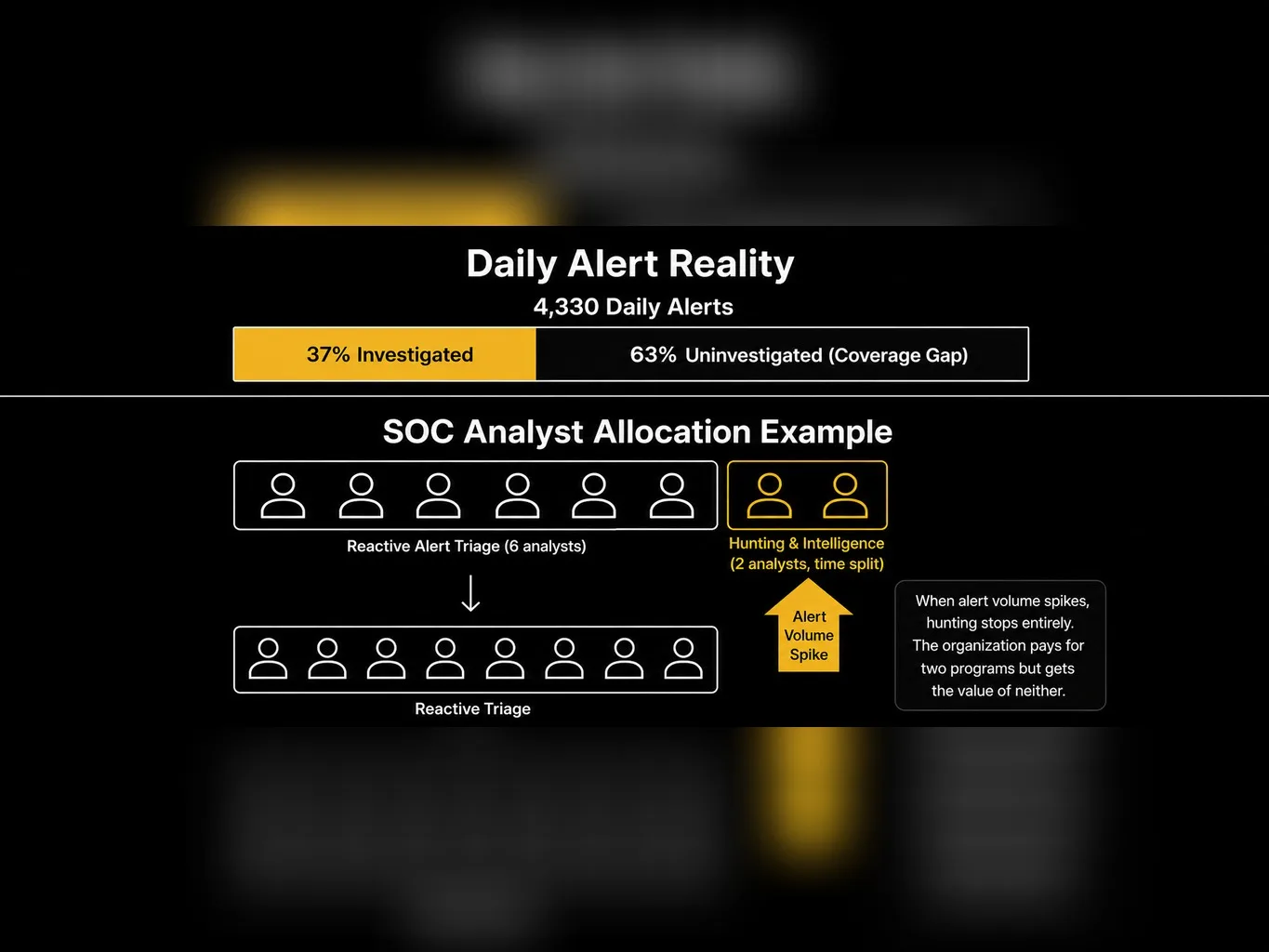
Reactive alert volume consumes the analyst capacity that hunting and intelligence require.
How Crogl Expands Capacity for Hunting and Intelligence
Every alert an analyst investigates by hand draws on the same hours that hunting and intelligence need. Crogl is designed to recover those hours. It investigates alerts across an organization's existing SIEM, EDR, ticketing, and data lake systems, producing evidence and documentation for analyst decisions. At a major US electric utility, a CRISP advisory used to take more than 24 hours to work through. With Crogl, it takes less than one. That is the loop running at speed: intelligence arrives, and the hunt answers it the same day.
Because Crogl runs on-premises, in a private cloud, or fully air-gapped, this capacity expansion applies even in the classified and isolated environments where hunting is most critical. One Department of War deployment runs air-gapped and classified across three SIEMs, two SOARs, and 100TB of data, investigating more than 1,000 alerts per day. Hunt teams can use Crogl's federated search to test hypotheses across fragmented data stores, querying sources in their native formats without building new data pipelines or waiting on another team for access. When a team adds a connector, Crogl builds its semantic knowledge graph automatically and maintains it without manual curation. A hunter can ask Crogl to show the queries it generates before they run. Running autonomously, Crogl executes them and shows the full evidence chain. Every action is logged in the customer's own case system, supporting the auditable evidence chain that hunt findings require. That case record is also where hunt findings can move into automated incident response or back to the intelligence team as structured input. Crogl's threat hunting use case walks through this workflow in more detail.
A hunt finding that never reaches the intelligence team costs the SOC twice: the detection gap stays open, and the next report repeats old assumptions. Intelligence points hunts at the right questions, and hunt findings sharpen the next round of intelligence. Keeping that exchange running takes analyst hours that most SOCs cannot protect from reactive alert work. So the practical question for your SOC is whether your analysts have the hours to run either function.
Download Crogl to run federated hunts across your SIEM, EDR, and data lake in their native formats without building a normalization pipeline.
Frequently asked questions
What skills does a threat hunter need that a threat intelligence analyst does not?
Threat hunters need fluency in query languages across multiple platforms, deep familiarity with log source schemas, and the ability to interpret raw telemetry. Intelligence analysts need collection tradecraft, source evaluation, structured analytic techniques, and the ability to produce finished intelligence products. ATT&CK is the shared vocabulary: hunters turn techniques into queries, and analysts use them to tag adversary reporting.
How should a SOC prioritize threat hunts based on intelligence requirements?
Start with the organization's priority intelligence requirements (PIRs), which reflect the threat actors and TTPs most relevant to the business. Map each PIR to a testable hypothesis and score hypotheses by coverage gap. A hunt backlog managed against PIRs prevents hunts from becoming ad hoc exercises that chase irrelevant threats.
How do you operationalize threat intelligence into repeatable hunt playbooks?
Translate each finished intelligence product into one or more hypotheses with named data sources, query logic, and expected evidence. Document the hypothesis, queries, and decision criteria in a hunt playbook, and log the evidence, decision, and owner for each run. After each hunt, update the playbook with findings and feed confirmed indicators back to the intelligence team as new collection inputs.
What data sources do threat hunters query that threat intelligence analysts typically do not?
The telemetry a hunter queries sits inside the network, including EDR process trees, SIEM authentication logs, DNS query logs, proxy logs, and firewall session records. Intelligence analysts work primarily with external sources: commercial feeds, OSINT, dark web forums, STIX/TAXII indicator streams, and vendor advisories.
How do you measure the effectiveness of a threat hunting program compared to a threat intelligence program?
For a hunt program, track hypotheses tested, new detections created from findings, and coverage of ATT&CK techniques across the environment. Intelligence programs measure collection coverage against PIRs, timeliness of finished products, and the rate at which intelligence generates confirmed hunt findings. Measuring them separately prevents one function from hiding behind the other's metrics.