Bring Your Own Model: Why AI Security Operations Need Multi-Model Support
Monzy Merza
Founder & CEO, Crogl
Does an AI SOC train on your data?
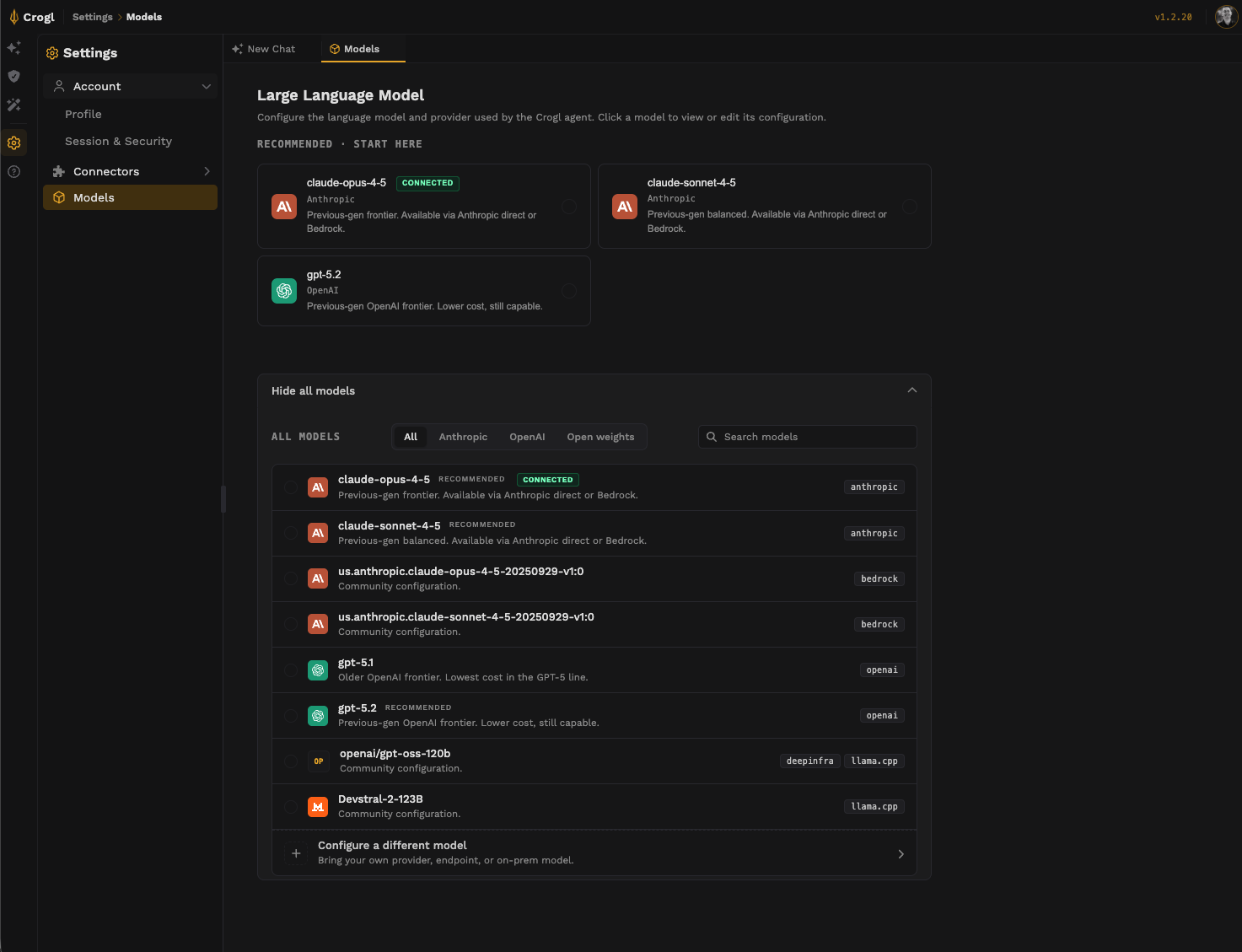
Not when you bring your own model. Crogl doesn't supply a language model, so there is no Crogl model to train on your data. You choose the provider and the model: a hosted provider, Amazon Bedrock, or an open weight model you run yourself. What a model provider may do with requests is set by your agreement with that provider, and by nothing outside your control when the model runs on your own hardware.
How Crogl does it
- You choose the language model and provider in Crogl's settings, and an upgrade keeps the model you chose.
- Air-gapped teams run an open weight model on their own GPUs, so inference never leaves the boundary.
- The model never sees the secrets behind your connectors.
- Crogl queries data where it lives through federated search instead of copying it into a vendor tenant.
- You can switch models when a provider changes terms, pricing, or availability, without rebuilding your investigations.
| Vendor-supplied model | Bring your own model (Crogl) | |
|---|---|---|
| Who picks the model | The vendor | You |
| Where inference runs | The vendor's infrastructure | Your provider, your cloud, or your own GPUs |
| Training on your data | Set by the vendor's terms | No Crogl model exists to train; your provider's terms apply |
| Governance approval | The vendor's model is fixed | Use the models your AI governance program approved |
| Switching models | Wait for the vendor | Change the model in settings |
What is multi-model AI support?
Multi-model AI support is the ability for a security platform to operate across multiple AI models and providers. It serves three requirements. Security teams use the right model for each task. AI use stays inside approved governance boundaries. Investigations continue when a provider is rate-limited or down.
Security operations teams are accountable for reducing risk regardless of what is happening in the technology ecosystem.
That accountability creates operational requirements.
Security operations require continuity of operations, resiliency, failover, governance compliance, and the ability to use the best tool for the job.
Multi-model support is what makes that accountability possible.
Multi-model support is the ability to operate across models in order to satisfy those requirements.
Complex organizations do not operate on a single technology. They use multiple cloud providers, multiple data stores, multiple authentication systems, and multiple security tools because different technologies solve different problems.
The models organizations use today are the weakest models they will ever use. Public reporting from the UK AI Security Institute shows frontier AI capabilities improving across domains that matter to national security and public safety, and OpenAI's Sam Altman has publicly described GPT-4 as "the dumbest model" people would have to use again. [1][2]
New models continue to emerge. Existing models continue to improve. Organizations are building and deploying models of their own.
Security teams operate within that reality.
Those requirements show up in three places: operations, governance, and continuity.
What operational requirements drive multi-model AI?
Security leaders require models that are authorized for their environment, fit their compliance requirements, and support the way their teams work.
Different operational requirements demand different models.
Investigation support, enrichment, reporting, workflow automation, and detection engineering all place different demands on AI systems. Security teams select technologies that help them reduce risk, and the best tool for a given task changes as the technology evolves.
Capability improvements continue to accelerate, model development is becoming more accessible, and organizations are building capabilities of their own. [1][2]
Different models serve different purposes.
Security teams need the right model at the right time for the right task.
How does AI governance shape model selection in the SOC?
Security teams also operate inside governance boundaries.
Sophisticated organizations are deploying internal AI services that provide access to approved models. These services sit between users and model providers. They enforce governance controls, data handling requirements, procurement decisions, and compliance policies while providing access to approved models.
I have seen this pattern across large enterprises and government organizations. The implementation details vary. The operational requirement does not.
Organizations use the models their governance programs approve. NIST's AI Risk Management Framework gives organizations a structure for managing AI risk, and OMB's federal AI memorandum establishes agency requirements for AI governance, innovation, and risk management. [3][4]
Those approvals are not static. Providers change. Policies evolve. Requirements change. Security teams adapt to those changes while maintaining continuity of operations.
Organizations operating under meaningful governance, compliance, and operational constraints require the ability to operate across approved models.
What happens when an AI model provider goes down?
We have already seen outages, rate limits, quotas, and token constraints across frontier model providers. OpenAI and Anthropic both publish public status histories, and both document rate limits in terms such as requests per minute and tokens per minute. [5][6][7][8]
This is the reality of a rapidly growing technology ecosystem.
The operational implication is straightforward: security operations continue.
Investigations continue. Analysts continue to respond to incidents. Risk continues to accumulate whether a model provider is available or not.
Security teams cannot pause an investigation because a quota has been exhausted. They cannot wait for a rate limit to reset before responding to an incident. They cannot suspend operations while a provider resolves an outage.
When a model becomes unavailable, operations require failover and failback. They require operational continuity. They require confidence that critical workflows will continue to operate under changing conditions.
Organizations already build redundancy into critical infrastructure.
Security operations require the same confidence across model providers and model architectures.
What does multi-model AI mean for high-consequence SOCs?
High-consequence organizations already operate in a multi-model world.
Publicly traded companies, critical infrastructure providers, and government organizations operate under some of the most demanding governance, compliance, and operational requirements in the world.
When AI SOC and AI security products are delivered as SaaS services, the customer can inherit the vendor's model decisions and the operational dependencies that come with them.
That limits the customer's ability to manage operational risk.
Security teams remain accountable for outcomes even when the underlying model strategy is controlled by someone else. Providers change. Models improve. Requirements change. Security operations continue.
Publicly traded companies, critical infrastructure organizations, and U.S. government organizations already use Crogl to maintain continuity of operations, governance compliance, and risk reduction as conditions change.
You can too.
References
[1] UK AI Security Institute, "AISI Frontier AI Trends Report (2025)"
[2] The Stanford Daily, "OpenAI CEO Sam Altman talks AI development and society"
[3] NIST, "AI Risk Management Framework"
[4] Office of Management and Budget, "M-24-10: Advancing Governance, Innovation, and Risk Management for Agency Use of Artificial Intelligence"
[5] OpenAI, OpenAI Status
[6] Anthropic, Anthropic Statuspage
[7] OpenAI, "Rate limits," OpenAI API Documentation
[8] Anthropic, "Rate limits," Anthropic API Documentation
Frequently asked questions
What is multi-model AI support in security operations?
Multi-model AI support is the ability for a security platform to operate across multiple AI models and providers. Security teams need it for three reasons. They use the right model for each task. They stay inside approved governance boundaries. They keep investigations running when a model becomes unavailable.
Why do SOCs need multi-model AI?
SOCs run continuous operations. A model going down does not pause an incident. A model being deprecated does not stall an investigation. A governance change does not delay a response. Multi-model support is how a SOC keeps operating when conditions change.
What is BYOM in AI security?
BYOM stands for Bring Your Own Model. A BYOM platform lets the customer choose the AI model, the provider, and the deployment pattern, so the customer keeps control of governance and operational risk. When AI SOC products are delivered as SaaS, the customer can inherit the vendor's model decisions and the dependencies that come with them. Crogl is built for BYOM.
How does multi-model support handle AI provider outages?
A multi-model platform fails over to an approved alternate model when a provider is unavailable, and fails back when the original returns. Security teams cannot pause an investigation because a quota is exhausted or wait for a rate limit to reset. Investigators keep working, and the customer controls which models are approved for failover. Crogl users configure the language model and provider the Crogl agent uses.